Source MGMAT CAT 2
What is the area of the quadrilateral with vertices A, B, C, and D?
(1) The perimeter of ABCD is equal to 16.
(2) Quadrilateral ABCD is a rhombus.
OA E
I could sense that in explanation provided by MGMAT guys on test is that
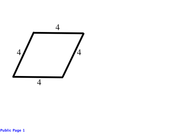
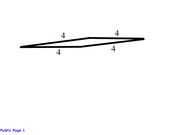
When we combine both st1 and st2 , we have a rhombus with sides 4 each
Now the Area of rhombus can be ( 4 * 4 ) = 16
OR
The area of Rhombus can be ( Base * Height = 4 * 2 root3 )
So, are they considering Rhombus to be a Parallelogram ?? qestion 1
FACT : I knew that Area of Rhombus = .5 * diagonal1 * diagonal 2.. This is something new I learnt..
Is every Square a Rectangle ?
Is everry Rhombus a Parallelogram?
What Am I missing here ??[/spoiler]
What is the area of the quadrilateral with vertices A, B, C, and D?
(1) The perimeter of ABCD is equal to 16.
(2) Quadrilateral ABCD is a rhombus.
OA E
I could sense that in explanation provided by MGMAT guys on test is that
When we combine both st1 and st2 , we have a rhombus with sides 4 each
Now the Area of rhombus can be ( 4 * 4 ) = 16
OR
The area of Rhombus can be ( Base * Height = 4 * 2 root3 )
So, are they considering Rhombus to be a Parallelogram ?? qestion 1
FACT : I knew that Area of Rhombus = .5 * diagonal1 * diagonal 2.. This is something new I learnt..
Is every Square a Rectangle ?
Is everry Rhombus a Parallelogram?
What Am I missing here ??[/spoiler]