BREAKING: Target Test Prep releases Brand New 2026 On Demand GMAT prep course

Redeem

Target Test Prep · GMAT

Choose how you want to prepare

Learn live with an expert or move at your own pace. Every option includes the complete TTP study system.

★★★★★5.0559 reviews
GMATLiveTeach 7 seats left
Chris Peckover
NEXT LIVE COHORT

Oct 13 to Jan 7, 2027

with Chris Peckover

Schedule
Tue, Thu · 8:00 to 10:00 PM ET
Included
40 live hours + 6 months of GMAT OnDemand
  • Live instruction and real-time questions
  • Class recordings and assigned practice
View class & enroll
Limited cohort · enrollment openTarget Test Prep
EALiveTeach 5 seats left
Logan Thompson
EXECUTIVE ASSESSMENT

Sep 6 to Dec 6, 2026

with Logan Thompson

Schedule
Sun · 9:30 AM to 12:30 PM ET
Included
40 hours of live online classes plus six months of access to the complete TTP EA OnDemand course.
  • 165+ EA Score Guarantee
  • 4,100+ Quant, Verbal, and Integrated Reasoning practice questions
  • 400+ hours of in-depth video lessons
  • 3,000+ step-by-step video solutions
View EA class & enroll
Limited cohort · enrollment openTarget Test Prep
GMATOnDemand Start anytime
SELF-PACED MASTERCLASS

Target Test Prep GMAT OnDemand

Complete access from day one. Study on your schedule.

715+ score guarantee
$0to start then $127/mo
  • Personalized study plan and analytics
  • Thousands of lessons and practice questions

Compare the format, schedule, and included access before enrolling. Prices and seat counts shown reflect the supplied offer details.

Rhombus / Parallelogram ?

Expert replies
by mmslf75 » Thu Dec 10, 2009 1:25 am
Source MGMAT CAT 2

What is the area of the quadrilateral with vertices A, B, C, and D?

(1) The perimeter of ABCD is equal to 16.

(2) Quadrilateral ABCD is a rhombus.


OA E


I could sense that in explanation provided by MGMAT guys on test is that
When we combine both st1 and st2 , we have a rhombus with sides 4 each
Now the Area of rhombus can be ( 4 * 4 ) = 16
OR
The area of Rhombus can be ( Base * Height = 4 * 2 root3 )

So, are they considering Rhombus to be a Parallelogram ?? qestion 1
FACT : I knew that Area of Rhombus = .5 * diagonal1 * diagonal 2.. This is something new I learnt..


Is every Square a Rectangle ?
Is everry Rhombus a Parallelogram?


What Am I missing here ??[/spoiler]
Join the discussion
Source: — Data Sufficiency |

by punitkaur » Thu Dec 10, 2009 11:04 am
Hi mmslf75,

how did you calculate the height of the rhombus given the side?
Join the discussion

by Stuart@KaplanGMAT » Thu Dec 10, 2009 11:23 am
mmslf75 wrote:Source MGMAT CAT 2

What is the area of the quadrilateral with vertices A, B, C, and D?

(1) The perimeter of ABCD is equal to 16.

(2) Quadrilateral ABCD is a rhombus.


OA E


I could sense that in explanation provided by MGMAT guys on test is that
When we combine both st1 and st2 , we have a rhombus with sides 4 each
Now the Area of rhombus can be ( 4 * 4 ) = 16
OR
The area of Rhombus can be ( Base * Height = 4 * 2 root3 )

So, are they considering Rhombus to be a Parallelogram ?? qestion 1
FACT : I knew that Area of Rhombus = .5 * diagonal1 * diagonal 2.. This is something new I learnt..


Is every Square a Rectangle ?
Is everry Rhombus a Parallelogram?


What Am I missing here ??[/spoiler]
The OA is correct.

Special shapes also belong to general categories.

Every square is a rhombus, rectangle, parallelogram and quadrilateral.
Every rectangle is a parallelogram and quadrilateral.
Every rhombus is a parallelogram and quadrilateral.
Every parallelogram is a quadrilateral.

Basically, if a shape fits the definition of a more general shape, it also belongs to that class. Since a parallelogram is simply a quadrilateral with 2 pairs of parallel sides, and since squares, rectangles and rhombii all have 2 pairs of parallel sides, they're all parallelograms.

The formula for the area of a parallelogram is simply:

area = base * height

Combining the statements, we know that we have a parallelogram with sides of 4 (by definition a rhombus has 4 equal sides, so we calculate the length of a side by taking perimiter/4); however, we have no clue how "slanted" the rhombus is, so there's no way to calculate the height. For example, the shape could be a square with an area of 16 or could have any area smaller than 16, depending on the angles.
Image

Stuart Kovinsky | Kaplan GMAT Faculty | Toronto

Kaplan Exclusive: The Official Test Day Experience | Ready to Take a Free Practice Test? | Kaplan/Beat the GMAT Member Discount
BTG100 for $100 off a full course
Join the discussion

by punitkaur » Thu Dec 10, 2009 11:36 am
Yup.. thats what I was wondering, where did the height come from.
Join the discussion

by mmslf75 » Fri Dec 11, 2009 9:37 am
punitkaur wrote:Hi mmslf75,

how did you calculate the height of the rhombus given the side?
In MGMAT explanation it is assumed ABCD to be a ll gram...with angle 60 degrees...therefore height 2 root 3
Join the discussion

by Stuart@KaplanGMAT » Fri Dec 11, 2009 10:42 am
mmslf75 wrote:
punitkaur wrote:Hi mmslf75,

how did you calculate the height of the rhombus given the side?
In MGMAT explanation it is assumed ABCD to be a ll gram...with angle 60 degrees...therefore height 2 root 3
Is it assumed that the angle is 60 degrees, or is that just given as one possibility, in order to show that the statements are insufficient?

As I stated in my post above, a rhombus is a sub-class of parallelogram.
Image

Stuart Kovinsky | Kaplan GMAT Faculty | Toronto

Kaplan Exclusive: The Official Test Day Experience | Ready to Take a Free Practice Test? | Kaplan/Beat the GMAT Member Discount
BTG100 for $100 off a full course
Join the discussion

by mmslf75 » Fri Dec 11, 2009 10:47 pm
Stuart Kovinsky wrote:
mmslf75 wrote:
punitkaur wrote:Hi mmslf75,

how did you calculate the height of the rhombus given the side?
In MGMAT explanation it is assumed ABCD to be a ll gram...with angle 60 degrees...therefore height 2 root 3
Is it assumed that the angle is 60 degrees, or is that just given as one possibility, in order to show that the statements are insufficient?

As I stated in my post above, a rhombus is a sub-class of parallelogram.


Assumed 60 degrees..

I actually went by my own theory that since we are asked to find area of rhombus, I can say area = .5 d1 d2 and since d1 and d2 are not possible..to find out....I marked E

but u explained with the other concept..Do we actually need to go that far ?
Join the discussion

by mmslf75 » Wed Dec 16, 2009 9:44 am
mmslf75 wrote:
Stuart Kovinsky wrote:
mmslf75 wrote:
punitkaur wrote:Hi mmslf75,

how did you calculate the height of the rhombus given the side?
In MGMAT explanation it is assumed ABCD to be a ll gram...with angle 60 degrees...therefore height 2 root 3
Is it assumed that the angle is 60 degrees, or is that just given as one possibility, in order to show that the statements are insufficient?

As I stated in my post above, a rhombus is a sub-class of parallelogram Assumed 60 degrees..

I actually went by my own theory that since we are asked to find area of rhombus, I can say area = .5 d1 d2 and since d1 and d2 are not possible..to find out....I marked E

but u explained with the other concept..Do we actually need to go that far ?


think I understand now..

IN GENERAL AREA OF A PARALLELO is BASE * HEIGHT ( and PARALLELO being the SUPERSET of ALL QUADS ) we took
the area of rhombus to be the same


Wow !! I got it

thanks
Join the discussion

by agarwalmanoj2000 » Tue Jul 12, 2011 12:56 pm
Should answer be C? Please advise.

- Area of Rhombus = (D1*D2)/2
- 2 diagonals of Rhombus are equal and perpendicular bisector.

Based on statement 1 & 2, each side of the Rhombus is 4. As the diagonals are perpendicular bisector, they bisect each other making 90 degree angle. Diagonals makes 4 isosceles right angle triangle with hypotenuse equal to 4, so the other sides of each triangle will be 4/Sq.root 2 and hence diagonals will equal 2*(4/Sq.root 2) = 8/Sq.root 2.

Therefore area of the Rhombus = [(8/Sq.root 2) * (8/Sq.root 2)] *2 = 64.
Join the discussion

by newgmattest » Tue Jul 12, 2011 5:19 pm
Please remember that diagonals of Rhombus are *NOT* equal in length and they just bisect the other at 90 degree.
Join the discussion

by amit2k9 » Tue Jul 12, 2011 11:18 pm
a+b

base = 4 but height = ?
E it is.
For Understanding Sustainability,Green Businesses and Social Entrepreneurship visit -https://aamthoughts.blocked/
(Featured Best Green Site Worldwide-https://bloggers.com/green/popular/page2)
Join the discussion

by gmattesttaker2 » Fri Oct 04, 2013 9:51 pm
Hello,

I was trying to solve as follows:

1 - Insuff. Since we don't know what kind of quadrilateral it is.

2 - Insuff. No information about rhombus ABCD. Hence, can't calculate area.

1 and 2:

Perimeter of rhombus ABCD = 16. Hence, each side is 4 (since all sides are equal).

Area of rhombus = 1/2 * (d1 + d2) , where d1 and d2 are diagonals of the rhombus

However, I was not sure after this point. Can you please tell what information is needed to find the diagonals of a rhombus? Thanks a lot.

Best Regards,
Sri
Join the discussion

by theCodeToGMAT » Fri Oct 04, 2013 10:08 pm
gmattesttaker2 wrote:Hello,

I was trying to solve as follows:

1 - Insuff. Since we don't know what kind of quadrilateral it is.

2 - Insuff. No information about rhombus ABCD. Hence, can't calculate area.

1 and 2:

Perimeter of rhombus ABCD = 16. Hence, each side is 4 (since all sides are equal).

Area of rhombus = 1/2 * (d1 + d2) , where d1 and d2 are diagonals of the rhombus

However, I was not sure after this point. Can you please tell what information is needed to find the diagonals of a rhombus? Thanks a lot.

Best Regards,
Sri
At this point, we cannot calculate the measure of Diagnol.. had this question mentioned that, side angles are 90*.. then we could have move forward..

So [spoiler]{E}[/spoiler]
R A H U L
Join the discussion

by GMATGuruNY » Sat Oct 05, 2013 3:36 am
mmslf75 wrote:Source MGMAT CAT 2

What is the area of the quadrilateral with vertices A, B, C, and D?

(1) The perimeter of ABCD is equal to 16.

(2) Quadrilateral ABCD is a rhombus.
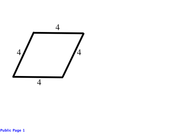
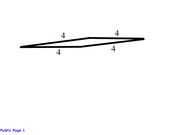
When the statements are combined, ABCD could look like either of the following:

Case 1:
Image

Case 2:
Image

Thus, different areas are possible.

The correct answer is E.
Private tutor exclusively for the GMAT and GRE, with over 20 years of experience.
Followed here and elsewhere by over 1900 test-takers.
I have worked with students based in the US, Australia, Taiwan, China, Tajikistan, Kuwait, Saudi Arabia -- a long list of countries.
My students have been admitted to HBS, CBS, Tuck, Yale, Stern, Fuqua -- a long list of top programs.

As a tutor, I don't simply teach you how I would approach problems.
I unlock the best way for YOU to solve problems.

For more information, please email me (Mitch Hunt) at [email protected].
Student Review #1
Student Review #2
Student Review #3
Join the discussion

by Anaira Mitch » Sat Dec 31, 2016 1:56 am
Just curious to know if in statement 2 it would have been "(2) Quadrilateral ABCD is a Square". I believe answer should have been C.
Anyone can confirm on this?
Join the discussion