sana.noor wrote:
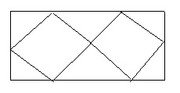
In the figure shown, two identical squares are inscribed in the rectangle. If the area of the rectangle is 36, what is the perimeter of each square?
Here's a slightly different approach:
Since the height of the rectangle and the diagonal of a square are the same length, let's let
x = height of rectangle
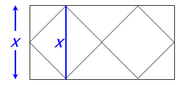
Since the width of the rectangle is equal to the length of two square diagonals, then the width of the rectangle =
2x.
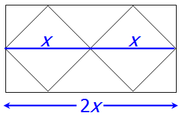 The area of the rectangle is 36.
So, (base)(height) = 36
(2x)(x) = 36
2x²= 36
x²= 18
x = √18
NOTE: There's no need to simplify √18 at this point (you'll see why shortly)
If the height of the rectangle is √18, then the length of the red line (shown below) must equal √18/(2)
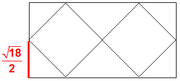
Likewise, the other red line has length √18/(2)
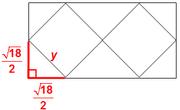
If we let
y = the length of the hypotenuse, then the Pythagorean Theorem states that...
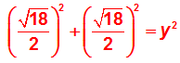
Now solve this equation for
y.
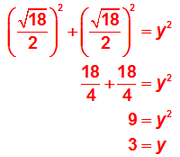
If
y = 3, then the perimeter of one square = (4)(
3) = 12
Cheers,
Brent
Last edited by
Brent@GMATPrepNow on Thu Apr 19, 2018 1:41 pm, edited 1 time in total.
Brent Hanneson - Creator of GMATPrepNow.com



























