Timer
00:00
Answers
A
B
C
D
E
Stats
Difficulty—
BREAKING: Target Test Prep releases Brand New 2026 On Demand GMAT prep course
Redeem
Scott Woodbury-Stewart’s private virtual classroom — 400 hours of master-class video lessons for the GMAT Focus Edition.
A
B
C
D
E
(The formula below we suggest you memorize. It will be used here twice.)AAPL wrote:Economist GMAT
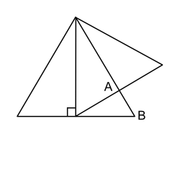
The height of an equilateral triangle is the side of a smaller equilateral triangle, as shown above. If the side of the large triangle is 1, what is AB?
$$A.\ 1-\frac{\sqrt{3}}{2} \,\,\,\,\,\,\, B.\ 0.25 \,\,\,\,\,\,\, C.\ 2-\sqrt{3} \,\,\,\,\,\,\, D.\ \frac{1}{3} \,\,\,\,\,\,\, E.\ 1-\frac{\sqrt{3}}{4}$$


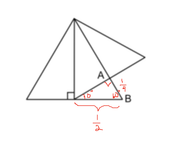
Very nice, ceilidh.erickson!ceilidh.erickson wrote:Here's an easier way to look at it: we've created another 30-60-90 triangle between A, B, and the midpoint of the base of the larger triangle.
If the base = 1, then half the base = 1/2. This is the hypotenuse of the right triangle. Thus, AB must be half that length: 1/4.
Yes, good point! I didn't include it in my diagram, but we can't just assume it's 90 - we have to justify it with the reasoning Fabio outlined.fskilnik@GMATH wrote:Very nice, ceilidh.erickson!ceilidh.erickson wrote:Here's an easier way to look at it: we've created another 30-60-90 triangle between A, B, and the midpoint of the base of the larger triangle.
If the base = 1, then half the base = 1/2. This is the hypotenuse of the right triangle. Thus, AB must be half that length: 1/4.
To validate your argument, it is important to justify the 90-degrees angle.
The figure presented in my post (above) does that.
Regards,
Fabio.
I would like to make this PUBLIC compliment to ceilidh.ceilidh.erickson wrote: Yes, good point! I didn't include it in my diagram, but we can't just assume it's 90 - we have to justify it with the reasoning Fabio outlined.
New here Create free account