
BREAKING: Target Test Prep releases Brand New 2026 On Demand GMAT prep course

Redeem

Target Test Prep · GMAT

Choose how you want to prepare

Learn live with an expert or move at your own pace. Every option includes the complete TTP study system.

★★★★★5.0559 reviews
GMATBootcamp Starts Sep 21
Chris Peckover, Target Test Prep GMAT expert
LIVE ONLINE BOOTCAMP

Live Online Bootcamp Class with Top GMAT Expert Chris Peckover

Sep 21 to Oct 9, 2026

Schedule
Mon to Fri · 7:00 to 10:00 PM ET
Included
Live classes + 6 months of TTP OnDemand
  • Boost your GMAT score in less than one month in a live online class
  • 6 months access to TTP OnDemand video courses included
View bootcamp & enroll
Limited cohort · enrollment openTarget Test Prep
EALiveTeach 5 seats left
Logan Thompson
EXECUTIVE ASSESSMENT

Sep 6 to Dec 6, 2026

with Logan Thompson

Schedule
Sun · 9:30 AM to 12:30 PM ET
Included
40 hours of live online classes plus six months of access to the complete TTP EA OnDemand course.
  • 165+ EA Score Guarantee
  • 4,100+ Quant, Verbal, and Integrated Reasoning practice questions
  • 400+ hours of in-depth video lessons
  • 3,000+ step-by-step video solutions
View EA class & enroll
Limited cohort · enrollment openTarget Test Prep
GMATOnDemand Start anytime
SELF-PACED MASTERCLASS

Target Test Prep GMAT OnDemand

Complete access from day one. Study on your schedule.

715+ score guarantee
$0to start then $127/mo
  • Personalized study plan and analytics
  • Thousands of lessons and practice questions

Compare the format, schedule, and included access before enrolling. Prices and seat counts shown reflect the supplied offer details.

The random variable x has the following continuous

Expert replies
by AAPL » Thu Sep 27, 2018 4:17 am

Timer

00:00

Answers

A

B

C

D

E

Stats

Difficulty

Manhattan Prep

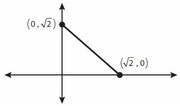
The random variable x has the following continuous probability distribution in the range $$0 < x < \sqrt{2},$$ as shown in the coordinate plane with x on the horizontal axis:
Image
$$\text{The probability that } x < 0 = \text{ the probability that } x > \sqrt{2} = 0.$$
What is the median of x?

$$A.\ \frac{\sqrt{2}-1}{2}$$
$$B.\ \frac{\sqrt{2}}{4}$$
$$C.\ \sqrt{2}-1$$
$$D.\ \frac{\sqrt{2}+1}{4}$$
$$E.\ \frac{\sqrt{2}}{2}$$
OA is C.
Join the discussion
Source: — Problem Solving |

by fskilnik@GMATH » Thu Sep 27, 2018 9:23 am
AAPL wrote:Manhattan Prep

The random variable x has the following continuous probability distribution in the range $$0 < x < \sqrt{2},$$ as shown in the coordinate plane with x on the horizontal axis:

Image
$$\text{The probability that } x < 0 = \text{ the probability that } x > \sqrt{2} = 0.$$
What is the median of x?

$$A.\ \frac{\sqrt{2}-1}{2} \,\,\,\, B.\ \frac{\sqrt{2}}{4} \,\,\,\,C.\ \sqrt{2}-1 \,\,\,\, D.\ \frac{\sqrt{2}+1}{4} \,\,\,\, E.\ \frac{\sqrt{2}}{2}$$
We are talking about the median of a continuous random variable with a given probability density function... and all this wording is absolutely out-of-GMAT´s-scope!

On the other hand, the same problem could be put into GMAT´s reality (for instance) like that:
In the figure above, what is the value of x such that the areas under the line from 0 to x, and from x to the square root of 2, coincide?
Image
\[? = x\,\,\,\,:\,\,\,\,{S_{\,{\text{I}}}} + {S_{\,{\text{II}}}} = {S_{\,{\text{III}}}}\,\,\,\,\,\,\left( * \right)\]
\[{S_{\,{\text{I}}}} + {S_{\,{\text{II}}}} = \frac{{x \cdot x}}{2} + x\left( {\sqrt 2 - x} \right) = x\sqrt 2 - \frac{{{x^2}}}{2}\]
\[{S_{\,{\text{III}}}} = \frac{{\left( {\sqrt 2 - x} \right)\left( {\sqrt 2 - x} \right)}}{2} = \frac{{2 - 2x\sqrt 2 + {x^2}}}{2} = 1 + \frac{{{x^2}}}{2} - x\sqrt 2 \]
\[\left( * \right)\,\,\,\,\, \Rightarrow \,\,\,\,\,x\sqrt 2 - \frac{{{x^2}}}{2} = 1 + \frac{{{x^2}}}{2} - x\sqrt 2 \,\,\,\,\,\,\, \Rightarrow \,\,\,\,\,{x^2} - 2x\sqrt 2 + 1 = 0\]
\[{\text{Sum}}\,\, = \,\,\,2\sqrt 2 \,\,\,\,\,,\,\,\,\,{\text{Product}}\,\, = \,\,\,1\,\,\,\,\,\,\, \Rightarrow \,\,\,\,\,\,\,{x_1} = \sqrt 2 - 1\,\,,\,\,\,{x_2} = \sqrt 2 + 1\]
\[{x_2} > \sqrt 2 \,\,\,\,\,\, \Rightarrow \,\,\,\,\,? = {x_1} = \sqrt 2 - 1\]

The correct answer is therefore (C).


This solution follows the notations and rationale taught in the GMATH method.

Regards,
fskilnik.
Fabio Skilnik :: GMATH method creator ( Math for the GMAT)
English-speakers :: https://www.gmath.net
Portuguese-speakers :: https://www.gmath.com.br
Join the discussion

by fskilnik@GMATH » Thu Sep 27, 2018 10:35 am
"Another" algebraic approach:
\[? = x\,\,\,\,:\,\,\,\,{S_{\,{\text{I}}}} + {S_{\,{\text{II}}}} = {S_{\,{\text{III}}}}\,\,\,\,\,\,\left( * \right)\]
\[\left( * \right)\,\,\,\, \Rightarrow \,\,\,\,{S_{\,{\text{I}}}} + {S_{\,{\text{II}}}} = \frac{{{S_{\,{\text{total}}}}}}{2} = \frac{1}{2}\left( {\frac{{\sqrt 2 \cdot \sqrt 2 }}{2}} \right) = \frac{1}{2}\]
\[\frac{1}{2} = {S_{\,{\text{I}}}} + {S_{\,{\text{II}}}} = x\sqrt 2 - \frac{{{x^2}}}{2}\,\,\,\, \Rightarrow \,\,\,\,\,2x\sqrt 2 - {x^2} = 1\,\,\,\,\,\,\,\mathop \Rightarrow \limits^{{\text{test}}\,{\text{alternatives}}\,!} x = \sqrt 2 - 1\,\,\,\,\left( E \right)\]

Regards,
Fabio.
Fabio Skilnik :: GMATH method creator ( Math for the GMAT)
English-speakers :: https://www.gmath.net
Portuguese-speakers :: https://www.gmath.com.br
Join the discussion

















