=>
Forget conventional ways of solving math questions. For DS problems, the VA (Variable Approach) method is the quickest and easiest way to find the answer without actually solving the problem. Remember that equal numbers of variables and independent equations ensure a solution.
Visit
https://www.mathrevolution.com/gmat/lesson for details.
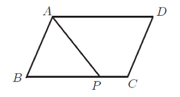
Since we have a parallelogram, we have 3 variables, and E is most likely the answer. So, we should consider conditions 1) & 2) together first. After comparing the number of variables and the number of equations, we can save time by considering conditions 1) & 2) together first.
Conditions 1) & 2)
∠B + ∠C = 180° and ∠C = ∠BAD = ∠BAP + ∠DAP.
Since ∠B : ∠C = 2 : 3 and ∠B + ∠C = 180° from condition 1), we have ∠B = 72° and ∠C = 108°, because:
∠B + ∠C = 180° can be rewritten as ∠B = 180° - ∠C
Substitute into ∠B : ∠C = 2 : 3
180 - ∠C : ∠C = 2 : 3
3(180° - ∠C) = 2C (by cross multiplying)
540° - 3∠C = 2∠C
540° = 5∠C (adding 3∠C to both sides)
∠C = 108° (dividing both sides by 5)
∠B = 180° - ∠C, B = 180° - 108°, or ∠B = 72°
Since ∠C = 108° = ∠BAP + ∠DAP and ∠BAP = ∠DAP, we have ∠BAP = 54°.
Thus the exterior angle ∠APC of the triangle ABP is the sum of ∠ABP and ∠BAP and we have ∠APC = ∠ABP + ∠BAP = 72° + 54° = 126°.
The answer is unique, and the conditions combined are sufficient.
Therefore, C is the answer.
Answer: C