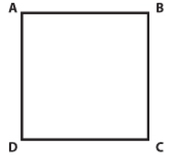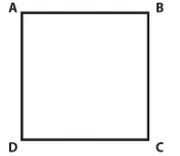
Square ABCD has an area of 9 square inches. Sides AD and BC are lengthened to x inches each. By how many inches were sides AD and BC lengthened?
(1) The diagonal of the resulting rectangle measures 5 inches.
(2) The resulting rectangle can be cut into three rectangles of equal size.
OA=A
Source: Manhattan GMAT
Hi Vjesus12.
Here, the question we need to answer is, what is \(x\)?
Statement 1:
(1) The diagonal of the resulting rectangle measures 5 inches.
Since the square has an area of 9 square inches, then AB=BC=3 in. Then, we can draw the following picture
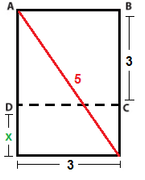
By the Pythagorean Theorem, we get that $$\left(3+x\right)^2+3^2=5$$ and from this equation we can get the value of \( x\). So, this statement is
SUFFICIENT.
Statement 2:
(2) The resulting rectangle can be cut into three rectangles of equal size.
This information doesn't tell us anything since any rectangle can be divided into 3 rectangles of equal size. So, this statement is
NOT SUFFICIENT.
Therefore, the correct answer is the option
_A_.
I hope it helps you.