PROBLEM IN SOLVIN!!!! PS!! Plzzzzz help asap...

This topic has expert replies
User avatar
Senior | Next Rank: 100 Posts
Posts: 80
Joined: Sat Sep 15, 2012 1:07 am
Thanked: 1 times
Followed by:1 members
A square wooden plaque has a square brass inlay in the centre, leaving a wooden strip of uniform width around the brass square. If the ratio of the brass area to the wooden area is 25 to 39, which of the following could be the width in inches of the woooden strip?

A) 1
B) 3
C) 4

i) A only
ii) B only
iii) A and B only
iv) A and C only
v) A, B and C
Source: — Problem Solving |

User avatar
MBA Admissions Consultant
Posts: 2279
Joined: Fri Nov 11, 2011 7:51 am
Location: New York
Thanked: 660 times
Followed by:266 members
GMAT Score:770

by Jim@StratusPrep » Wed Oct 17, 2012 6:54 am
Because this is a ratio, there are literally infinite combinations for the two squares. The ratio of this sides just as to be 8:5. Because of this any length for the wooden strip will work.

Answer is E.
GMAT Answers provides a world class adaptive learning platform.
-- Push button course navigation to simplify planning
-- Daily assignments to fit your exam timeline
-- Organized review that is tailored based on your abiility
-- 1,000s of unique GMAT questions
-- 100s of handwritten 'digital flip books' for OG questions
-- 100% Free Trial and less than $20 per month after.
-- Free GMAT Quantitative Review

Image

User avatar
GMAT Instructor
Posts: 15539
Joined: Tue May 25, 2010 12:04 pm
Location: New York, NY
Thanked: 13060 times
Followed by:1906 members
GMAT Score:790

by GMATGuruNY » Wed Oct 17, 2012 6:58 am
A square wooden plaque has a brass inlay in the center, leaving a wooden strip of uniform width around the brass square. If the ratio of the brass area to the wooden area is 25 to 39, which of the following could be the width, in inches of the wooden strip?

I. 1
II. 3
III. 4

a. I only
b. II only
c. I and II only
d. I and III only
e. I, II, and III
There is no math to be done here; just use common sense. Why couldn't the width of the strip be any value? We could choose a width for the strip, then shrink or expand the inlay until the ratio of inlay area:strip area = 25:39.

The correct answer is E.
Private tutor exclusively for the GMAT and GRE, with over 20 years of experience.
Followed here and elsewhere by over 1900 test-takers.
I have worked with students based in the US, Australia, Taiwan, China, Tajikistan, Kuwait, Saudi Arabia -- a long list of countries.
My students have been admitted to HBS, CBS, Tuck, Yale, Stern, Fuqua -- a long list of top programs.

As a tutor, I don't simply teach you how I would approach problems.
I unlock the best way for YOU to solve problems.

For more information, please email me (Mitch Hunt) at [email protected].
Student Review #1
Student Review #2
Student Review #3

GMAT/MBA Expert

User avatar
GMAT Instructor
Posts: 273
Joined: Tue Sep 21, 2010 5:37 am
Location: Durham, NC
Thanked: 154 times
Followed by:74 members
GMAT Score:770

by Whitney Garner » Wed Oct 17, 2012 10:00 am
AIM TO CRACK GMAT wrote:A square wooden plaque has a square brass inlay in the centre, leaving a wooden strip of uniform width around the brass square. If the ratio of the brass area to the wooden area is 25 to 39, which of the following could be the width in inches of the woooden strip?

A) 1
B) 3
C) 4

i) A only
ii) B only
iii) A and B only
iv) A and C only
v) A, B and C
Hi AIM TO CRACK GMAT!

This is a fairly tricky problem and the ease will depend on HOW we set it up. So let's think about the picture of this scenario.

We have a choice to make.

Option 1:
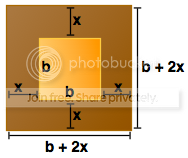
We can define the dimensions of the small brass inlay as (b), and then add some unknown (x) to all sides for the width of the border and then use that new measure for the large plaque:
Image

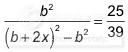
But our ratio between the area of the brass inlay (b^2) and the area of the border is difficult because we have to define the area of that border region. And it would be the difference between the area of the larger wooden square (b+2x)^2 and the brass inlay (b^2).
Image

Option 2:
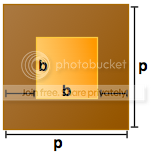
Or we can define the dimensions of the small brass inlay as (b) and the dimensions of the outer plaque as (p):
Image

In this case our ratio between the area of the brass inlay (b^2) and the area of the border (which is the area of the large area (p^2) minus the area of the brass inlay (b^2)) would be:

Image

And the width of the border (x) would be half of the difference between the dimension of the big and small squares (p-b)/2.

Which do we choose??
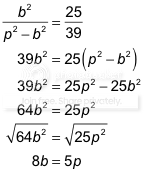
So which of these is easier to deal with? Well, solving for the ratio in the first case would involve squaring the binomial (b+2x) so that might get ugly. Might be nice to see if we can simplify the ratio in the second equation simply by cross-multiplying and combining like terms:
Image

So we see that we get a relationship between the dimensions of 8b=5p, or that at long as b=(5/8)p, our ratio works out. So what does this mean for the possible widths of the wooden strip? Because the problem never specifies that all measurements are integers, we can show that ANY positive value will work as the width of the border - it will just depend on the sides of plaque and brass inlay we choose.

Remember that what we want to find is the width = (p-b)/2. Sub in for b...

(p-(5/8)p)/2 = [(3/8)p]/2 = (3/16)p.

So as long as the border values given can be equal to (3/16)p for SOME value of p, we are fine (so we can choose any of them - the answer is E.)

But to prove it:

x=(3/16)p

can x=1?
1=(3/16)p ... p=16/3 (so if the outer dimension is 16/3 and the inner is b=(5/8)(p)=(5/8)(16/3) = 10/3, the width of the wooden strip could equal 1)

can x=3?
3=(3/16)p ... p=16 (so if the outer dimension is 16 and the inner is b=(5/8)(p)=(5/8)(16) = 10, the width of the wooden strip could equal 3)

can x=4?
4=(3/16)p ... p=64/3 (so if the outer dimension is 64/3 and the inner is b=(5/8)(p)=(5/8)(64/3) = 40/3, the width of the wooden strip could equal 4)

Hope this helps!
:)
Whit
Whitney Garner
GMAT/GRE/EA Instructor & Anxiety/Accommodations Coach
www.whitneygarner.com

Contributor to Beat The GMAT!

Math is a lot like love - a simple idea that can easily get complicated :heart-eyes: