-
gmat_thingie
- Junior | Next Rank: 30 Posts
- Posts: 23
- Joined: Thu Nov 12, 2009 12:37 am
BREAKING: Target Test Prep releases Brand New 2026 On Demand GMAT prep course
Redeem
Target Test Prep GMAT OnDemand
Scott Woodbury-Stewart’s private virtual classroom — 400 hours of master-class video lessons for the GMAT Focus Edition.
- 715+ score guarantee — highest in the industry (99th percentile)
- 52 chapters · 1,500+ lessons · 4,000+ practice questions
- 400 hours of video · 1,500+ instructor-led HD smartboard lessons
- 300,000+ students accepted to Harvard, Stanford, Wharton, Booth & Sloan & more
- 24/7 live support + weekly Zoom office hours with GMAT instructors
- TTP AI Assist — 24/7 AI-powered virtual tutor for instant help
- 1,200+ flashcards + AI-powered study assistant & daily calendar
- OnDemand, LiveTeach & GMAT Bootcamp formats available
- Also: GRE, SAT Math & Executive Assessment courses
- MBA Admissions Consulting now available
- 🏆 2025 EdTech Breakthrough Award: Test Prep Solution Provider of the Year
- 200,000+ students served
- 5-day free trial — $0 to start, no auto-billing, cancel anytime
★★★★★
5.0
(559 reviews)
130-pt guarantee
$0 to start
then $127/mo
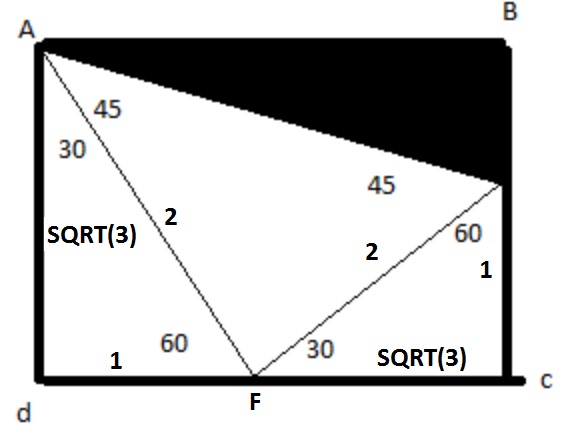
SHADED REGION (GEOMETRY_Uploaded image)
Source: Beat The GMAT — Problem Solving |
Two equations worthwhile to know:gmat_thingie wrote:Clearer image
Sin 30 = 1/2
Sin 60 = sqrt(3)/2
lets label the point on CD where the two points meet as F
lets label the point on BC where the two points meet as E

Area of reactangle = AD X CD
Area of reactangle = (sqrt 3) x (1 + sqrt 3) = sqrt 3 + 3
Area of trapezium = 1/2 * (AD + CE) * CD
Area of trapezium = 1/2 * (sqrt 3 + 1) * (1 + sqrt 3))
Area of trapezium = 1/2 * (3 + 2 * sqrt 3 + 1) = 1/2 * (4 + 2 * sqrt 3) = 2 + sqrt 3
Area of shaded region = (sqrt 3 + 3) - (2 + sqrt 3) = 1
Ans = b
These equations are not at all worthwhile on the GMAT, as trigonometry is not tested.theCEO wrote: Two equations worthwhile to know:
Sin 30 = 1/2
Sin 60 = sqrt(3)/2
The proportions of a 30-60-90 are essential, but you can find them by splitting an equilateral in half and using the Pythagorean Theorem should you forget them; do NOT dust off your trig books and start learning about sines and cosines!
Hi
I think I went through this question again and found it fairly simple.
AD = ROOT 3 AND AE = 2 (30/60/90 Triangle calculation)
EF = 2, AF = 2 ROOT 2 (45,45,90 Triangle traits), AE IS known from above
FOR ECF, EC = ROOT 3 AND FC = 1 on account of EF = 2
BF = ROOT 3 - 1 (ROOT 3 - FC)
AB = 1 + ROOT 3
PERIMETER = 2 ROOT 2 + 2 ROOT 3 (OPTION 5)
SQUARE OF the shaded triangle ABF = 1
I think I went through this question again and found it fairly simple.
AD = ROOT 3 AND AE = 2 (30/60/90 Triangle calculation)
EF = 2, AF = 2 ROOT 2 (45,45,90 Triangle traits), AE IS known from above
FOR ECF, EC = ROOT 3 AND FC = 1 on account of EF = 2
BF = ROOT 3 - 1 (ROOT 3 - FC)
AB = 1 + ROOT 3
PERIMETER = 2 ROOT 2 + 2 ROOT 3 (OPTION 5)
SQUARE OF the shaded triangle ABF = 1