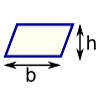
sachindia wrote:If the area of a parallelogram is 100, what is the perimeter of the parallelogram?
1) The base of the parallelogram is 10.
2) One of the angles of the parallelogram is 45 degrees.
OA later! :mrgreen:
Target question:
What is the perimeter of the parallelogram?
Given: The area is 100
Statement 1: The base of the parallelogram is 10.
Since the area of a parallelogram = (base)(height), we now know that
the height of the parallelogram is 10.
Does this provide enough information to find the perimeter?
No.
It could be the case that the parallelogram is a square . . .

. . . in which case
the perimeter is 40
Or it could be the case that the parallelogram is not a square . . .

. . . in which case
the perimeter is not 40
Since we cannot answer the
target question with certainty, statement 1 is NOT SUFFICIENT
Statement 2: One of the angles of the parallelogram is 45 degrees.
Edited to reflect Anurag's comments below
Let's let the length of the base = x
If the area of the parallelogram is 100 (and the base has length x), then the height must must be 100/x
So, at this point, we know that our parallelogram looks something like this:

Now, notice that we can extend two sides to get a convenient 45-45-90 triangle:

Since we have the lengths of 2 sides of this special right triangle, we can find the length of the 3rd side:

Since the opposite sides of a parallelogram have equal lengths,
the perimeter = x + x + (sqrt2)(100/x) + (sqrt2)(100/x)
As you can see, the perimeter of the parallelogram will fluctuate, depending on the value of x.
As such, statement 2 is NOT SUFFICIENT
Statements 1 and 2 combined:
From statement 2, we know that the perimeter = x + x + (sqrt2)(100/x) + (sqrt2)(100/x)
From statement 1, we know that x = 10
So, we can plug x=10 into our formula to find the perimeter.
As such, the combined statements are SUFFICIENT
Answer =
C
Cheers,
Brent