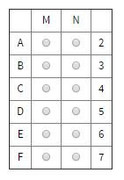
What we see: a Two-Part Analysis question about coins. We pick one value for \(M\) and one for \(N\) so that \(\frac{1}{p} + \frac{1}{q} = 72\) and \(M < N\).
Step 1. Write \(p\) and \(q\) in terms of \(M\) and \(N\).
What we see: each fair coin lands faceup with chance \(\frac{1}{2}\), and the coins do not affect each other.
What it means: the chance that all \(M\) coins land faceup is \(\frac{1}{2}\) multiplied by itself \(M\) times, so \(p = \frac{1}{2^M}\). In the same way, \(q = \frac{1}{2^N}\).
What we do and why: we flip each fraction, because the equation uses \(\frac{1}{p}\) and \(\frac{1}{q}\): \(\frac{1}{p} = 2^M\) and \(\frac{1}{q} = 2^N\).
Step 2. Turn the condition into a sum of powers of 2.
What we see: \(\frac{1}{p} + \frac{1}{q} = 72\).
What it means: \(2^M + 2^N = 72\). We need two powers of 2 that add up to 72.
What we do and why: list the powers of 2 below 72: 1, 2, 4, 8, 16, 32, 64. Try the biggest first. \(64 + 8 = 72\) works. Check the rest: \(72 - 32 = 40\), \(72 - 16 = 56\), \(72 - 4 = 68\), \(72 - 2 = 70\), \(72 - 1 = 71\). None of those is a power of 2. So only one pair works: 8 and 64.
Step 3. Match the pair to \(M\) and \(N\).
What we see: \(8 = 2^3\) and \(64 = 2^6\), and the question says \(M < N\).
What it means: \(M = 3\) and \(N = 6\).
What we do and why: check: \(p = \frac{1}{8}\), \(q = \frac{1}{64}\), and \(8 + 64 = 72\). Since only one pair of powers works, this is the only answer, whatever other values the table lists.
The trap: treating the chance for \(M\) coins as \(\frac{M}{2}\), or adding \(p + q\) instead of \(\frac{1}{p} + \frac{1}{q}\). Both lead to numbers that never reach 72. Another slip is swapping the columns: \(M = 6\), \(N = 3\) breaks \(M < N\).
Faster way: write 72 as a sum of powers of 2 by taking the biggest one that fits: \(72 = 64 + 8\). That split is always the only one.
Takeaway: the chance that \(n\) fair coins all land the same chosen way is \(\frac{1}{2^n}\), so its flip is \(2^n\). When a question adds flipped probabilities, look for powers of 2.
Answer: M 3, N 6