-
Amrabdelnaby
- Master | Next Rank: 500 Posts
- Posts: 137
- Joined: Fri Nov 13, 2015 11:01 am
- Thanked: 1 times
- Followed by:2 members
One approach is to use the Double Matrix Method. This technique can be used for most questions featuring a population in which each member has two characteristics associated with it (aka overlapping sets questions).----------------YES---------NO----UNSURE
Subject M----500--------200-----100
Subject R----400--------100-----300
A total of 800 students were asked whether they found two subjects, M and R, interesting. Each answer was either "yes" or "no" or "unsure", and the numbers of students who gave these answers are listed in the table above. If 200 students answered "yes" only for subject M, how many of the students did not answer "yes" for either subject?
A. 100
B. 200
C. 300
D. 400
E. 500
Here, we have a population of students, and the two characteristics are:
- Said "yes" to liking subject M or didn't say "yes" to liking subject M
- Said "yes" to liking subject R or didn't say "yes" to liking subject R
IMPORTANT: Notice that I just lumped the "unsure" respondents in with those who answered "no." It's okay to do this since the question is only interested in those who did not answer "yes"
So, we can CONDENSE our table to get:
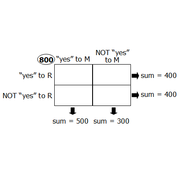
Subject M: 500 answered "yes," and 300 did NOT answer "yes"
Subject R: 400 answered "yes," and 400 did NOT answer "yes"
We can now set up our diagram as follows:

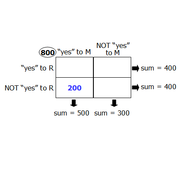
The question tells us 200 students answered "yes" only for subject M
So, we know that 200 students can be placed in the bottom-left box:

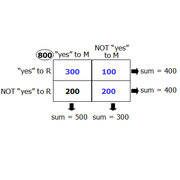
From here, we can find the other values in the empty boxes:

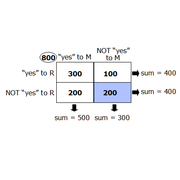
The question asks: How many of the students did not answer "yes" for either subject?
The bottom-right box represents those students:

So, the correct answer is B
------------------------
NOTE: This question type is VERY COMMON on the GMAT, so be sure to master the technique.
To learn more about the Double Matrix Method, watch our free video: https://www.gmatprepnow.com/module/gmat- ... ems?id=919
Once you're familiar with this technique, you can attempt these additional practice questions:
Easy Problem Solving questions
- https://www.beatthegmat.com/the-aam-aadm ... 72242.html
- https://www.beatthegmat.com/finance-majo ... 67425.html
Medium Problem Solving questions
- https://www.beatthegmat.com/probability- ... 73360.html
- https://www.beatthegmat.com/posted-speed ... 72374.html
- https://www.beatthegmat.com/motel-t271938.html
- https://www.beatthegmat.com/of-the-appli ... 70255.html
- https://www.beatthegmat.com/opening-nigh ... 64869.html
- https://www.beatthegmat.com/ds-french-ja ... 22297.html
Difficult Problem Solving questions
- https://www.beatthegmat.com/ratio-problem-t268339.html
- https://www.beatthegmat.com/overlapping- ... 65223.html
- https://www.beatthegmat.com/fractions-t264254.html
- https://www.beatthegmat.com/overlapping- ... 64092.html
- https://www.beatthegmat.com/mba/2011/05/ ... question-2
Easy Data Sufficiency questions
- https://www.beatthegmat.com/for-what-per ... 70596.html
- https://www.beatthegmat.com/ds-quest-t187706.html
Medium Data Sufficiency questions
- https://www.beatthegmat.com/sets-matrix-ds-t271914.html
- https://www.beatthegmat.com/each-of-peop ... 71375.html
- https://www.beatthegmat.com/a-manufacturer-t270331.html
- https://www.beatthegmat.com/in-costume-f ... 69355.html
- https://www.beatthegmat.com/mba/2011/05/ ... question-1
Difficult Data Sufficiency questions
- https://www.beatthegmat.com/double-set-m ... 71423.html
- https://www.beatthegmat.com/sets-t269449.html
- https://www.beatthegmat.com/mba/2011/05/ ... question-3
Cheers,
Brent