BREAKING: Target Test Prep releases Brand New 2026 On Demand GMAT prep course

Redeem

Geometry

Expert replies
by komati_anusha » Wed Dec 03, 2014 5:41 am
In the coordinate plane, a circle has center (2, -3) and passes through the point (5, 0). What is the area of the circle?

A. 3Ï€
B. 3√2π
C. 3√3π
D. 9Ï€
E. 18Ï€

Can anyone say what are the concepts that it is testing?
How to relate coordinate geometry with circles?
Join the discussion
Source: — Problem Solving |

by GMATGuruNY » Wed Dec 03, 2014 7:06 am
komati_anusha wrote:In the coordinate plane, a circle has center (2, -3) and passes through the point (5, 0). What is the area of the circle?

A. 3Ï€
B. 3√2π
C. 3√3π
D. 9Ï€
E. 18Ï€
When given a shape on the coordinate plane, use the coordinate plane to learn about the shape, use the shape to learn about the coordinate plane, or do both.

Here, we can use the coordinate plane to learn about the circle.
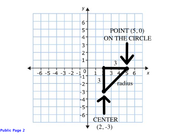
DRAW:
Image
As the figure above shows, the radius of the circle is the hypotenuse of an isosceles right triangle with legs of length 3.
In an isosceles right triangle, the sides are in the following ratio:
x : x : x√2.
Thus, the sides of the isosceles right triangle in the figure above are 3 : 3 : 3√2, implying that the radius of the circle = 3√2.
Since A = πr², we get:
A = π(3√2)² = 18π.

The correct answer is E.
Private tutor exclusively for the GMAT and GRE, with over 20 years of experience.
Followed here and elsewhere by over 1900 test-takers.
I have worked with students based in the US, Australia, Taiwan, China, Tajikistan, Kuwait, Saudi Arabia -- a long list of countries.
My students have been admitted to HBS, CBS, Tuck, Yale, Stern, Fuqua -- a long list of top programs.

As a tutor, I don't simply teach you how I would approach problems.
I unlock the best way for YOU to solve problems.

For more information, please email me (Mitch Hunt) at [email protected].
Student Review #1
Student Review #2
Student Review #3
Join the discussion

by Mathsbuddy » Wed Dec 03, 2014 7:18 am
In the coordinate plane, a circle has center (2, -3) and passes through the point (5, 0). What is the area of the circle?
The displacement between points (2,-3) and (5,0) is the radius of the circle.
Change in x = 5 - 2 = 3
Change in y = 0 - -3 = 3
By Pythagoras: r^2 = 3^2 + 3^2 = 18
Area = pi x r^2 = 18 x pi
Join the discussion

by komati_anusha » Wed Dec 03, 2014 7:41 am
Hi Mitch Hunt!

I understood
But radius of a circle is the hypotenuse of a isosceles triangle.
But in a circle , radius will be same from center to any point in a circle.
And why can't we consider legs of a triangle as a radius in this.

sorry for silly questions!Pls
Join the discussion

by GMATGuruNY » Wed Dec 03, 2014 9:02 am
komati_anusha wrote:Hi Mitch Hunt!

I understood
But radius of a circle is the hypotenuse of a isosceles triangle.
But in a circle , radius will be same from center to any point in a circle.
And why can't we consider legs of a triangle as a radius in this.

sorry for silly questions!Pls
The hypotenuse is a radius because it extends from the center (2, -3) to a point on the circle (5, 0).
As shown in my solution above, the hypotenuse -- and thus the radius -- each have a length of 3√2.
All radii in a circle have the same length.
Since the legs of the triangle each have a length of 3, and the radius has a length of 3√2, the legs of the triangle cannot be radii.
Private tutor exclusively for the GMAT and GRE, with over 20 years of experience.
Followed here and elsewhere by over 1900 test-takers.
I have worked with students based in the US, Australia, Taiwan, China, Tajikistan, Kuwait, Saudi Arabia -- a long list of countries.
My students have been admitted to HBS, CBS, Tuck, Yale, Stern, Fuqua -- a long list of top programs.

As a tutor, I don't simply teach you how I would approach problems.
I unlock the best way for YOU to solve problems.

For more information, please email me (Mitch Hunt) at [email protected].
Student Review #1
Student Review #2
Student Review #3

Join the discussion

















