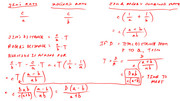
Jim takes a seconds to swim c meters at a constant rate from point P to point Q in a pool. Roger, who is faster than Jim, can swim the same distance in b seconds at a constant rate. If Jim leaves point P the same time that Roger leaves point Q, how many fewer meters will Jim have swum than Roger when the two swimmers pass each other?
A) c(b-a)/ a+b
B) c(a-b)/a+b
C) c(a+b)/a-b
D) ab(a-b)/a+b
E) ab(b-a)/a+b
The solution I am looking at tells me that I have to solve out for 't' It seems to me that for similar problems (for example: two trains leave point a and b and meet somewhere in between) I do not have to solve out for t. I am told that t= ab/a+b but I cannot figure out why that is necessary.
A) c(b-a)/ a+b
B) c(a-b)/a+b
C) c(a+b)/a-b
D) ab(a-b)/a+b
E) ab(b-a)/a+b
The solution I am looking at tells me that I have to solve out for 't' It seems to me that for similar problems (for example: two trains leave point a and b and meet somewhere in between) I do not have to solve out for t. I am told that t= ab/a+b but I cannot figure out why that is necessary.