Mo2men wrote:Line Q has the equation 5y - 3x = 45. If Line S is perpendicular to Q, has an integer for its y-intercept, and intersects Q in the second quadrant, then how many possible Line S's exist? (Note: Intersections on one of the axes do not count.)
(A) 25
(B) 33
(C) 36
(D) 41
(E) 58
Source: Magoosh
Line Q:
5y - 3x = 45
5y = 3x + 45
y = (3/5) + 9.
Draw line Q:
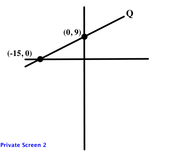
The slopes of perpendicular lines are NEGATIVE RECIPROCALS.
Since line S must be perpendicular to line Q -- and the slope of line Q is 3/5 -- the slope of line S = -5/3.
Thus, the equation for line S is as follows:
y = (-5/3)x + b.
If line S intersects line Q at the x-axis, the following figure is yielded:
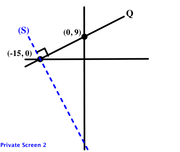
Here, line S includes (-15, 0).
Plugging (-15, 0) into y = (-5/3)x + b, we get:
0 = (-5/3)(-15) + b
0 = 25 + b
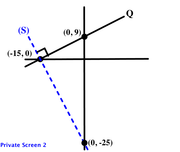
b = -25.
The result is the following figure:
If line S intersects line Q at the y-axis, we get:
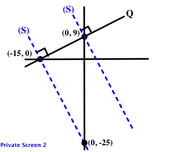
Since lines Q and S may not intersect at either axis, the resulting figure implies that the y-intercept of line S must be an integer value BETWEEN -25 AND 9.
Thus, the y-intercept for line S may be any integer value between -24 and 8, inclusive, for a total of 33 integer options.
The correct answer is
B.
Private tutor exclusively for the GMAT and GRE, with over 20 years of experience.
Followed here and elsewhere by over 1900 test-takers.
I have worked with students based in the US, Australia, Taiwan, China, Tajikistan, Kuwait, Saudi Arabia -- a long list of countries.
My students have been admitted to HBS, CBS, Tuck, Yale, Stern, Fuqua -- a long list of top programs.
As a tutor, I don't simply teach you how I would approach problems.
I unlock the best way for YOU to solve problems.
For more information, please email me (Mitch Hunt) at
[email protected].
Student Review #1
Student Review #2
Student Review #3























