alltimeacheiver wrote:Each light bulb at Hotel California is either incandescent or fluorescent. At a certain moment, forty percent of the incandescent bulbs are switched on, and ten percent of the fluorescent bulbs are switched off. If eighty percent of all the bulbs are switched on at this moment, what percent of the bulbs that are switched on are incandescent?
22 (2/9)%
16 (2/3)%
11 (1/9)%
10%
5%
I'll argue that the easiest way to deal with these types of problems is to use a Grid (we call it a Double-Set Matrix in the book). The idea is to recognize the problem type as one that presents you with 2 MECE pairs...
What is a MECE Pair?
- Let's start with the meaning of MECE (Mututally Exclusive, Collectively Exhaustive).
So, if I group data and I want to make sure those categories are MECE, then they must be:
Mutually Exclusive - if you belong to one group, you cannot belong to the other
Collectively Exhaustive - everyone belongs to one of the groups.
We can think of a MECE pair like a light switch (pardon the similarity to the current question). A MECE pair would be like a light switch turning a quality ON and OFF. Some example MECE pairs would be the following:
Male/Female, Night/Day, Pass/Fail, Nocturnal/Diurnal, Cat/Not-Cat (notice that it isn't Cat/Dog because there are plenty of other categories besides Cat and Dog that things can fall into).
So let's get back to our example. We are talking about Light Bulbs. What are the characteristics that can be turned On or Off??
(1) The lights can be On or OFF (okay, then that is one MECE Pair).
(2) The lights can be either Incandescent or Fluorescent (there is our second pair).
Then we build a 3x3 matrix where we put 1 pair across the top and one down the side:
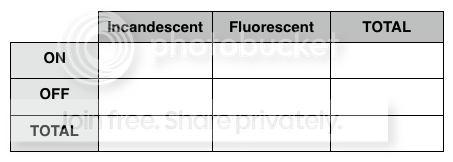
Notice that in every row and column, we can fill in information by looking at the cross-listings. For example, the number of Incandescent lights that are ON would be the top left box, and the TOTAL number of lights that are ON would be the top right!
We can also see that columns add down to give totals, and rows add across - pretty handy!
Now, because the original problem talks only of percents and gives no real numbers, let's use a smart number to represent the TOTAL number of light bulbs = 100.
Now we fill in the rest:
40% of Incandescent are ON (do we know the total number of incandescent? No, we will need a variable, and then we can take 40% of it (40% of X = .4X)!
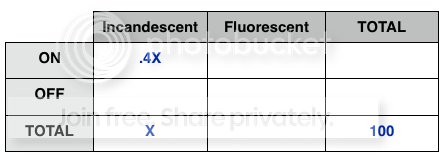
Then we can use addition and subtraction to fill in a few additional boxes:
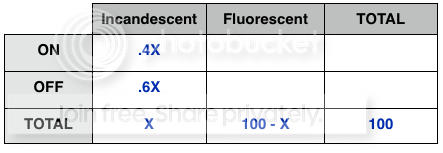
10% of the fluorescent bulbs are OFF (well, we know now that this is 100-x, so we can use .1*(100-x) for that box).
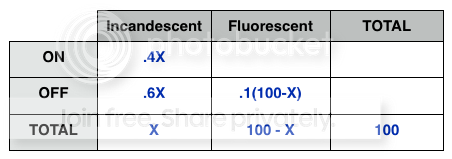
Finally, we know that 80% of ALL bulbs are ON. This means 80 of our 100 are on.
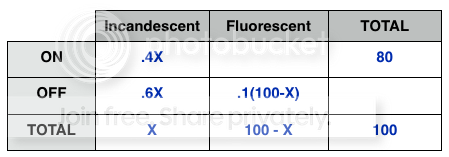
Use addition and subtraction to fill in the other boxes (we really only need enough to have a completed row).
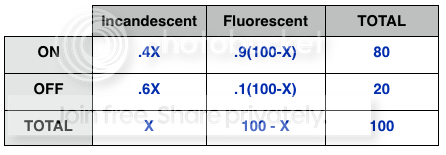
Now we can use EITHER row to solve for X:
.6X + .1(100-X) = 20
.6X + 10 - .1X = 20
.5X = 10
5X = 100
X = 20
But we don't just want the number of incandescent bulbs. We actually want to know what percent of the ON bulbs are Incandescent. Well, that would be .4X/80 = 4X/800 = X/200 = 20/200 = 10/100 = 10%!
This explanation might seem a bit long, but building and filling in your own table is actually quite quick!!
Hope this helps!

Whit
























