BREAKING: Target Test Prep releases Brand New 2026 On Demand GMAT prep course

Redeem

Target Test Prep · GMAT

Choose how you want to prepare

Learn live with an expert or move at your own pace. Every option includes the complete TTP study system.

★★★★★5.0559 reviews
GMATLiveTeach 7 seats left
Chris Peckover
NEXT LIVE COHORT

Oct 13 to Jan 7, 2027

with Chris Peckover

Schedule
Tue, Thu · 8:00 to 10:00 PM ET
Included
40 live hours + 6 months of GMAT OnDemand
  • Live instruction and real-time questions
  • Class recordings and assigned practice
View class & enroll
Limited cohort · enrollment openTarget Test Prep
EALiveTeach 5 seats left
Logan Thompson
EXECUTIVE ASSESSMENT

Sep 6 to Dec 6, 2026

with Logan Thompson

Schedule
Sun · 9:30 AM to 12:30 PM ET
Included
40 hours of live online classes plus six months of access to the complete TTP EA OnDemand course.
  • 165+ EA Score Guarantee
  • 4,100+ Quant, Verbal, and Integrated Reasoning practice questions
  • 400+ hours of in-depth video lessons
  • 3,000+ step-by-step video solutions
View EA class & enroll
Limited cohort · enrollment openTarget Test Prep
GMATOnDemand Start anytime
SELF-PACED MASTERCLASS

Target Test Prep GMAT OnDemand

Complete access from day one. Study on your schedule.

715+ score guarantee
$0to start then $127/mo
  • Personalized study plan and analytics
  • Thousands of lessons and practice questions

Compare the format, schedule, and included access before enrolling. Prices and seat counts shown reflect the supplied offer details.

PS- Coordinate Geometry

Expert replies
by pareekbharat86 » Mon Nov 04, 2013 10:11 pm
In the rectangular coordinate system which quadrant, if any, contains no point ( x, y ) that satisfies the inequality 2x − 3y ≤ − 6 ?
(A) None
(B) Ι
(C) ΙI
(D) ΙII
(E) IV

OA is E.

My Response to the ques:

Assuming x=0, then -3y<= -6 or y>= 2.

Assuming y=0, x<= -3.

Therefore a line with coordinates (X<= -3, Y>=2) should be located in quadrant 2 only.

Having done this much, I got stuck. I did not really comprehend what the question stem meant.
Thanks,
Bharat.
Join the discussion
Source: — Problem Solving |

by theCodeToGMAT » Mon Nov 04, 2013 10:51 pm
2x - 3y <= -6

x = 0==> -3y <= -6 ==> y>=2

y = 0==> 2x <= -6 ==> x <= -3

Since, any line drawn using the above points will result lines passing 1st, 2nd & 3rd quadrant.
So, Answer {E}
Attachments
solution.JPG
R A H U L
Join the discussion

by mevicks » Mon Nov 04, 2013 11:04 pm
pareekbharat86 wrote:In the rectangular coordinate system which quadrant, if any, contains no point ( x, y ) that satisfies the inequality 2x − 3y ≤ − 6 ?
(A) None
(B) Ι
(C) ΙI
(D) ΙII
(E) IV
Let us first trace the region depicted by 2x − 3y ≤ − 6
2x − 3y ≤ − 6
−3y ≤ -2x − 6
3y ≥ 2x + 6 ... multiplying both sides by (-1)

y ≥ (2/3)x + 2

Consider the line y = (2/3)x + 2
Its y intercept = 2 (put x = 0 in the above equation)
Its x intercept = -3 (put y = 0 in the above equation)

We need a region which is greater than y = (2/3)x + 2
(since the original equation states greater than equal to...)

Image

Original question: which quadrant contains no point that satisfies the inequality ...

The points in the 4th quadrant will not be a part of the equation y ≥ (2/3)x + 2 and thus the answer is E
Join the discussion

by Brent@GMATPrepNow » Tue Nov 05, 2013 4:56 am
pareekbharat86 wrote:In the rectangular coordinate system which quadrant, if any, contains no point ( x, y ) that satisfies the inequality 2x − 3y ≤ −6 ?
(A) None
(B) Ι
(C) ΙI
(D) ΙII
(E) IV
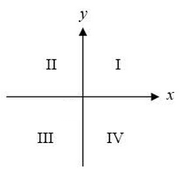
For those who are unfamiliar with the location of the quadrants in the x-y coordinate plane, they are shown here
Image

Another approach here is the recognize how the coordinates of points look in each quadrant.
Quadrant I: (positive, positive)
Quadrant II: (negative, positive)
Quadrant III: (negative, negative)
Quadrant IV: (positive, negative)

From here, we can check each quadrant.
For example, let's see if it's possible for a point in QUADRANT I (where the x and y coordinates are both positive) to satisfy the inequality 2x − 3y ≤ −6
Well, how about x = 1 and y = 10.
When we plug these in, we get 2(1) − 3(10) ≤ −6
Simplify to get -28 ≤ −6 [PERFECT it works]
ELIMINATE B

Is it possible for a point in QUADRANT II (where the x is negative and y is positive) to satisfy the inequality 2x − 3y ≤ −6?
Well, how about x = -10 and y = 10.
When we plug these in, we get 2(-10) − 3(10) ≤ −6
Simplify to get -50 ≤ −6 [PERFECT it works]
ELIMINATE C

Is it possible for a point in QUADRANT III (where the x is negative and y is negative) to satisfy the inequality 2x − 3y ≤ −6?
Well, how about x = -10 and y = -1.
When we plug these in, we get 2(-10) − 3(-1) ≤ −6
Simplify to get -17 ≤ −6 [PERFECT it works]
ELIMINATE D

Is it possible for a point in QUADRANT IV (where the x is positive and y is negative) to satisfy the inequality 2x − 3y ≤ −6?
NO.
When we plug these in, we get 2(positive) − 3(negative) ≤ −6
Simplify to get positive - negative ≤ −6
Since a positive number minus a negative number will always be positive, we get . . .
POSITIVE ≤ −6
Since this is IMPOSSIBLE, the correct answer must be E

Cheers,
Brent
Brent Hanneson - Creator of GMATPrepNow.com
Image
Join the discussion


















