BREAKING: Target Test Prep releases Brand New 2026 On Demand GMAT prep course

Redeem

Inequalities: Reciprocal Rule

Expert replies
by AkiB » Wed Jul 16, 2014 12:04 am
What is the largest integer n such that 1/2^n> 0.01?

a)5
b)6
c)7
d)10
e)51

The solution to this problem mentioned in the OG is as follows
Since 1/2^n > 0.01 is equivalent to 2n < 100, find
2"
the largest integer n such that 2" < 100. Using
trial and error, 2^6 = 64 and 64 < 100, but
2^7 = 128 and 128 > 100. Therefore, 6 is the largest
integer such that 2^n > 0.01.
The correct answer is B.

My question is

The inequality sign only flips if u multiply or divide by a negative number, so why does the sign flip in the above case.

Thanks
Join the discussion
Source: — Problem Solving |

by unknown13 » Wed Jul 16, 2014 12:14 am
Hi
IMO answer is B

as 0.01 = 1/100
and (1/2)^n for n = 7 is 1/128
and for n = 6 it is 1/64

so highest integer value will be 6

thanks and regards
Join the discussion

by [email protected] » Wed Jul 16, 2014 12:15 am
Hi AkiB,

This question asks us to compare fractions. The decimal .01 can be written as 1/100. Since 1/(2^N) and 1/100 both have numerators that equal 1, we can focus on the denominators. We're asked how big we can make N so that 1/(2^N) > 1/100. For the first fraction to be bigger than the second, the denominator must be SMALLER than 100, BUT we still have to make it as BIG as possible.

In answer to your question, the sign doesn't "flip"; you're actually cross-multiplying the inequality, so....

1/(2^N) > 1/100

becomes....

100 > 2^N

GMAT assassins aren't born, they're made,
Rich
Contact Rich at [email protected]
Image
Join the discussion

by Matt@VeritasPrep » Wed Jul 16, 2014 10:46 am
Here's a nice algebraic approach.

(1/2)� > .01 is really
(1/2)� > 1/100, or
1/2� > 1/100

Since 2� and 100 are both positive, when we cross-multiply, the sign WON'T flip. So we have

100 > 2�

We know that 2�=128 > 100 > 2�=64, so n must be 6.
Join the discussion

by GMATinsight » Wed Jul 16, 2014 6:36 pm
AkiB wrote:What is the largest integer n such that 1/2^n> 0.01?

a)5
b)6
c)7
d)10
e)51

The solution to this problem mentioned in the OG is as follows
Since 1/2^n > 0.01 is equivalent to 2n < 100, find
2"
the largest integer n such that 2" < 100. Using
trial and error, 2^6 = 64 and 64 < 100, but
2^7 = 128 and 128 > 100. Therefore, 6 is the largest
integer such that 2^n > 0.01.
The correct answer is B.

My question is

The inequality sign only flips if u multiply or divide by a negative number, so why does the sign flip in the above case.

Thanks

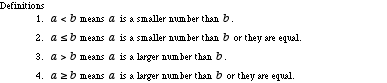
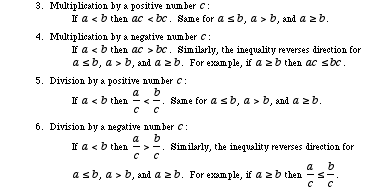
For better understanding of the rules of Inequality, Please see the rules below:

Inequality Rules

Image
Image

Transitive Property of Inequalities

If a < b and b < c , then a < c.
If a ≤ b and b ≤ c , then a ≤ c.
If a > b and b > c , then a > c.
If a ≥ b and b ≥ c , then a ≥ c.
"GMATinsight"Bhoopendra Singh & Sushma Jha
Most Comprehensive and Affordable Video Course 2000+ CONCEPT Videos and Video Solutions
Whatsapp/Mobile: +91-9999687183 l [email protected]
Contact for One-on-One FREE ONLINE DEMO Class Call/e-mail
Most Efficient and affordable One-On-One Private tutoring fee - US$40-50 per hour
Join the discussion