BREAKING: Target Test Prep releases Brand New 2026 On Demand GMAT prep course

Redeem

X-pand till End

Expert replies
by sanju09 » Wed Jul 16, 2014 10:36 pm
If x > 0, y > 0, and n is a perfect square odd integer, how many negative terms will 2(x - y)^√n have when expanded?
A. ½(n - 1)
B. ½n
C. ½(n + 1)
D. ½{(√n) - 1}
E. ½{(√n) + 1}


Made Up!
Attachments
funny Exam Expand.jpg
The mind is everything. What you think you become. -Lord Buddha


Sanjeev K Saxena
Quantitative Instructor
The Princeton Review - Manya Abroad
Lucknow-226001

www.manyagroup.com
Join the discussion
Source: — Problem Solving |

by GMATinsight » Thu Jul 17, 2014 9:12 am
sanju09 wrote:If x > 0, y > 0, and n is a perfect square odd integer, how many negative terms will 2(x - y)^√n have when expanded?
A. ½(n - 1)
B. ½n
C. ½(n + 1)
D. ½{(√n) - 1}
E. ½{(√n) + 1}
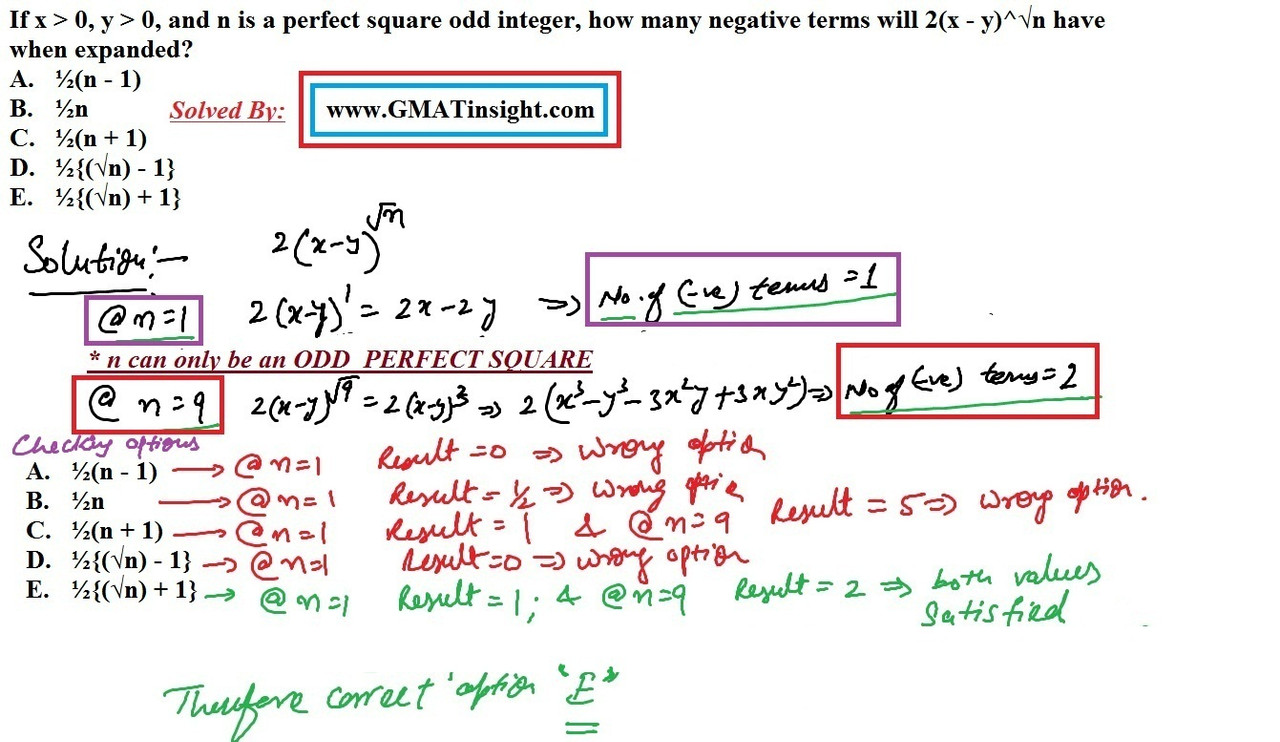
Please find the explanation mentioned below:

Image


Answer: Option E
Image
"GMATinsight"Bhoopendra Singh & Sushma Jha
Most Comprehensive and Affordable Video Course 2000+ CONCEPT Videos and Video Solutions
Whatsapp/Mobile: +91-9999687183 l [email protected]
Contact for One-on-One FREE ONLINE DEMO Class Call/e-mail
Most Efficient and affordable One-On-One Private tutoring fee - US$40-50 per hour
Join the discussion