BREAKING: Target Test Prep releases Brand New 2026 On Demand GMAT prep course

Redeem

OG SC

Expert replies
Source: — Sentence Correction |

by Amadalia » Fri Apr 04, 2014 1:44 pm
try to tell us what bother you the most with the question, this way we can more easily participate to the discussion
Join the discussion

by abhasjha » Fri Apr 04, 2014 11:09 pm
Join the discussion

by [email protected] » Sat Apr 05, 2014 3:47 pm
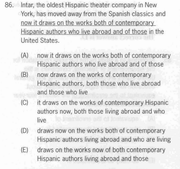
Follow the parallel structure of the sentence. Both those who X and those who Y.
Join the discussion

by VivianKerr » Sun Apr 06, 2014 4:31 pm
Sometimes it helps to "trim the fat" from longer SC's and check out the most simple version of the sentence to identify the error.

A simple version of this sentence would read:

"Intar has moved away from X and now it draws on both of Y and of Z."

So while there's no glaring grammatical error, there's two things we know the GMAT doesn't like stylistically. When a subject does the action of two verbs separated by the word "and," we don't need a pronoun before the second verb. Why can't the sentence be "has moved away AND now draws." The "it" is unnecessary. Again, now 100% wrong, but definitely not GMAT--ideal.

The second issue is the repetition of the preposition "of." Idiomatically, we usually say "both X and Y" -- it would be a simpler sentence to say "of both X and Y" -- rather than the idiomatically awkward and repetitive "both of X and of Y."

(B), (D), and (E) remove the unnecessary pronoun, and out of these choices, (B) and (E) both remove the awkward idiom. So which one is correct? The one that is the most parallel ("those..."those"). Never underestimate how much the GMAT LOVES parallelism.

TAKEAWAY

Primary Concept: Parallelism (Rule: Verbs separated by "and" should be parallel, in the idiom "both X and Y", X and Y should be parallel)

Secondary Concept: Pronoun (Rule: If a pronoun stands in the way of perfect parallelism, get rid of it)
Vivian Kerr
GMAT Rockstar, Tutor
https://www.GMATrockstar.com
https://www.yelp.com/biz/gmat-rockstar-los-angeles

Former Kaplan and Grockit instructor, freelance GMAT content creator, now offering affordable, effective, Skype-tutoring for the GMAT at $150/hr. Contact: [email protected]

Thank you for all the "thanks" and "follows"! :-)
Join the discussion

by [email protected] » Sun Apr 06, 2014 9:31 pm
Dear VivianKerr,
I know my question is very silly but still do answer.
Q How is present perfect and simple present parallel in the above example?

Regards,
Mukherjee
Join the discussion

by unknown13 » Sun Apr 06, 2014 10:16 pm
IMO B
Join the discussion

by Cutsona25 » Mon Apr 07, 2014 10:20 am
Choices B, D, and E, which remove the unnecessary pronoun "it" as Vivian said, have differences in their approach to what is being drawn upon. In the original sentence, the meaning is 'both of those who live abroad and of those in the US.' This is awkward with a double used "of", and is more easily written 'draws on authors, who live both abroad and in the US.' Choice B most recognizably follows this pattern. However, there are other obvious flaws with D and E.
Choice D begins with "draws now on", which is more awkward than 'now draws on,' and ends with 'both of authors living abroad and who are living in the US.' This structure implies that it draws on both Authors and 'something else.' The difference is between the authors, not two sources.
Choice E again implies that two sources are drawn upon, but this option at least informs us that it's those living abroad and those living in the US that are being compared. However it does not simplify to our original prediction of authors with a difference between them. It also say "draws on the works now" which is even more awkward than Choice D about 'now draws on.'

Choice B is the only option that implies Intar draws on authors, abroad and in the US, while other choices imply that Intar draws on both authors and something else.

Join the discussion

• Page 1 of 1