BREAKING: Target Test Prep releases Brand New 2026 On Demand GMAT prep course

Redeem

Target Test Prep · GMAT

Choose how you want to prepare

Learn live with an expert or move at your own pace. Every option includes the complete TTP study system.

★★★★★5.0559 reviews
GMATLiveTeach 7 seats left
Chris Peckover
NEXT LIVE COHORT

Oct 13 to Jan 7, 2027

with Chris Peckover

Schedule
Tue, Thu · 8:00 to 10:00 PM ET
Included
40 live hours + 6 months of GMAT OnDemand
  • Live instruction and real-time questions
  • Class recordings and assigned practice
View class & enroll
Limited cohort · enrollment openTarget Test Prep
EALiveTeach 5 seats left
Logan Thompson
EXECUTIVE ASSESSMENT

Sep 6 to Dec 6, 2026

with Logan Thompson

Schedule
Sun · 9:30 AM to 12:30 PM ET
Included
Live EA class + 6 months of EA OnDemand
  • Expert-led weekly online sessions
  • EA Masterclass access between classes
View EA class & enroll
Limited cohort · enrollment openTarget Test Prep
GMATOnDemand Start anytime
SELF-PACED MASTERCLASS

Target Test Prep GMAT OnDemand

Complete access from day one. Study on your schedule.

130-point score guarantee
$0to start then $127/mo
  • Personalized study plan and analytics
  • Thousands of lessons and practice questions

Compare the format, schedule, and included access before enrolling. Prices and seat counts shown reflect the supplied offer details.

Pat will walk from intersection X to intersection Y along a

Expert replies
by BTGmoderatorDC » Sat Dec 07, 2019 6:17 pm
Image


Pat will walk from intersection X to intersection Y along a route that is confined to the square grid of four streets and three avenues shown in the map above. How many routes from X to Y can Pat take that have the minimum possible length?

A. Six
B. Eight
C. Ten
D. Fourteen
E. Sixteen


OA C

Source: Official Guide
Join the discussion
Source: — Problem Solving |

by henilshaht » Sun Dec 08, 2019 7:36 am
Here, the shortest path will have a length of 5. And in every solution, one needs to go UP 3 times and RIGHT 2 times.

One of the solutions will be: UUURR

Total paths will be:
$$\frac{5!}{3!\cdot2!}$$ = 10.

This is because U is repeated 3 times and R is repeated 2 times.
Join the discussion

by [email protected] » Sun Dec 08, 2019 1:29 pm
Hi All,

We're told that Pat will walk from intersection X to intersection Y along a route that is confined to the square grid of four streets and three avenues shown in the map above. We're asked for the number of possible routes from X to Y that Pat can take that have the MINIMUM possible length. There are a couple of ways that you can approach this question; since the answers are relatively small, there are at least 6 ways to get from X to Y, but no more than 16 ways to get from X to Y. In a pinch, you could draw pictures and physically find all of the possibilities.

If you're more interested in a "math" approach, then you'll see that to get from X to Y you'll need to go 3 blocks "up" and 2 blocks "over" no matter how you get from X to Y.

Since you have to make 5 "moves" and 3 of them have to be "up", you have a combination formula situation....In other words...

5c3

5!/[3!2!] = 10

You COULD also say that to make 5 "moves" and 2 of them have to be "over", you could also use the combination formula in this way...

5c2

5!/[2!3!] = 10

It's the same answer because 5c3 is the same as 5c2.

Final Answer: C

GMAT assassins aren't born, they're made,
Rich
Contact Rich at [email protected]
Image
Join the discussion

by Scott@TargetTestPrep » Tue Dec 10, 2019 7:16 pm
BTGmoderatorDC wrote:Image
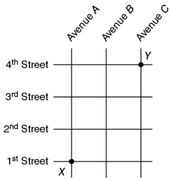

Pat will walk from intersection X to intersection Y along a route that is confined to the square grid of four streets and three avenues shown in the map above. How many routes from X to Y can Pat take that have the minimum possible length?

A. Six
B. Eight
C. Ten
D. Fourteen
E. Sixteen


OA C

Let V denote a step in the vertical direction and H denote a step in the horizontal direction. For instance, V-V-V-H-H denotes the path of walking along Avenue A until the intersection of 4th street and walking along 4th street until the point Y. Similarly, V-H-V-H-V denotes the path of walking along Avenue A, then walking along 2st street, then walking along Avenue B, then walking along 3rd street and finally walking along Avenue C to reach point Y.

We notice that a shortest path between point X and Y must include three V and two H. Further, any arrangement of three V's and two H's i.e. any arrangement of the letters V-V-V-H-H gives us a shortest path between X and Y. Using permutations with indistinguishable objects formula, we see that there are 5!/(3!*2!) = (5 x 4)/2 = 10 such arrangements. Thus, there are 10 shortest paths between points X and Y.

Answer: C

Source: Official Guide

Scott Woodbury-Stewart
Founder and CEO
[email protected]

Image

See why Target Test Prep is rated 5 out of 5 stars on BEAT the GMAT. Read our reviews

ImageImage
Join the discussion

by Brent@GMATPrepNow » Wed Dec 11, 2019 7:12 am
BTGmoderatorDC wrote:Image


Pat will walk from intersection X to intersection Y along a route that is confined to the square grid of four streets and three avenues shown in the map above. How many routes from X to Y can Pat take that have the minimum possible length?

A. Six
B. Eight
C. Ten
D. Fourteen
E. Sixteen


OA C

Source: Official Guide
If we define Pat's path in a block-by-block manner, we can see that any route from X to Y will consist of 3 UPS and 2 RIGHTS.
So for example, if we let U represent walking one block UP, and let R represent walking one block RIGHT, one possible path is URURU.
Another possible path is UUURR
Another possible path is UURUR

So our question becomes, "In how many different ways can we arrange 3 U's and 2 R's?"

-----------ASIDE-----------------
When we want to arrange a group of items in which some of the items are identical, we can use something called the MISSISSIPPI rule. It goes like this:

If there are n objects where A of them are alike, another B of them are alike, another C of them are alike, and so on, then the total number of possible arrangements = n!/[(A!)(B!)(C!)....]

So, for example, we can calculate the number of arrangements of the letters in MISSISSIPPI as follows:
There are 11 letters in total
There are 4 identical I's
There are 4 identical S's
There are 2 identical P's
So, the total number of possible arrangements = 11!/[(4!)(4!)(2!)]
---------------------------------

Now let's apply the MISSISSIPPI rule to arranging 3 U's and 2 R's
There are 5 letters in total
There are 3 identical U's
There are 2 identical R's
So, the total number of possible arrangements = 5!/[(3!)(2!)] = 10

Answer: C

Cheers,
Brent
Brent Hanneson - Creator of GMATPrepNow.com
Image
Join the discussion




















