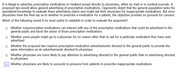
It is illegal to advertise prescription medications in Hedland except directly to physicians, either by mail or in medical journals. A proposed law would allow general advertising of prescription medications. Opponents object that the general population lacks the specialized knowledge to evaluate such advertisements and might ask their physicians for inappropriate medications. But since physicians have the final say as to whether to prescribe a medication for a patient, inappropriate prescriptions would not become more common.
Which of the following would it be most useful to establish in order to evaluate the argument?
Conclusion: Because PHYSICIANS DECIDE whether to prescribe medications, ADVERTISING TO PATIENTS cannot cause inappropriate prescriptions to become more common.
Assumption: That PATIENTS do not affect what PHYSICIANS DECIDE.
Rephrase the answer choices as STATEMENTS.
Rephrased as a statement, the correct answer choice will either STRENGTHEN or WEAKEN the assumption.
E, rephrased as a statement:
PHYSICIANS WILL GIVE IN TO A PATIENT'S DEMAND for a prescription medication chosen by the patient when the one originally prescribed by the physician fails to perform as desired.
Implication:
PATIENTS DO AFFECT what PHYSICIANS DECIDE, weakening the conclusion that advertising to patients cannot cause inappropriate prescriptions to become more common.
The correct answer is
E.
Private tutor exclusively for the GMAT and GRE, with over 20 years of experience.
Followed here and elsewhere by over 1900 test-takers.
I have worked with students based in the US, Australia, Taiwan, China, Tajikistan, Kuwait, Saudi Arabia -- a long list of countries.
My students have been admitted to HBS, CBS, Tuck, Yale, Stern, Fuqua -- a long list of top programs.
As a tutor, I don't simply teach you how I would approach problems.
I unlock the best way for YOU to solve problems.
For more information, please email me (Mitch Hunt) at
[email protected].
Student Review #1
Student Review #2
Student Review #3