BREAKING: Target Test Prep releases Brand New 2026 On Demand GMAT prep course

Redeem

Target Test Prep · GMAT

Choose how you want to prepare

Learn live with an expert or move at your own pace. Every option includes the complete TTP study system.

★★★★★5.0559 reviews
GMATLiveTeach 7 seats left
Chris Peckover
NEXT LIVE COHORT

Oct 13 to Jan 7, 2027

with Chris Peckover

Schedule
Tue, Thu · 8:00 to 10:00 PM ET
Included
40 live hours + 6 months of GMAT OnDemand
  • Live instruction and real-time questions
  • Class recordings and assigned practice
View class & enroll
Limited cohort · enrollment openTarget Test Prep
EALiveTeach 5 seats left
Logan Thompson
EXECUTIVE ASSESSMENT

Sep 6 to Dec 6, 2026

with Logan Thompson

Schedule
Sun · 9:30 AM to 12:30 PM ET
Included
Live EA class + 6 months of EA OnDemand
  • Expert-led weekly online sessions
  • EA Masterclass access between classes
View EA class & enroll
Limited cohort · enrollment openTarget Test Prep
GMATOnDemand Start anytime
SELF-PACED MASTERCLASS

Target Test Prep GMAT OnDemand

Complete access from day one. Study on your schedule.

130-point score guarantee
$0to start then $127/mo
  • Personalized study plan and analytics
  • Thousands of lessons and practice questions

Compare the format, schedule, and included access before enrolling. Prices and seat counts shown reflect the supplied offer details.

OG 2017 Online Two Part Analysis Problem

Data Sufficiency, Multi-Source Reasoning, Table Analysis, Graphics Interpretation, Two-Part Analysis
Expert replies
by jloock524 » Tue Jun 27, 2017 12:15 pm
attached is an IR Two Part Analysis question; sequencing is the topic. Please explain how to complete this problem. I am having trouble understanding the explanation the OG gives.

Thank you
Attachments
GMAT question.PNG
Join the discussion
Source: — Data Insights |

by ceilidh.erickson » Tue Jul 04, 2017 9:50 am
Here, we can translate the sequence notation Image
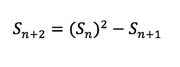
as the following:
For any given nth term (Sn), the value of the term two places above it (S(n+2)) will be equal to the nth term squared minus the value of the term one above the nth term (S(n-1)).

Or in other words...
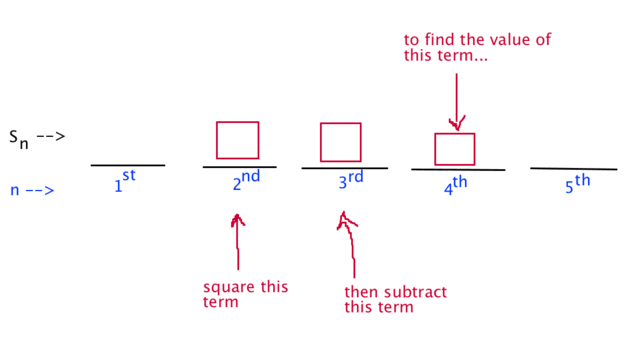
Image

Since S4 depends on knowing the values of both S2 and S3, and S3 depends on knowing the values of S1 and S2, let's begin by testing the possible given values of S1:
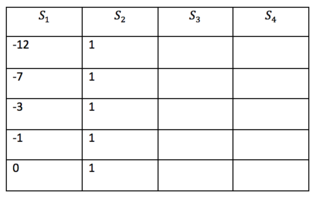
Image

Now, generate the value of S3 for each by squaring S1 then subtracting S2:
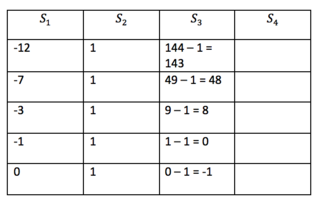
Image

Now, generate S4 for each by squaring S2 then subtracting S3:
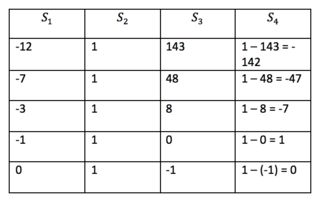
Image

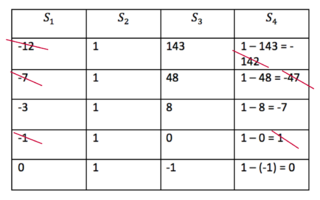
Now we need to find a value for S1 that would have a matching value for S4.
Image

Since -142, -47, and 1 are not options for S4, eliminate -12, -7, and -1 as options for S1. S4 = 0 is an option... but we're told to select 2 different values, so this must not be the answer.
The only valid match is:
S1 = -3
S4 = -7
Ceilidh Erickson
EdM in Mind, Brain, and Education
Harvard Graduate School of Education

Join the discussion


















