BREAKING: Target Test Prep releases Brand New 2026 On Demand GMAT prep course

Redeem

Target Test Prep · GMAT

Choose how you want to prepare

Learn live with an expert or move at your own pace. Every option includes the complete TTP study system.

★★★★★5.0559 reviews
GMATLiveTeach 7 seats left
Chris Peckover
NEXT LIVE COHORT

Oct 13 to Jan 7, 2027

with Chris Peckover

Schedule
Tue, Thu · 8:00 to 10:00 PM ET
Included
40 live hours + 6 months of GMAT OnDemand
  • Live instruction and real-time questions
  • Class recordings and assigned practice
View class & enroll
Limited cohort · enrollment openTarget Test Prep
EALiveTeach 5 seats left
Logan Thompson
EXECUTIVE ASSESSMENT

Sep 6 to Dec 6, 2026

with Logan Thompson

Schedule
Sun · 9:30 AM to 12:30 PM ET
Included
40 hours of live online classes plus six months of access to the complete TTP EA OnDemand course.
  • 165+ EA Score Guarantee
  • 4,100+ Quant, Verbal, and Integrated Reasoning practice questions
  • 400+ hours of in-depth video lessons
  • 3,000+ step-by-step video solutions
View EA class & enroll
Limited cohort · enrollment openTarget Test Prep
GMATOnDemand Start anytime
SELF-PACED MASTERCLASS

Target Test Prep GMAT OnDemand

Complete access from day one. Study on your schedule.

715+ score guarantee
$0to start then $127/mo
  • Personalized study plan and analytics
  • Thousands of lessons and practice questions

Compare the format, schedule, and included access before enrolling. Prices and seat counts shown reflect the supplied offer details.

beat this if you can!

Expert replies
by sachindia » Thu Feb 28, 2013 6:03 am
If the area of a parallelogram is 100, what is the perimeter of the parallelogram?

1) The base of the parallelogram is 10.
2) One of the angles of the parallelogram is 45 degrees.

OA later! :mrgreen:
Regards,
Sach
Join the discussion
Source: — Data Sufficiency |

by Brent@GMATPrepNow » Thu Feb 28, 2013 7:22 am
sachindia wrote:If the area of a parallelogram is 100, what is the perimeter of the parallelogram?

1) The base of the parallelogram is 10.
2) One of the angles of the parallelogram is 45 degrees.

OA later! :mrgreen:
Target question: What is the perimeter of the parallelogram?

Given: The area is 100

Statement 1: The base of the parallelogram is 10.
Since the area of a parallelogram = (base)(height), we now know that the height of the parallelogram is 10.
Does this provide enough information to find the perimeter?
No.
It could be the case that the parallelogram is a square . . .
Image
. . . in which case the perimeter is 40

Or it could be the case that the parallelogram is not a square . . .
Image
. . . in which case the perimeter is not 40

Since we cannot answer the target question with certainty, statement 1 is NOT SUFFICIENT


Statement 2: One of the angles of the parallelogram is 45 degrees.
Edited to reflect Anurag's comments below
Let's let the length of the base = x
If the area of the parallelogram is 100 (and the base has length x), then the height must must be 100/x
So, at this point, we know that our parallelogram looks something like this:
Image

Now, notice that we can extend two sides to get a convenient 45-45-90 triangle:
Image

Since we have the lengths of 2 sides of this special right triangle, we can find the length of the 3rd side:
Image

Since the opposite sides of a parallelogram have equal lengths, the perimeter = x + x + (sqrt2)(100/x) + (sqrt2)(100/x)

As you can see, the perimeter of the parallelogram will fluctuate, depending on the value of x.
As such, statement 2 is NOT SUFFICIENT

Statements 1 and 2 combined:
From statement 2, we know that the perimeter = x + x + (sqrt2)(100/x) + (sqrt2)(100/x)
From statement 1, we know that x = 10
So, we can plug x=10 into our formula to find the perimeter.
As such, the combined statements are SUFFICIENT

Answer = C

Cheers,
Brent
Last edited by Brent@GMATPrepNow on Thu Feb 28, 2013 9:59 am, edited 2 times in total.
Brent Hanneson - Creator of GMATPrepNow.com
Image
Join the discussion

by Anurag@Gurome » Thu Feb 28, 2013 9:23 am
Brent@GMATPrepNow wrote:There is an infinite number of parallelograms with these angle measurements (45-45-135-135). There are super small parallelograms and super huge parallelograms .
IMPORTANT: Each time you make one of these parallelograms bigger or smaller, the area gets bigger or smaller. So, there's only one parallelogram in the universe (with angles 45, 45, 135, 135) that has an area of 100.
I'd disagree here.
There will be infinite parallelograms in the universe (with angles 45, 45, 135, 135) that has an area of 100. Without going into mathematical details, one can visualize that once we get one such parallelogram we can slightly "squeeze" it to change the length of the sides without changing the area. For example, in the following figure both parallelograms are with angles (45, 135, 45, 135) but they may have same area.
Image

Now the mathematical proof,
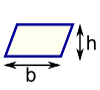
Area of parallelogram is given by (base*height), where base and height are defined as follows...
Image

Now, b*h = 100
Assume in the first case, b = h = 10 and in the second case b = 5 and h = 20
So we have two different parallelograms with angles (45, 135, 45, 135) and area 100.

<-- Not relevant to GMAT discussion starts -->
A more methodical proof**,
Are of a parallelogram is given by ab*sin(θ), where a and b are the length of the consecutive sides and θ is the angle between them. Here, θ = 45 degrees. Hence, sin(θ) = 1/√2

Hence, ab = 100√2
Obviously the perimeter of the parallelogram = 2(a + b) can have infinite values NOT any single one.
For example,
  • a = 100, b = √2 ---> 2(a + b) = 2(100 + √2)
    a = 50, b = 10√2 ---> 2(a + b) = 2(50 + 10√2)
**This is not required for GMAT. The first method is sufficient to show the insufficiency of statement 2. This is just to clarify the situation in a more generic way.
<-- Not relevant to GMAT discussion ends -->
Anurag Mairal, Ph.D., MBA
GMAT Expert, Admissions and Career Guidance
Gurome, Inc.
1-800-566-4043 (USA)

Join Our Facebook Groups
GMAT with Gurome
https://www.facebook.com/groups/272466352793633/
Admissions with Gurome
https://www.facebook.com/groups/461459690536574/
Career Advising with Gurome
https://www.facebook.com/groups/360435787349781/
Join the discussion

by Brent@GMATPrepNow » Thu Feb 28, 2013 9:30 am
Argh! You're absolutely right Anurag!
My bad.
I drew ONE 45-45-135-135 parallelogram and based everything else on that ONE parallelogram.
Yeesh!

I've edited my response accordingly.

Cheers,
Brent

Brent Hanneson - Creator of GMATPrepNow.com
Image
Join the discussion