Veritas Prep CAT question

This topic has expert replies
Newbie | Next Rank: 10 Posts
Posts: 3
Joined: Fri Oct 24, 2014 10:05 am

Veritas Prep CAT question

by cfleck » Sat Feb 07, 2015 1:35 pm
I took a Veritas Practice CAT today, and while reviewing the math portion, one of the explanations isn't quite resonating with me. Maybe someone can explain it in other terms so it "clicks"?

"At an elite baseball camp, 60% of players can bat both right-handed and left-handed. If 25% of the players who bat left-handed do not bat right-handed, what is the probability that a player selected at random does not bat left-handed?"

A 15%
B 20%
C 25%
D 30%
E 40%

The answer is B.

Thanks!!
Source: — Problem Solving |

User avatar
GMAT Instructor
Posts: 15539
Joined: Tue May 25, 2010 12:04 pm
Location: New York, NY
Thanked: 13060 times
Followed by:1906 members
GMAT Score:790

by GMATGuruNY » Sat Feb 07, 2015 1:56 pm
cfleck wrote: "At an elite baseball camp, 60% of players can bat both right-handed and left-handed. If 25% of the players who bat left-handed do not bat right-handed, what is the probability that a player selected at random does not bat left-handed?"

A 15%
B 20%
C 25%
D 30%
E 40%
Si]25% of the players who bat left-handed do not bat right-handed[/i].
Implication:
75% of the players who bat left-handed DO also bat right-handed.

We can PLUG IN THE ANSWERS, which represent the percentage who do NOT bat left-handed.
When the correct answer choice is plugged in, the percentage who bat both left-handed and right-handed = 60%.

Answer choice D: 30%
Since 30% do not bat left-handed, 70% do bat left-handed.
Since 75% of the players who bat left-handed also bat right-handed, the percentage who bat both left-handed and right-handed = (3/4)(70) = 52.5%.
Doesn't work.
Eliminate D.

Answer choice B: 20%
Since 20% do not bat left-handed, 80% do bat left-handed.
Since 75% of the players who bat left-handed also bat right-handed, the percentage who bat both left-handed and right-handed = (3/4)(80) = 60%.
Success!

The correct answer is B.
Private tutor exclusively for the GMAT and GRE, with over 20 years of experience.
Followed here and elsewhere by over 1900 test-takers.
I have worked with students based in the US, Australia, Taiwan, China, Tajikistan, Kuwait, Saudi Arabia -- a long list of countries.
My students have been admitted to HBS, CBS, Tuck, Yale, Stern, Fuqua -- a long list of top programs.

As a tutor, I don't simply teach you how I would approach problems.
I unlock the best way for YOU to solve problems.

For more information, please email me (Mitch Hunt) at [email protected].
Student Review #1
Student Review #2
Student Review #3

GMAT/MBA Expert

User avatar
GMAT Instructor
Posts: 16207
Joined: Mon Dec 08, 2008 6:26 pm
Location: Vancouver, BC
Thanked: 5254 times
Followed by:1268 members
GMAT Score:770

by Brent@GMATPrepNow » Sat Feb 07, 2015 2:39 pm
cfleck wrote:At an elite baseball camp, 60% of players can bat both right-handed and left-handed. If 25% of the players who bat left-handed do not bat right-handed, what is the probability that a player selected at random does not bat left-handed?"

A 15%
B 20%
C 25%
D 30%
E 40%
Here's another way to set up the Double Matrix.

The Double Matrix Method can be used for most questions featuring a population in which each member has two characteristics associated with it.
Here, we have a population of baseball players, and the two characteristics are:
- bats left-handed or DOESN'T bat left-handed
- bats right-handed or DOESN'T bat right-handed

NOTICE that the question does not ask us to find an actual number. It asks us to find a probability. This means we can assign whatever value we wish to the total number of couples.
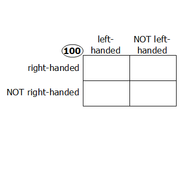
So, let's say there are 100 players, which we'll add to our diagram:
Image

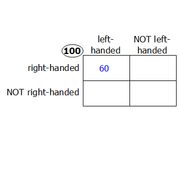
60% of players can bat both right-handed and left-handed
60% of 100 = 60, so 60 players can bat both right-handed AND left-handed .
Add that to the diagram to get:
Image

25% of the players who bat left-handed do not bat right-handed
Hmmm, we don't know the number of left-handed players, so we can't find 25% of that value.
So, let's assign a variable.
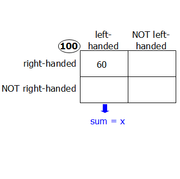
Let's let x = left-handed batters, and add it to our diagram:
Image
So, x of the 100 players bat left handed.

25% of the players who bat left-handed do not bat right-handed
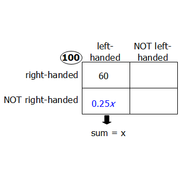
If x players bat left-handed, then 25% of x do not bat right-handed.
In other words, 0.25x = number of players who do not bat right-handed
Add this to our diagram:
Image

At this point, we see that the two left-hand boxes add to x.
So, we can write the equation: 60 + 0.25x = x
Rearrange to get 60 = 0.75x
Rewrite 0.75 as fraction to get: 60 = (3/4)x
Multiply both sides by 4/3 to get: 80 = x
If x = 80, then we know that 80 of the 100 players bat left-handed.
This means that the remaining 20 players DO NOT bat left handed.
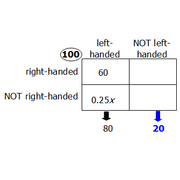
Image

So, P(player doesn't bat left-handed) = 20/100 = [spoiler]20%[/spoiler] = B


---------------------------------------------------------

NOTE: this question type is VERY COMMON on the GMAT, so be sure to master the technique.

To learn more about the Double Matrix Method, watch our free video: https://www.gmatprepnow.com/module/gmat- ... ems?id=919

Once you're familiar with this technique, you can attempt these additional practice questions:

Easy Problem Solving questions
- https://www.beatthegmat.com/the-aam-aadm ... 72242.html
- https://www.beatthegmat.com/finance-majo ... 67425.html

Medium Problem Solving questions
- https://www.beatthegmat.com/probability- ... 73360.html
- https://www.beatthegmat.com/posted-speed ... 72374.html
- https://www.beatthegmat.com/motel-t271938.html
- https://www.beatthegmat.com/of-the-appli ... 70255.html
- https://www.beatthegmat.com/opening-nigh ... 64869.html
- https://www.beatthegmat.com/ds-french-ja ... 22297.html
- https://www.beatthegmat.com/prblem-solving-t279424.html

Difficult Problem Solving questions
- https://www.beatthegmat.com/ratio-problem-t268339.html
- https://www.beatthegmat.com/overlapping- ... 65223.html
- https://www.beatthegmat.com/fractions-t264254.html
- https://www.beatthegmat.com/overlapping- ... 64092.html
- https://www.beatthegmat.com/mba/2011/05/ ... question-2

Easy Data Sufficiency questions
- https://www.beatthegmat.com/for-what-per ... 70596.html
- https://www.beatthegmat.com/ds-quest-t187706.html

Medium Data Sufficiency questions
- https://www.beatthegmat.com/sets-matrix-ds-t271914.html
- https://www.beatthegmat.com/each-of-peop ... 71375.html
- https://www.beatthegmat.com/a-manufacturer-t270331.html
- https://www.beatthegmat.com/in-costume-f ... 69355.html
- https://www.beatthegmat.com/mba/2011/05/ ... question-1

Difficult Data Sufficiency questions
- https://www.beatthegmat.com/double-set-m ... 71423.html
- https://www.beatthegmat.com/sets-t269449.html
- https://www.beatthegmat.com/mba/2011/05/ ... question-3

Cheers,
Brent
Brent Hanneson - Creator of GMATPrepNow.com
Image

GMAT/MBA Expert

User avatar
Elite Legendary Member
Posts: 10392
Joined: Sun Jun 23, 2013 6:38 pm
Location: Palo Alto, CA
Thanked: 2867 times
Followed by:511 members
GMAT Score:800

by [email protected] » Sat Feb 07, 2015 7:36 pm
Hi cfleck,

This question can be considered an Overlapping Sets question (and solved with the Tic-Tac-Toe Board), but you don't need to organize your information in that way to get to the correct answer.

The key to this question is in realizing that some Left-handed batters ALSO bat with their Right-hands. Here's how you can answer the question by TESTing VALUES:

To start, let's choose 100 for the TOTAL number of players:

60% can bat with BOTH hands = 60 players

**Note: the TOTAL number of players who can bat with their LEFT hands include these 60 players AND the players who can bat with the Left hands ONLY.**

Next, we're told that 25% of players who can bat with their LEFT hands DO NOT bat with their Right hands.

X = Total who can bat Left-handed
25% of X DO NOT use their Right hands
75% of X CAN ALSO use their Right hands

Early on, we had 60 players who could bat with BOTH hands; THAT group is the 75% mentioned above...

.75X = 60
X = 80

There are 80 players who are Left-handed (20 are JUST Left-handed; 60 can bat with BOTH hands).

We're asked for the probability of randomly selecting a NON-Left-handed player.

Total = 100
NON-Left-handed = 20

20/100 = 20%

Final Answer: B

GMAT assassins aren't born, they're made,
Rich
Contact Rich at [email protected]
Image

GMAT Instructor
Posts: 2630
Joined: Wed Sep 12, 2012 3:32 pm
Location: East Bay all the way
Thanked: 625 times
Followed by:119 members
GMAT Score:780

by Matt@VeritasPrep » Sun Feb 08, 2015 10:12 pm
Here's another approach. Suppose x% of the players bat left-handed. We know 25% of x CANNOT bat right-handed, so 75% of x CAN bat right-handed. So 75% of x% can bat left and right.

But we were told before that 60% of hitters can bat left and right, so

60% = 75% of x%, so x% = 80%.

That means 80% of the hitters CAN bat left-handed in some fashion, which means everyone else (the other 20%) CANNOT bat left-handed, and we're done!



















