Matrix!
Let's start by inserting all the info we're given in the question stem. We know 30% of those who passed the written test did not pass the practical. So we'll call the number who passed the written 'w,' which means .3w passed the written, but did not pass the practical. Consequently, if 30% of those who passed the written failed the practical, 70% of those who passed the written, passed the practical as well. Call that cell .7w. We want to know how many students passed both tests, so we're looking for 7w. Put another way, if we have 'w' we have sufficiency. (Also, we know that no one failed both tests, so we can insert 0 into that cell.) This gives us the following matrix:

S1: This gives us the total students. Our table now looks like this:

No way this gives us w. Not Sufficient
S2: Let's call the total who passed the practical 'p.' If 20% of those failed the written test, we can designate the Passed Practical/Failed Written as .2p. And then we know that 80% of those who passed the practical, also passed the written. So let's call that .8p. (Notice this is the same cell that we've already designated as .7w, so those quantities are equal.) Now we have this:
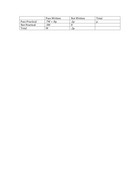
Well, we know that .7w = .8p, but there's still no way to solve for w or p. Not Sufficient.
Together, we'll have the following matrix:
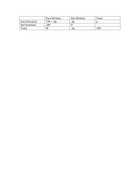
Now we have .7w = .8p. But if we add the bottom row, we'd also have w + .2p = 188; 2 linear equations/2 variables, so sufficient. (Anytime we have at least as many unique linear equations as we have variables, we know that we can solve for all the variables without actually doing so.) Answer is
C























