BTGModeratorVI wrote: ↑Thu Jun 18, 2020 5:56 am
At an elite baseball camp, 60% of players can bat both right-handed and left-handed. If 25% of the players who bat left-handed do not bat right-handed, what is the probability that a player selected at random does not bat left-handed?
A.15%
B. 20%
C. 25%
D. 30%
E. 40%
Answer:
B
Source: Veritas Prep
We can solve using the
Double Matrix Method.
The Double Matrix Method can be used for most questions featuring a population in which each member has two characteristics associated with it.
Here, we have a population of baseball players, and the two characteristics are:
- bats left-handed or DOESN'T bat left-handed
- bats right-handed or DOESN'T bat right-handed
NOTICE that the question does
not ask us to find an actual number. It asks us to find a
probability. This means we can assign whatever value we wish to the total number of couples.
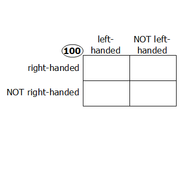
So, let's say there are
100 players, which we'll add to our diagram:
 60% of players can bat both right-handed and left-handed
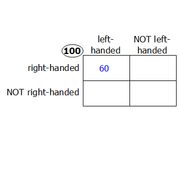
60% of 100 = 60, so 60 players can bat both right-handed AND left-handed .
Add that to the diagram to get:
 25% of the players who bat left-handed do not bat right-handed
Hmmm, we don't know the number of left-handed players, so we can't find 25% of that value.
So, let's assign a variable.
Let's let x = left-handed batters, and add it to our diagram:
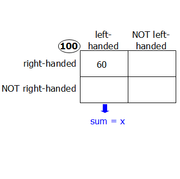
So, x of the 100 players bat left handed.
25% of the players who bat left-handed do not bat right-handed
If x players bat left-handed, then 25% of x do not bat right-handed.
In other words, 0.25x = number of players who do not bat right-handed
Add this to our diagram:
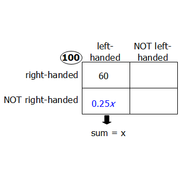
At this point, we see that the two left-hand boxes add to x.
So, we can write the equation: 60 + 0.25x = x
Rearrange to get 60 = 0.75x
Rewrite 0.75 as fraction to get: 60 = (3/4)x
Multiply both sides by 4/3 to get: 80 = x
If x = 80, then we know that 80 of the 100 players bat left-handed.
This means that the remaining
20 players DO NOT bat left handed.
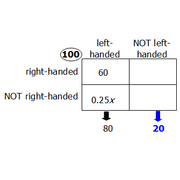
So, P(player doesn't bat left-handed) =
20/100 = 20%
Answer: B
Aside: We can also use Venn diagrams and formulae to solve overlapping sets questions. However, as difficulty levels increase, it becomes harder to apply those other approaches, whereas the Double Matrix Method works every time.
------------------------
NOTE: This question type is
VERY COMMON on the GMAT, so be sure to master the technique.
To learn more about the Double Matrix Method, watch this video:
https://www.gmatprepnow.com/module/gmat- ... ems?id=919
Once you’re familiar with this technique, you can attempt these additional practice questions:
Easy Problem Solving questions
-
https://www.beatthegmat.com/finance-majo ... 67425.html
Medium Problem Solving questions
-
https://www.gmatprepnow.com/module/gmat- ... /video/920
-
https://www.beatthegmat.com/posted-speed ... 72374.html
-
https://www.beatthegmat.com/motel-t271938.html
-
https://www.beatthegmat.com/of-the-appli ... 70255.html
-
https://www.beatthegmat.com/opening-nigh ... 64869.html
-
https://www.beatthegmat.com/at-least-100 ... 74669.html
-
https://www.beatthegmat.com/prblem-solving-t279424.html
Difficult Problem Solving questions
-
https://www.gmatprepnow.com/module/gmat- ... /video/946
-
https://www.beatthegmat.com/ratio-problem-t268339.html
-
https://www.beatthegmat.com/overlapping- ... 65223.html
-
https://www.beatthegmat.com/fractions-t264254.html
-
https://www.beatthegmat.com/overlapping- ... 64092.html
-
https://www.beatthegmat.com/mba/2011/05/ ... question-2
Easy Data Sufficiency questions
-
https://www.gmatprepnow.com/module/gmat- ... /video/943
-
https://www.beatthegmat.com/for-what-per ... 70596.html
-
https://www.beatthegmat.com/ds-quest-t187706.html
Medium Data Sufficiency questions
-
https://www.beatthegmat.com/sets-matrix-ds-t271914.html
-
https://www.beatthegmat.com/each-of-peop ... 71375.html
-
https://www.beatthegmat.com/a-manufacturer-t270331.html
-
https://www.beatthegmat.com/in-costume-f ... 69355.html
-
https://www.beatthegmat.com/mba/2011/05/ ... question-1
Difficult Data Sufficiency questions
-
https://youtu.be/dsCeqF9Kbk8
-
https://www.beatthegmat.com/double-set-m ... 71423.html
-
https://youtu.be/dOZ9KM1m5Hs
-
https://www.beatthegmat.com/sets-t269449.html
-
https://www.beatthegmat.com/mba/2011/05/ ... question-3
Cheers,
Brent


























