Multi Dimension Overlapping Sets

Problem Solving — algebra and arithmetic (GMAT Focus Edition)
This topic has expert replies
Master | Next Rank: 500 Posts
Posts: 233
Joined: Wed Aug 22, 2007 3:51 pm
Location: New York
Thanked: 7 times
Followed by:2 members

Multi Dimension Overlapping Sets

by yellowho » Thu Jan 27, 2011 3:02 am
Anyone know a good way to keep track of overlapping sets with 3 dimensions or more? I usually use the grid for 2 items. The info. on 3 dimensional overlapping sets can be cubersome to handle. Just wondering what the experts are doing.
Source: — Quantitative Reasoning |

User avatar
Legendary Member
Posts: 1255
Joined: Fri Nov 07, 2008 2:08 pm
Location: St. Louis
Thanked: 312 times
Followed by:90 members

by Tani » Sat Jan 29, 2011 2:01 pm
I use the formula G1 + G2 + G3 - G12 - G13 - G23 - 2*G123 + N = T

group 1 + group 2 + group 3 minus (those in both 1 and 2) minus (those in both 1 and 3) minus (those in both 2 and 3) minus twice (those in all three groups) plus those not in any group = total
Tani Wolff

Master | Next Rank: 500 Posts
Posts: 233
Joined: Wed Aug 22, 2007 3:51 pm
Location: New York
Thanked: 7 times
Followed by:2 members

by yellowho » Sat Jan 29, 2011 9:21 pm
Hi Tania. I was being confusing. What I was referring to is 3 dimensions of something example:

In a class 40% are Male 60% Female, 20% of Male and 50% of female take calculus. Of the people who takes calculus 15% got higher than a B.

So the matrix would be: 1) M/F vs Calculus/Not Calculus 2) Higher than B/Not HIgher vs M/F 3) M/F vs Higher than B/Not higher than B.

I've seen these types of problem quite a bit during practice just wondering how people are handling them.


NOTE: That problem is totally made up.


[quote="Tani Wolff - Kaplan"]I use the formula G1 + G2 + G3 - G12 - G13 - G23 - 2*G123 + N = T

group 1 + group 2 + group 3 minus (those in both 1 and 2) minus (those in both 1 and 3) minus (those in both 2 and 3) minus twice (those in all three groups) plus those not in any group = total[/quote]

User avatar
GMAT Instructor
Posts: 132
Joined: Mon Jan 10, 2011 12:26 pm
Location: New York City
Thanked: 68 times
Followed by:37 members
GMAT Score:780

by Adam@Knewton » Sun Jan 30, 2011 10:51 pm
yellowho wrote:Anyone know a good way to keep track of overlapping sets with 3 dimensions or more? I usually use the grid for 2 items. The info. on 3 dimensional overlapping sets can be cubersome to handle. Just wondering what the experts are doing.
First of all, Tani's formula is correct, but can be confusing. To handle overlapping sets questions with 3 groups, I highly recommend drawing a Venn Diagram -- in fact, although the grid method works for 2-group problems, I recommend being comfortable with the Venn Diagram so that you can be sure to handle whatever strange info they throw your way. Here's what it looks like for 3 groups:

Image

Here, each variable stands for what's in that area only, so there is no need for any subtraction. "A" means "Only group 1, not the other groups"; "D" means "Groups 1 and 3, not group 2," etc. This way you can keep track of any info they give you, even if it's strange.

Hope that helps!
Prep Smarter, Score Higher
www.knewton.com

User avatar
GMAT Instructor
Posts: 1035
Joined: Fri Dec 17, 2010 11:13 am
Location: Los Angeles, CA
Thanked: 474 times
Followed by:365 members

by VivianKerr » Fri Feb 04, 2011 11:25 am
Adam is right on - sometimes making a Venn diagram is the easiest way to solve. It gives you a nice visual way of sorting the data.

Just for fun, here is how we would arrange the data for Male/Female/Calculus. Obviously, this is a bit silly since we know there no one can be male AND female, or neither male NOR female. :) But you'll get the idea of how to sort 3 categories:

Image

The key to these is knowing that the TOTAL for each category lies on the outside of the circle, so all 3 elements within each circle must add to that total.

Good luck with these!
Vivian Kerr
GMAT Rockstar, Tutor
https://www.GMATrockstar.com
https://www.yelp.com/biz/gmat-rockstar-los-angeles

Former Kaplan and Grockit instructor, freelance GMAT content creator, now offering affordable, effective, Skype-tutoring for the GMAT at $150/hr. Contact: [email protected]

Thank you for all the "thanks" and "follows"! :-)

GMAT/MBA Expert

User avatar
GMAT Instructor
Posts: 273
Joined: Tue Sep 21, 2010 5:37 am
Location: Durham, NC
Thanked: 154 times
Followed by:74 members
GMAT Score:770

by Whitney Garner » Mon Feb 07, 2011 2:14 pm
yellowho wrote:Hi Tania. I was being confusing. What I was referring to is 3 dimensions of something example:

In a class 40% are Male 60% Female, 20% of Male and 50% of female take calculus. Of the people who takes calculus 15% got higher than a B.

So the matrix would be: 1) M/F vs Calculus/Not Calculus 2) Higher than B/Not HIgher vs M/F 3) M/F vs Higher than B/Not higher than B.

I've seen these types of problem quite a bit during practice just wondering how people are handling them.
Although I completely agree that the Venn Diagram approach is wonderful when people can belong to any of 3 groups (think students who can take French, Spanish or German and any mix of the 3), that actually doesn't work with the problem you have outlined above. What you have outlined is less of a grouping and more of a layering (within the class there are boys and girls, then within those groups are calc and non-calc students, and then within the calc are B+ and less than Bs).

One of the best methods to deal with a problem that has more than 2 "layers" is to build a tree. So let me edit your question a bit to offer something that we can compute:

In a certain class, 40% of the students are Male and 60% are Female. 1/4 of Male students and 1/3 of female take calculus. If 2/3 of all students taking calculus score a B or better, and 40% of Males in Calculus scored less than a B, then approximately what percent of Female students scored a B or better in their calculus class?

A 5%
B 10%
C 15%
D 20%
E 30%

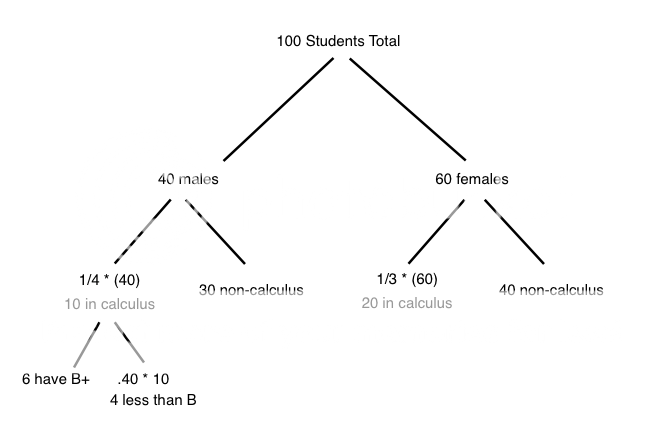
So we can draw the following tree (picking a simple 100 for the total percent):

Image

Once we fill out our Tree, we can read that 6 males scored a B or greater. But we are told that 2/3 of students taking calculus score Bs or better. Using the tree, we see that 10 boys and 20 girls take calculus. This means 30 total calculus students. Of these, 2/3 or 20 score a B or better. We have accounted for 6 or those with the boys, so the girls will have to make up the other 14. Now to answer we need the following ratio:

Females scoring a B or better in Calc / Total Females = 14/60 = 7/30 = .23333 = approx 20%. The answer is B.

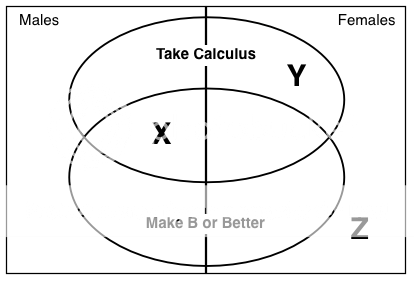
Just for completeness, the following would be the "Venn" Diagram needed to show the information you provided:

Image

Where X would be males who take calc AND get a B or better, Y would be females who take calc but get less than a B, and Z would be females who do not take Calc and do not get a B (in whatever it is they do take).

And note that this Venn Diagram:
Image

Does not include information pertaining to the grades of students so would not help us solve. In fact, it would be better collapsed to 2 mutually exclusive groups (Male/Female and Calc/NoCalc) and put into an overlapping sets matrix (table).

Tricky question but VERY interesting to think about - Great Post!!

:D
Whit
Whitney Garner
GMAT/GRE/EA Instructor & Anxiety/Accommodations Coach
www.whitneygarner.com

Contributor to Beat The GMAT!

Math is a lot like love - a simple idea that can easily get complicated :heart-eyes:

Master | Next Rank: 500 Posts
Posts: 233
Joined: Wed Aug 22, 2007 3:51 pm
Location: New York
Thanked: 7 times
Followed by:2 members

by yellowho » Fri Feb 11, 2011 5:48 pm
Actually thats a good point. I think all of these methods work (including matrix) but identifying the best method is key. Whitney, do you have any tips on how to identify problems as "layered" problem?

[quote="Whitney Garner"][quote="yellowho"]Hi Tania. I was being confusing. What I was referring to is 3 dimensions of something example:

In a class 40% are Male 60% Female, 20% of Male and 50% of female take calculus. Of the people who takes calculus 15% got higher than a B.

So the matrix would be: 1) M/F vs Calculus/Not Calculus 2) Higher than B/Not HIgher vs M/F 3) M/F vs Higher than B/Not higher than B.

I've seen these types of problem quite a bit during practice just wondering how people are handling them.
[/quote]

Although I completely agree that the Venn Diagram approach is wonderful when people can belong to any of 3 groups (think students who can take French, Spanish or German and any mix of the 3), that actually doesn't work with the problem you have outlined above. What you have outlined is less of a grouping and more of a layering (within the class there are boys and girls, then within those groups are calc and non-calc students, and then within the calc are B+ and less than Bs).

One of the best methods to deal with a problem that has more than 2 "layers" is to build a tree. So let me edit your question a bit to offer something that we can compute:

In a certain class, 40% of the students are Male and 60% are Female. 1/4 of Male students and 1/3 of female take calculus. If 2/3 of all students taking calculus score a B or better, and 40% of Males in Calculus scored less than a B, then approximately what percent of Female students scored a B or better in their calculus class?

A 5%
B 10%
C 15%
D 20%
E 30%

So we can draw the following tree (picking a simple 100 for the total percent):

[img]https://i1200.photobucket.com/albums/bb3 ... 5340PM.png[/img]

Once we fill out our Tree, we can read that 6 males scored a B or greater. But we are told that 2/3 of students taking calculus score Bs or better. Using the tree, we see that 10 boys and 20 girls take calculus. This means 30 total calculus students. Of these, 2/3 or 20 score a B or better. We have accounted for 6 or those with the boys, so the girls will have to make up the other 14. Now to answer we need the following ratio:

Females scoring a B or better in Calc / Total Females = 14/60 = 7/30 = .23333 = approx 20%. The answer is B.

Just for completeness, the following would be the "Venn" Diagram needed to show the information you provided:

[img]https://i1200.photobucket.com/albums/bb3 ... 0612PM.png[/img]

Where X would be males who take calc AND get a B or better, Y would be females who take calc but get less than a B, and Z would be females who do not take Calc and do not get a B (in whatever it is they do take).

And note that this Venn Diagram:
[img]https://s3.postimage.org/kb5mhdedl/venn3.jpg[/img]

Does not include information pertaining to the grades of students so would not help us solve. In fact, it would be better collapsed to 2 mutually exclusive groups (Male/Female and Calc/NoCalc) and put into an overlapping sets matrix (table).

Tricky question but VERY interesting to think about - Great Post!!

:D
Whit[/quote]