BREAKING: Target Test Prep releases Brand New 2026 On Demand GMAT prep course

Redeem

Target Test Prep · GMAT

Choose how you want to prepare

Learn live with an expert or move at your own pace. Every option includes the complete TTP study system.

★★★★★5.0559 reviews
GMATLiveTeach 7 seats left
Chris Peckover
NEXT LIVE COHORT

Oct 13 to Jan 7, 2027

with Chris Peckover

Schedule
Tue, Thu · 8:00 to 10:00 PM ET
Included
40 live hours + 6 months of GMAT OnDemand
  • Live instruction and real-time questions
  • Class recordings and assigned practice
View class & enroll
Limited cohort · enrollment openTarget Test Prep
EALiveTeach 5 seats left
Logan Thompson
EXECUTIVE ASSESSMENT

Sep 6 to Dec 6, 2026

with Logan Thompson

Schedule
Sun · 9:30 AM to 12:30 PM ET
Included
40 hours of live online classes plus six months of access to the complete TTP EA OnDemand course.
  • 165+ EA Score Guarantee
  • 4,100+ Quant, Verbal, and Integrated Reasoning practice questions
  • 400+ hours of in-depth video lessons
  • 3,000+ step-by-step video solutions
View EA class & enroll
Limited cohort · enrollment openTarget Test Prep
GMATOnDemand Start anytime
SELF-PACED MASTERCLASS

Target Test Prep GMAT OnDemand

Complete access from day one. Study on your schedule.

715+ score guarantee
$0to start then $127/mo
  • Personalized study plan and analytics
  • Thousands of lessons and practice questions

Compare the format, schedule, and included access before enrolling. Prices and seat counts shown reflect the supplied offer details.

What is the probability that event A occurs?

Expert replies
by gmattesttaker2 » Mon Apr 28, 2014 10:00 pm
Hello,

Can you please assist with this:

Events A and B are independent and have equal probabilities of occurring. What is the probability that event A occurs?

1.The probability that at least one of events A and B occurs is .84.
2.The probability that event B occurs and event A does not is .24.


OA: A


Thanks a lot,
Sri
Join the discussion
Source: — Data Sufficiency |

by vaibhav108 » Sun May 04, 2014 1:02 pm
Hello,

Can you please assist with this:

Events A and B are independent and have equal probabilities of occurring. What is the probability that event A occurs?

1.The probability that at least one of events A and B occurs is .84.
2.The probability that event B occurs and event A does not is .24.


[spoiler]OA: A[/spoiler]


Thanks a lot,
Sri

Given that, P(A) = P(B) and both are independent.

From 1 -
Atleast one of the events occur! That is either A will occur OR B will occur.
P(A) + P(B) = .84 ..... (OR represents Addition)
As, P(A) = P(B)
2P(A) = .84
P(A) = .42
SUFFICIENT

From 2 -
P(B) = .24 ....as A and B are independent.
[spoiler]NOT SUFFICIENT
[/spoiler]
[spoiler]ANSWER : A[/spoiler]
Join the discussion

by [email protected] » Sun May 04, 2014 8:12 pm
Hi Sri,

vaibhav108 made a slight error in his interpretation of this question, but his overall answer is correct.

We're told that events A and B are independent and have EQUAL PROBABILITY of occurring. We're asked for the probability that event A occurs.

Fact 1: The probability that AT LEAST one of the events occurs is .84

This means that A, or B or BOTH occurs = .84

We can restate this to mean that the probability that neither A, nor B nor BOTH occurs = .16

(Not A)(Not B) = .16

Since we're told that A and B have equal probabilities of occurring, they also have equal probabilities of NOT occurring. So....

(Not A) = (Not B)

Combining these 2 equations gives us the probability that A will not occur.....

(.4)(.4) = .16

The probability that A DOES NOT occur = .4
The probability that A DOES occur = .6
Fact 1 is SUFFICIENT

Fact 2: The probability that B occurs and A DOES NOT occur = .24

This tells us that....

(B)(Not A) = .24

From the prompt, we know that...

A = B
(Not A) = (Not B)
A + (Not A) = 1

In this scenario, the values are .4 and .6, but we don't know which is which (one is the probability the event occurs, the other is the probability that the event does NOT occur). Either one COULD be the answer.
Fact 2 is INSUFFICIENT.

Final Answer: A

GMAT assassins aren't born, they're made,
Rich
Contact Rich at [email protected]
Image
Join the discussion

by vaibhav108 » Sun May 04, 2014 11:41 pm
Hi Rich,

Thanks for a great explaination!
vaibhav108 made a slight error in his interpretation of this question, but his overall answer is correct.
I think it was not slight error. It was a major one!

For 1 -
I did not consider the case that both A and B can occur. So P(A).P(B) needs to be considered.
Considering that case, I landed to a quadratic equation x^2-2x+.84=0, which is not that easy to solve. So, I will go with your method.

One quick question here...
We can restate this to mean that the probability that neither A, nor B nor BOTH occurs = .16
Shouldn't this be Probability of both (NOT A) AND (NOT B)? As we need to make sure that BOTH do not occur. Please correct me if I am wrong here...

Once again thank you for pointing out the flaw in my thought process!

-V
Join the discussion

by Matt@VeritasPrep » Mon May 12, 2014 12:24 pm
Here's a succinct approach:

Let's say the probability of A occurring is x. Then the probability of A NOT occurring is (1 - x).

Since A and B have identical probabilities, B's probabilities are also x and (1 - x), respectively.

S1 tells us that

1 - (Probability of Neither A Nor B) = .84

or

1 - (1 - x)² = .84

or

(1 - x)² = .16

or

(1 - x) = .4

Since (1 - x) is the probability of B's NOT occurring, we know the probability of B's occurring is .6, or 60%, and S1 is SUFFICIENT!

S2 tells us that

x * (1 - x) = .24

or

x - x² = .24

or

x² - x + .24 = 0

or

(x - .6)(x - .4) = 0

This gives us TWO distinct, valid solutions for x, so it's INSUFFICIENT.
Join the discussion

by GMATinsight » Tue May 13, 2014 7:24 am
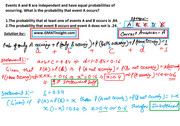
Image
"GMATinsight"Bhoopendra Singh & Sushma Jha
Most Comprehensive and Affordable Video Course 2000+ CONCEPT Videos and Video Solutions
Whatsapp/Mobile: +91-9999687183 l [email protected]
Contact for One-on-One FREE ONLINE DEMO Class Call/e-mail
Most Efficient and affordable One-On-One Private tutoring fee - US$40-50 per hour
Join the discussion