BREAKING: Target Test Prep releases Brand New 2026 On Demand GMAT prep course

Redeem

Target Test Prep · GMAT

Choose how you want to prepare

Learn live with an expert or move at your own pace. Every option includes the complete TTP study system.

★★★★★5.0559 reviews
GMATBootcamp Starts Sep 28
Chris Peckover, Target Test Prep GMAT expert
LIVE ONLINE BOOTCAMP

Live Online Bootcamp Class with Top GMAT Expert Chris Peckover

15 live classes from Sep 28, 2026

Schedule
Mon to Fri · 7:00 to 10:00 PM ET
Included
Live classes + 6 months of TTP OnDemand
  • Boost your GMAT score in less than one month in a live online class
  • 6 months access to TTP OnDemand video courses included
View bootcamp & enroll
Limited cohort · enrollment openTarget Test Prep
EALiveTeach 5 seats left
Logan Thompson
EXECUTIVE ASSESSMENT

Sep 6 to Dec 6, 2026

with Logan Thompson

Schedule
Sun · 9:30 AM to 12:30 PM ET
Included
40 hours of live online classes plus six months of access to the complete TTP EA OnDemand course.
  • 165+ EA Score Guarantee
  • 4,100+ Quant, Verbal, and Integrated Reasoning practice questions
  • 400+ hours of in-depth video lessons
  • 3,000+ step-by-step video solutions
View EA class & enroll
Limited cohort · enrollment openTarget Test Prep
GMATOnDemand Start anytime
SELF-PACED MASTERCLASS

Target Test Prep GMAT OnDemand

Complete access from day one. Study on your schedule.

715+ score guarantee
$0to start then $127/mo
  • Personalized study plan and analytics
  • Thousands of lessons and practice questions

Compare the format, schedule, and included access before enrolling. Prices and seat counts shown reflect the supplied offer details.

MGMAT CAT Question - Absolute Value Inequalities

Expert replies
Source: — Data Sufficiency |

by Frankenstein » Wed Jul 13, 2011 1:44 am
Hi,
When it is Greek to you, just start from basics :)
Basic rule:
|x| = x if x>0
|x| = -x if x<0
From(1):
(x/|x|) < x
case-1: x>0, So, |x| = x =>x/|x| = 1
So, (x/|x|) < x implies x>1.
So, |x| > 1
case-2: x<0. So, {x{ = -x => x/|x| = -1
So, (x/|x|) < x implies x>-1.
So, -1<x<0 => |x| is less than 1
So, we cannot definitely say whether |x| is less than 1
All we can say is |x| > 1 for x >0 and |x|<1 for x<0
Not sufficient

From(2):
|x|>x
If x is positive, |x| = x
So, |x|>x means x is negative.
Not sufficient

Both(1) and (2):
From st(1) we get : |x| > 1 for x >0 and |x|<1 for x<0
From st(2) we get : x < 0
So, combining we get
|x| < 1
Sufficient

Hence, C
Cheers!

Things are not what they appear to be... nor are they otherwise
Join the discussion

by Whitney Garner » Wed Jul 13, 2011 11:14 am
mdavidm_531 wrote:If x is not equal to 0, is |x| less than 1?

(1) (x/|x|) < x

(2) |x| > x

This is Greek to me. :(
I often find that Absolute Value problems (particularly DS) can get some help through number lines. So first we want to rephrase the stem:

if x/=0, then is |x|<1?

Using a number line, you can visualize the numbers that make this absolute value expression true? Stuff less than one, BUT also bigger than -1. The new question becomes, "Is x in the shaded region of the number line?"

Image

Statement (1): (x/|x|) < x


If I divide X by the absolute value of X, the X parts of the numbers cancel each other out, and I'm only left to deal with the sign. That means the following:

If x>0, then the left side is positive 1, and if x<0, the left side is negative 1. I have to combine that with the X on the other side:

x>0 ---> 1 < x --> x is either a positive number greater than 1
x<0 ---> -1 < x --> or x is a negative number greater than -1 (between -1 and 0)

Image

If x is a negative number, the answer to our stem is YES, but if x is a positive number our answer is NO. We have shaded parts of the number line BOTH inside and outside of the range we want so the statement is INSUFF

Statement (2): |x| > x

For |x| to be greater than x, it must be the case that x is a negative number so that taking the absolute value makes it positive. If x were positive, then |x| would have to equal x. So our number line for statement (2) becomes:

Image

Because the shaded area is both inside and outside of the range we want - INSUFF.

Statement (1+2):

When we combine the 2 graphs, we shade ONLY the areas included in both statements.
Image

This means that we can only shade an area that is completely included in the desired region - the answer is SUFF.

I like using visuals whenever possible because it can really help clean up scratch paper (and help prevent you making careless errors in long strings of equations/expressions).

:)
Whit
Whitney Garner
GMAT/GRE/EA Instructor & Anxiety/Accommodations Coach
www.whitneygarner.com

Contributor to Beat The GMAT!

Math is a lot like love - a simple idea that can easily get complicated :heart-eyes:
Join the discussion

by srikanthb.69 » Wed Jul 13, 2011 7:33 pm
Whitney Garner wrote:
mdavidm_531 wrote:If x is not equal to 0, is |x| less than 1?

(1) (x/|x|) < x

(2) |x| > x

This is Greek to me. :(
I often find that Absolute Value problems (particularly DS) can get some help through number lines. So first we want to rephrase the stem:

if x/=0, then is |x|<1?

Using a number line, you can visualize the numbers that make this absolute value expression true? Stuff less than one, BUT also bigger than -1. The new question becomes, "Is x in the shaded region of the number line?"

Image

Statement (1): (x/|x|) < x


If I divide X by the absolute value of X, the X parts of the numbers cancel each other out, and I'm only left to deal with the sign. That means the following:

If x>0, then the left side is positive 1, and if x<0, the left side is negative 1. I have to combine that with the X on the other side:

x>0 ---> 1 < x --> x is either a positive number greater than 1
x<0 ---> -1 < x --> or x is a negative number greater than -1 (between -1 and 0)

Image

If x is a negative number, the answer to our stem is YES, but if x is a positive number our answer is NO. We have shaded parts of the number line BOTH inside and outside of the range we want so the statement is INSUFF

Statement (2): |x| > x

For |x| to be greater than x, it must be the case that x is a negative number so that taking the absolute value makes it positive. If x were positive, then |x| would have to equal x. So our number line for statement (2) becomes:

Image

Because the shaded area is both inside and outside of the range we want - INSUFF.

Statement (1+2):

When we combine the 2 graphs, we shade ONLY the areas included in both statements.

Image

This means that we can only shade an area that is completely included in the desired region - the answer is SUFF.

I like using visuals whenever possible because it can really help clean up scratch paper (and help prevent you making careless errors in long strings of equations/expressions).

:)
Whit
I Think the Numbers are interchanged.. -1 should be in place of 1 because u are drawing number range of X. Correct me if i'm wrong :)
Join the discussion

by amit2k9 » Wed Jul 13, 2011 8:27 pm
q is asking -1 < x < 1

a for x=0.5 | -0.5. different values for LHS and RHS. not sufficient.

b x < 0. not sufficient.


a+b -1<x<0. hence C it is. for x=-2 LHS > RHS.
For Understanding Sustainability,Green Businesses and Social Entrepreneurship visit -https://aamthoughts.blocked/
(Featured Best Green Site Worldwide-https://bloggers.com/green/popular/page2)
Join the discussion

by goalevan » Thu Jul 14, 2011 3:52 am
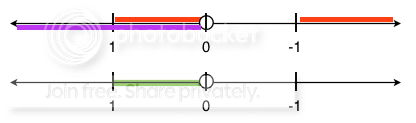
It helps to visualize with a graph too.

Statement 1 gives a range of -1 < x < 0 AND x > 1 (what I've shaded green in first graph)
Statement 2 gives a range of x < 0 (shaded green in second graph)

Together we know x lies in -1 < x < 0, so sufficient. C
Attachments
7-14-2011 5-49-51 AM.jpg
Join the discussion


















