BREAKING: Target Test Prep releases Brand New 2026 On Demand GMAT prep course

Redeem

700 level math question

Expert replies
by san2009 » Mon Jun 07, 2010 9:29 am
In the figure shown above, two identical squares are inscribed in the rectangle. If the perimeter of the rectangle is 18 by squareroot2, then what is the perimeter of each square?
(A)8 by squareroot2
(B)12
(C)12 by squareroot2
(D)16
(E)18

Image
Join the discussion
Source: — Problem Solving |

by liferocks » Mon Jun 07, 2010 9:33 am
Diagonal of each square is 18/(2*V2) or 9/V2

if side of the square is a diagonal will be aV2
so aV2 =9/V2 or a=9/2

hence perimeter of each square=4* 9/2 or 18

Ans option E
"If you don't know where you are going, any road will get you there."
Lewis Carroll
Join the discussion

by san2009 » Mon Jun 07, 2010 9:49 am
sorry, whats V2?
Join the discussion

by jeffreydamian » Mon Jun 07, 2010 10:30 am
shouldn't it be?

let x = side of square

L of rectangle = 2 diagonals of square = 2xsqrt2
W of rectangle = 1 diagonal of square = xsqrt2
perimeter = 2(2xsqrt2) + 2(xsqrt2)

or

18sqrt2 = 4xsqrt2 + 2xsqrt2
18sqrt2 = 6xsqrt2

x = 3

perimeter of square = 4x or 4x3 = 12?
Join the discussion

by indiantiger » Mon Jun 07, 2010 10:46 am
First of all 18 by sqrt(2) got me confused, I am going to take it as 18sqrt(2)

rectangle's perimeter = 2length + 2breadth ----(A)

from the figure we can see that length of rectangle = 2* diagonal of square (d)

from the figure we can see that breadth of rectangle = d


put these in (A)

we get 2(d+2d) = 6d

6d = 18*sqrt(2)
d= 3sqrt(2)

d = 2a^2 ('a' is the side of the square)

=> a^2 = 9*2 /2
a = 3

perimeter of square = 4*3 = 12 (ANSWER = B)
"Single Malt is better than Blended"
Join the discussion

by san2009 » Mon Jun 07, 2010 11:53 am
thanks a bunch!
i can't believe i didn't see that...sometimes studying doesn't pay.
Join the discussion

by liferocks » Mon Jun 07, 2010 6:11 pm
jeffreydamian wrote:shouldn't it be?

let x = side of square

L of rectangle = 2 diagonals of square = 2xsqrt2
W of rectangle = 1 diagonal of square = xsqrt2
perimeter = 2(2xsqrt2) + 2(xsqrt2)

or

18sqrt2 = 4xsqrt2 + 2xsqrt2
18sqrt2 = 6xsqrt2

x = 3

perimeter of square = 4x or 4x3 = 12?
Sorry..I read the question as the breath of the rectangle in 18/V2 ...you are correct.It should be
6*aV2 =18/V2 [18 by squareroot2 and V2 is squareroot2]

in this way 4a=6..am I again making any mistake or the perimeter is 18 squareroot2? @san2009 can you please confirm.
"If you don't know where you are going, any road will get you there."
Lewis Carroll
Join the discussion

by pverma23 » Thu Aug 20, 2015 10:52 am
I know this post is super old, but I tried it out today and others might too. Hope my approach - less algebraic more geometric - helps someone.

The square within the rectangle can be viewed as two special triangles put together, where the hypotenuse/diagonal of the square is root2.

The height of the rectangle is one hypotenuse long, and the length is 2 hypotenuses long, so the perimeter = 6 hypotenuses, all of which are factors of root2. The perimeter is 18root2. 18root2/6 = 3root2.

If the hypotenuse/diagonal of the square is 3*root2, then each side is 3*1 = 3 (ratios of special triangle 1:1:root2). Therefore each side = 3 and 3*4 = 12, the perimeter of the square.
Join the discussion

by Brent@GMATPrepNow » Thu Aug 20, 2015 11:13 am
san2009 wrote:In the figure shown above, two identical squares are inscribed in the rectangle. If the perimeter of the rectangle is 18 by squareroot2, then what is the perimeter of each square?
(A)8√2
(B)12
(C)12√2
(D)16
(E)18

Image
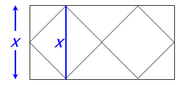
Since the height of the rectangle and the diagonal of a square are the same length, let's let x = height of rectangle
Image

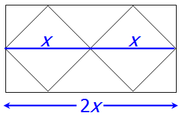
Since the width of the rectangle is equal to the length of two square diagonals, then the width of the rectangle = 2x.
Image

The area of the rectangle is 36.
So, (base)(height) = 36
(2x)(x) = 36
2x²= 36
x²= 18
x = √18

NOTE: There's no need to simplify √18 at this point (you'll see why shortly)

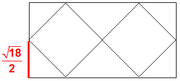
If the height of the rectangle is √18, then the length of the red line (shown below) must equal √18/(2)
Image

Likewise, the other red line has length √18/(2)
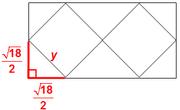
Image

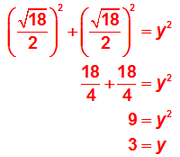
If we let y = the length of the hypotenuse, then the Pythagorean Theorem states that...
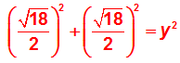
Image

Now solve this equation for y.
Image

If y = 3, then the perimeter of one square = (4)(3) = 12

Answer: B

Cheers,
Brent
Brent Hanneson - Creator of GMATPrepNow.com
Image
Join the discussion

by Max@Math Revolution » Fri Aug 21, 2015 7:13 pm
Forget conventional ways of solving math questions. In PS, IVY approach is the easiest and quickest way to find the answer.


In the figure shown above, two identical squares are inscribed in the rectangle. If the perimeter of the rectangle is 18 by squareroot2, then what is the perimeter of each square?
(A)8 by squareroot2
(B)12
(C)12 by squareroot2
(D)16
(E)18


==> Since the rectangle is consists of two big squares next to each other with each side of the square is a, then 6a=18sqrt2, a=3sqrt2. Then the diagonal side of the square is 6(right angled triangle with angles of 45 degrees has ratio of 1:1:sqrt2). Then each side of the small square inside has length of 3, and since the problem asks for the perimeter of the small square, 4*3 = 12, therefore the answer is B


www.mathrevolution.com
l The one-and-only World's First Variable Approach for DS and IVY Approach for PS that allow anyone to easily solve GMAT math questions.

l The easy-to-use solutions. Math skills are totally irrelevant. Forget conventional ways of solving math questions.

l The most effective time management for GMAT math to date allowing you to solve 37 questions with 10 minutes to spare

l Hitting a score of 45 is very easy and points and 49-51 is also doable.

l Unlimited Access to over 120 free video lessons at https://www.mathrevolution.com/gmat/lesson

Our advertising video at https://www.youtube.com/watch?v=R_Fki3_2vO8
Attachments
beate_johnen_02.jpg
Join the discussion

by ArefinM » Mon Aug 24, 2015 10:46 pm
I am bit confused. I am new. The question says the parameter is 18 by squareroot2. However, the calculation shows parameter of the rectangle in 18 into squareroot2. confused.
Join the discussion