BREAKING: Target Test Prep releases Brand New 2026 On Demand GMAT prep course
RedeemBest MBA for Entrepreneurship: Top Programs for Founders, Startups & Family Business Owners

If you’re serious about building a company, joining an early-stage startup, or scaling a family business, choosing the right MBA matters. The “best” program isn’t simply the one ranked highest – it’s the one whose ecosystem, resources, and culture align with how you want to build.
Our team at Vantage Point works with ambitious applicants targeting top MBA programs in the U.S. and globally. Many of our clients are founders, startup operators, and family business successors. We’ve seen firsthand how the right school can accelerate an entrepreneurial path – through access to co-founders, investors, early customers, and a network that compounds long after graduation.
In this article, we break down what matters most when evaluating MBA programs for entrepreneurship and highlight the schools that consistently provide strong platforms for founders and builders.
Quick Answer: The 9 Best MBAs for Entrepreneurship
For those who want a fast, skimmable answer: here are the nine best MBA programs for entrepreneurship. These rankings are based on their MBA entrepreneurship program strengths, resources, and outcomes that are most relevant to startup-focused applicants.
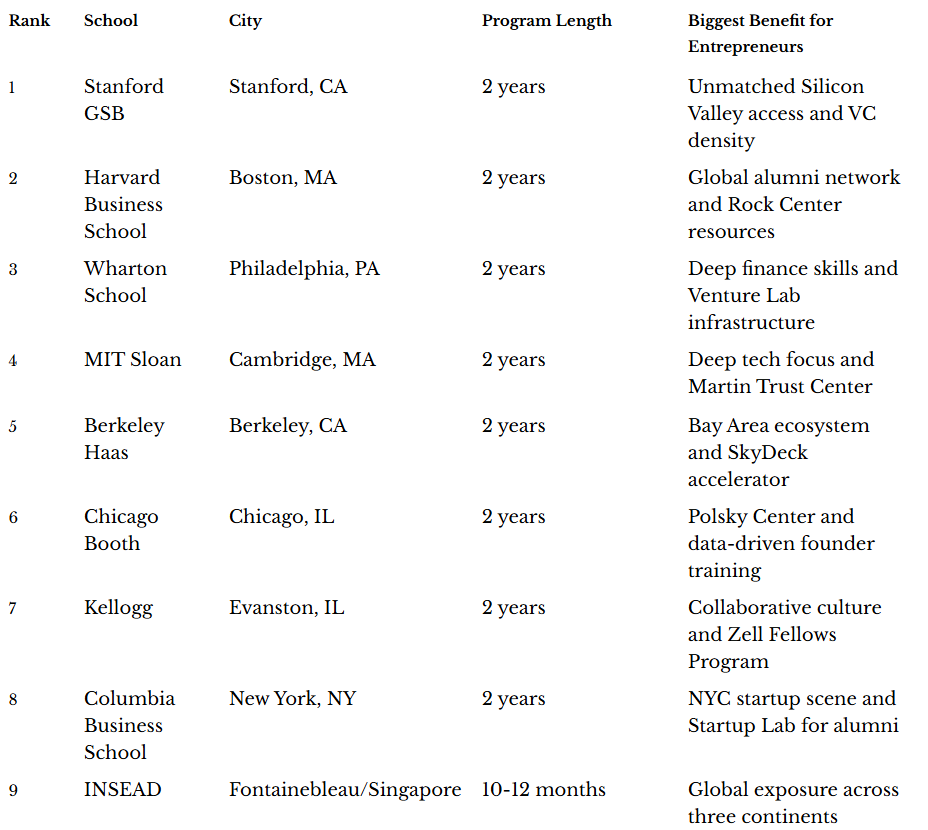
A note on rankings: This ranking is intended as a starting point – not a definitive hierarchy. Entrepreneurship outcomes are personal and highly path-dependent. The “best” program depends on what you want to build, where you want to build it, and how you plan to use your MBA experience. In putting this list together, we considered:
- Overall school strength and long-term brand durability
- Depth and accessibility of entrepreneurship resources
- Ecosystem proximity (investors, startup density, cross-campus talent)
- Cultural support for risk-taking and venture-building
- What we consistently see work well for founders, operators, investors, and family business successors
How to Choose the Best MBA Program for Entrepreneurs (Before You Fixate on Rankings)
While the “best” MBA for entrepreneurship depends entirely on your specific goals. Are you founding a company from scratch? Are you joining an early-stage startup in a key operations role? Are you taking over and modernizing a family business? Each path may favor different schools.
Before fixating on ranking positions, weigh these key criteria:
- Ecosystem location: Is the school embedded in a tech hub like Silicon Valley or a global business center like New York or London? Stanford and Haas offer immediate proximity to Sand Hill Road VCs. Columbia provides direct access to NYC’s fintech and media startup scenes.
- Access to VC and other investors: Look for structured investor networks, alumni angels, and funds closely tied to the school’s community. Stanford’s ties to Sequoia, Andreessen Horowitz, and Y Combinator are unmatched. Harvard’s global alumni network opens doors to funding worldwide.
- Incubators and accelerators: Look for on-campus resources like Stanford’s Startup Garage, Harvard’s Innovation Labs, Wharton’s Venture Lab, or MIT’s Martin Trust Center. These provide structured support to develop ideas into funded companies.
- Experiential courses: Programs emphasizing hands-on learning (Lean LaunchPad, live venture projects, action learning labs) help you develop skills through practice, not just theory.
- Culture and alumni founder density: What percentage of graduates actually go into startups or self-employment? Schools with high percentages of graduates pursuing entrepreneurship create stronger peer networks.
- Funding and competitions: Prize money and startup competitions (MIT $100K, HBS New Venture Competition, Booth’s New Venture Challenge) provide capital and visibility for student ventures.
Before making your decision, get a sense of the entrepreneurial resources, support, and experiential opportunities each MBA program offers. This comprehensive understanding will help you evaluate how effectively each school allocates support for aspiring founders.
The 9 Best MBA Programs for Entrepreneurship (Program-by-Program)
1. Stanford Graduate School of Business
When people think “MBA for entrepreneurship,” Stanford GSB is often one of the first schools that comes to mind – and for good reason. Located in Silicon Valley, Stanford offers unmatched proximity to venture capital, top accelerators, and world-class technical talent. With ~300 students per class, the program’s intimate size fosters deep relationships, and many students arrive already running or planning startups.
Why Stanford stands out
- Silicon Valley access and investor density are hard to replicate
- Stanford’s entrepreneurship curriculum is deeply experiential – built to help you test ideas quickly
- Founder and builder density among classmates is exceptionally high
Signature Entrepreneurship Offerings:
- Startup Garage: An experiential learning course where student teams launch real companies over two quarters
- Stanford Venture Studio: Entrepreneurship hub offering students a network of mentors, advisors, peers, and alumni to guide them in the process of developing a new business idea
- Lean LaunchPad: A hands-on course that explores how to build a successful startup through speaking to customers, partners, and regulators
- Center for Entrepreneurial Studies: The intellectual hub connecting research, mentors, and founders
Stanford’s integration with the university’s engineering and computer science schools creates natural co-founder matching opportunities. Both students and faculty are deeply involved in entrepreneurship activities, including clubs, mentorship, and startup events, with founders’ networks hosting regular events featuring startup veterans, investors, and industry leaders.
The local ecosystem advantage cannot be overstated. Sand Hill Road is a short drive away. Sequoia, Andreessen Horowitz, and dozens of other top VCs are accessible through alumni and school connections. Y Combinator, the world’s most influential accelerator, has deep ties to Stanford graduates.
Culturally, Stanford GSB attracts high-risk-tolerance individuals. Many of your classmates will be launching ventures during school. The collaborative environment means you’ll have access to talent, ideas, and honest feedback throughout your MBA.
2. Harvard Business School
Harvard Business School (HBS) offers a different but equally powerful path for entrepreneurs. Where Stanford provides Silicon Valley immersion, HBS delivers global scale, an intensely powerful alumni network, and resources designed to support founders at every stage. Moreover, the sheer density of HBS alumni in leadership positions – as investors, board members, and operators – creates a network effect that benefits entrepreneurs for decades after graduation.
Why HBS stands out
- One of the world’s most powerful alumni networks – often valuable not just for funding, but for distribution, hiring, partnerships, and credibility
- Strong entrepreneurship infrastructure that supports founders during school and as alumni
- Excellent environment for entrepreneurs in fintech, healthcare, consumer, and enterprise
Key Entrepreneurship Resources:
- Rock Center for Entrepreneurship: The hub for all founder-focused programming and resources
- Harvard Innovation Labs (i-lab): Open workspace and programming for students from all 13 of schools at Harvard
- Launch Lab X: Global online accelerator for alumni looking to grow their ventures
- New Venture Competition: Major funding opportunity with substantial prize money for student ventures
The case method is HBS’s signature pedagogy. It trains students in rapid pattern recognition and boardroom-style decision-making. You’ll study hundreds of real founder case studies, learning from both successes and failures across industries and geographies.
HBS also excels for entrepreneurs interested in social entrepreneurship, growth equity, or fintech.
Many HBS graduates don’t launch immediately upon graduation. Instead, they join late-stage startups, take product roles at big tech companies, or enter venture capital. Within 5-10 years, a significant percentage launch their own companies, leveraging the knowledge and network they built during their MBA.
3. University of Pennsylvania Wharton School
Wharton’s MBA program offers a unique combination of deep finance skills and entrepreneurship training.
Why Wharton stands out
- Strong venture infrastructure paired with deep finance training
- Great environment for fintech, healthcare, and consumer entrepreneurs
- Strong pipelines into VC and growth equity for those who want to invest before founding
- Access to both the East Coast finance ecosystem and Silicon Valley through Wharton West
Key Entrepreneurship Resources:
- Entrepreneurship & Innovation Major: Structured curriculum for aspiring entrepreneurs
- Wharton Venture Lab: Student entrepreneurship hub made in partnership with the school of engineering and design, providing pathway-based support for every stage
- Penn Wharton Innovation Fund: Investment capital for Penn-affiliated ventures
- Venture Initiation Program (VIP): Intense 3-month accelerator program for the most dedicated entrepreneurs and advanced startups
In addition, Wharton’s San Francisco campus, Wharton West, allows students to connect with West Coast alumni and immerse themselves in the Bay Area ecosystem during the academic year. For founders interested in venture capital, tech, or West Coast startup networks, this adds meaningful geographic flexibility – something unique among East Coast programs.
4. MIT Sloan School of Management
MIT Sloan is a top choice for technical founders and those excited by deep tech ventures – AI, robotics, biotech, climate, and hardware – because it sits inside one of the most innovation-dense universities in the world.
Why Sloan stands out
- Tight integration with MIT’s engineering and research ecosystem
- Strong evidence-based, experiment-driven approach to building ventures
- One of the best entrepreneurship competition ecosystems globally
Key Entrepreneurial Resources:
- Martin Trust Center for MIT Entrepreneurship: The hub for all startup activity, offering mentors, workspace, and programming
- MIT $100K Entrepreneurship Competition: One of the world’s oldest and most prestigious student venture competitions
- Sandbox Innovation Fund: Early-stage support for student founders, offering up to $25K in seed funding, mentorship, tailored entrepreneurship education
- Cross-registration: Access to MIT’s engineering, computer science, and media labs
Moreover, Sloan’s location in the Boston-Cambridge ecosystem provides access to world-class biotech, healthcare, and robotics clusters. Cross-pollination with Harvard creates additional networking opportunities. The broader academic community includes some of the world’s leading researchers in emerging technologies.
5. UC Berkeley Haas School of Business
Haas combines Bay Area access with a culture that tends to attract students who are both ambitious and mission-driven. If you want proximity to tech and venture – with a slightly different culture than Stanford – Haas offers a powerful ecosystem.
Key Resources:
- Berkeley SkyDeck: Globally-recognized university accelerator offering funding, office space, and mentorship
- Berkeley Haas eHub: Central hub for entrepreneurship that connects students with resources and mentorship to launch ventures
- UC LAUNCH: University-wide accelerator program supporting student ventures
- Sutardja Center for Entrepreneurship & Technology (SCET): Academic center focused on teaching technology entrepreneurship through courses and research
In addition, cross-campus opportunities with UC Berkeley’s College of Engineering and Computer Science provide technical co-founder opportunities. For founders targeting consumer internet, B2B SaaS, climate/energy, or social impact, Haas offers both the skills training and the ecosystem access to succeed.
6. Chicago Booth School of Business
Chicago Booth attracts analytically minded founders who value rigorous finance training and data-driven decision-making. Chicago’s startup scene has matured significantly in the past decade. It has strong clusters in fintech, logistics, food tech, and consumer products. Booth maintains strong ties to investors both in the Midwest and on the coasts.
Key Resources:
- Polsky Center for Entrepreneurship and Innovation: Offers an extensive suite of resources for students and alumni including education, mentorship, funding, accelerators, and networking
- New Venture Challenge: One of the strongest student startup competition ecosystems in the U.S.
7. Northwestern Kellogg School of Management
Kellogg is an excellent environment for entrepreneurs who understand that building a great company requires more than product – it requires customer insight, go-to-market excellence, and team-building. Kellogg’s highly collaborative, team-focused culture proves valuable for co-founder matching and training for early-stage team dynamics.
The Kellogg Innovation & Entrepreneurship Initiative and Zell Fellows Program provide mentorship, funding, and community for aspiring entrepreneurs. Access to Chicago’s startup scene through Northwestern’s broader ecosystem creates additional opportunities.
In addition, Kellogg offers specific concentrations, or “pathways”, that allow students to have flexibility and nuance in pursuing their areas of interest.
Specialized Entrepreneurship Pathways:
- Entrepreneurship: Offers a curriculum that combines strategy, finance, organizations, and marketing for students interested in starting their own venture or acquiring an existing company (entrepreneurship through acquisition)
- Growth & Scaling: For students interested in joining small and middle-market enterprises (SMEs), family businesses, and private equity/search funds in leadership roles
- Private Equity and Venture Capital: For students pursuing PE or VC investing careers
8. Columbia Business School
Columbia is the top MBA for founders building in New York City’s ecosystem. If your venture is best built in NYC – fintech, media, commerce, real estate, fashion, or B2B services – CBS is one of the strongest MBA launchpads.
Key Resources:
- Lang Entrepreneurship Center: Hub for entrepreneurship courses, mentorship, and funding
- Columbia Startup Lab: Dedicated workspace for CBS alumni launching companies
- Columbia Build Lab: Early-stage incubator that connects MBA founders with Columbia engineering students who help build the product or MVP
- Summer Startup Track (SST): Allows MBA students to work full-time on their startup during the summer
9. INSEAD
INSEAD is a top global option for entrepreneurs who want to build ventures in cross-border and emerging markets. Its format is typically 10–12 months, which appeals to people seeking speed – and its alumni network is exceptionally international.
Entrepreneurship Offerings:
- Multiple electives in entrepreneurship, social entrepreneurship, and venture capital
- Field trips to Silicon Valley, China, and other global startup hubs
- Cross-campus experience providing exposure to European, Asian, and Middle Eastern markets
Other Notable MBAs for Startups (Beyond the M7)
While we have focused on highlighting M7 and top global programs, several non-M7 schools demonstrate strength in entrepreneurship and may be strategic choices for certain applicants seeking more scholarship potential or those with slightly lower test scores and GPAs.

What Admissions Committees Look for in Entrepreneur-Oriented Applicants
Crucially, top MBA programs don’t simply want “people who say they “want to found a company.” They look for evidence of the entrepreneurial mindset in action. This can look like::
- Ownership and leadership.: Have you taken responsibility and driven results, not just participated?
- Problem-solving in ambiguous settings.: Can you create structure where none exists and develop solutions without clear roadmaps?
- Resilience and learning after setbacks.: How have you responded when things didn’t work? Admissions committees want to see learning and adaptation.
- Clear post-MBA goals.: Whether founding, operating, or investing – can you clearly articulate why the MBA is essential to your entrepreneurship path?
- Intellectual curiosity.: What drives you? What problems do you want to solve?
If you already have a startup, show traction with specifics (revenue, users, pilots, partnerships, fundraising). If you don’t, you can still show entrepreneurship through initiatives you built inside your job, side projects, or leadership that created something from nothing.
How Vantage Point MBA Helps Entrepreneurship-focused Applicants Stand Out
We help candidates clarify the right entrepreneurial story and translate it into an admissions-ready narrative, so your application signals real initiative and potential (not just aspiration). We also help you build a smart school list and position you for the type of entrepreneurial ecosystem that will accelerate your goals.
How We Support Entrepreneurship-Oriented Applicants:
- Long-term profile building (1-2+ years out): Identify gaps and develop experiences that strengthen your candidacy before you apply
- School selection tailored to startup goals: Match your specific entrepreneurship path to programs where you’ll thrive and succeed
- Essay strategy emphasizing initiative and resilience: Craft narratives that highlight your entrepreneurial mindset and achievements
- Recommender coaching: Prepare your recommenders to speak authentically about your leadership and creative problem-solving
- Interview prep for entrepreneurship-focused questions: Anticipate and practice responses to questions about failure, ambiguity, and future venture plans
We’ve helped clients with entrepreneurship goals get accepted to Stanford, HBS, Wharton, MIT Sloan, and other top programs. Our low consultant-to-client ratio (averaging just 4 clients per consultant at a time) means we invest deeply in each person we work with.
Ready to discuss your entrepreneurship goals and MBA strategy? Schedule a free initial consultation to explore how we can partner on your applications.