BREAKING: Target Test Prep releases Brand New 2026 On Demand GMAT prep course
RedeemHow Successful Applicants Choose Their Recommenders

Key Takeaways
- WHOM you choose as your recommenders lays the groundwork for what ultimately gets written about you, so choose thoughtfully and strategically
- Laying out relevant Pros and Cons is the best way to uncover red flags and assess tradeoffs between prospective recommenders
- The ideal choice of recommender(s) may vary by program
- Taking your own relationships and emotions out of the decision-making process is challenging; getting an unbiased outside opinion is always beneficial in deciding between recommenders
Truly spectacular letters of recommendation complement and enhance an MBA application seamlessly. But before agonizing over the content that you want your recommenders to include in their respective letters, make sure you have dedicated ample time to choosing the best recommenders.
You may already be familiar with strategies for preparing your recommenders to write stellar letters of recommendation. We have written a great deal about that topic as well. But what isn’t discussed nearly frequently enough, is how to choose the best recommenders…for you…in the first place.
The optimal choice is rarely straightforward. It often warrants further conversation that considers several important factors: from recommender familiarity with your work to their perspective on your strengths and weaknesses. (Notice we didn’t mention your recommender’s title!) Our hope is that after reading this article you will understand how to think through these tradeoffs.
Create a Potential Recommender List
For starters, create a list of all potential recommenders. And think broadly. They can go well beyond direct and indirect managers at current or past employers. Clients of ours have successfully tapped clients, vendors, organizational mentors, board members, and others to write strong letters of recommendation that lend a valuable perspective to their overall candidacy.
This list typically ranges from 3 to 10 individuals. The number is less important than the quality of your relationship with each person. If someone is older and more senior to you in their career and you had a meaningful experience working with them, then they belong on your list.
How to Identify the Relevant Pros and Cons
The next step is then to write a classic “pros and cons” list for each recommender. Doing so will help you clarify what each recommender brings to your application and what they may be lacking. Only then can you choose the best recommenders for you. (Trust me, it’s a worthwhile exercise!)
So how should you be thinking about the pros and cons of each person? Here are 6 questions and topics, ordered from most important to least important, to steer your focus in the right direction.
Sample Pros and Cons List
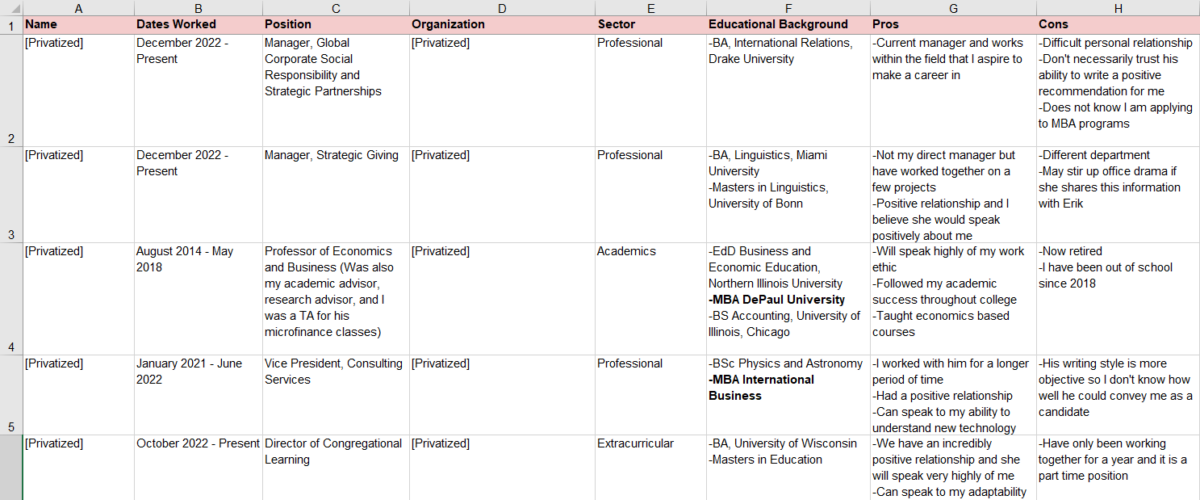
1. Quality / Depth of Relationship
Ask yourself how closely you have worked with each recommender and how well they can amplify your strengths and mitigate the potential “weaknesses” in your candidacy. For example, if quant is your Achilles heel, determine the extent to which each recommender can “plug” that gap by sharing the impact your quantitative abilities or problem-solving approach has had on people or businesses. If you have a global exposure weakness, try to recall specific projects or workstreams where each individual may have observed you working across cultures, countries, or markets.
2. Length of Relationship
Assess the length of time that each recommender has worked closely with you (on a daily or near-daily basis) and how long ago those interaction(s) were. Longer-term and more recent relationships typically have the most credibility in the eyes of the adcom.
3. Enthusiasm
How glowingly do you believe each recommender will speak about your time working together? Don’t forget to consider whether you think the individual is a strong writer, will want to go the extra mile for you, and tends to be more positive than negative in reviews.
PRO TIP: Reading past performance reviews is a great way to refresh your memory on this point.
4. Capacity to Commit
Be realistic about each recommender’s willingness and availability to commit significant time to writing and revising your letters of recommendation. Though questions are largely similar across programs, the word counts differ notably, and many programs ask additional questions unique to their program.
5. MBA Alumni
Identify which of your recommenders have an MBA from a top-tier program and whether you are applying to those same programs. This background positions them to speak to the qualities and skills you will lend to the MBA community and classroom.
6. Personal Relationship
Think through how well each potential recommender knows you outside of work and can speak to your personal passions, character, extracurricular endeavors, etc. Also consider how familiar each recommender is with your intracompany leadership and community initiatives such as recruiting, mentoring, training, involvement in Employee Resource Groups, social planning, and office team sports.
***********************************************
Don’t leave your MBA applications to chance.
Work with the best in the business so you too can become an MBA success story!
REQUEST AN INITIAL CONSULTATION
***********************************************
Weighing the Tradeoffs
Once you have effectively charted the key considerations, then you need to assess the tradeoffs. And that involves giving relative weight to the various factors. Although the 6 topics listed above are ordered by importance, this is far from an exact science.
You will likely find that no recommender checks every box. So, start by looking for red flags that could singlehandedly rule out a recommender. For example, if you don’t have confidence a recommender can write glowingly, has the necessary time to commit to the effort, or has worked closely with you for at least 3-6 months in the past two years, then it may not make sense to pursue that individual at all.
Then, try to focus on what is “nice-to-have” versus what is a “must-have”. For example, it’s beneficial, but not essential, that a recommender have a top-tier MBA and/or know a lot about you outside of work. You can inform them about relevant info if they don’t. Conversely, it’s critical that a chosen recommender knows you well in a professional capacity, can write glowingly, and has worked with you recently and for long enough.
PRO TIP: Show your spreadsheet to someone you trust who can assess it with fresh eyes and less bias. This could be a friend currently pursuing an MBA, a mentor, or an admissions consultant. Applicants are understandably “in the weeds” with all the details of this important decision. Sometimes it can be hard to see the forest! An unbiased individual can ask questions that clarify your thinking around choosing your recommenders.
Choosing Your Recommenders
Now you’re ready to make decisions. After eliminating anyone that failed to meet the necessary criteria and identifying which ones offered the most attractive tradeoffs, you can choose your 2-4 recommenders.
Notice that the number ranges from 2 to 4. And that’s because there are instances where you may have a recommender only write your letter for one or a subset of your schools. This may be driven by their capacity, their affiliation with a specific school, or other considerations. There’s no right or wrong here but successful applicants won’t overcomplicate this.
***********************************************
If you’d like expert input on choosing the best recommenders, we’d love to chat. Our team is here to help you make the best choice for YOU. Simply fill out the brief questionnaire through the button below to schedule your free initial consultation.
REQUEST AN INITIAL CONSULTATION
***********************************************
Other Recommender FAQs
We also wanted to share some of the frequent questions we hear from our clients regarding choosing their recommenders. They include:
What if I can’t ask my current manager for a recommendation because I’m not planning to tell my company that I’m applying?
That’s OK. Applicants find themselves in that situation all the time. And it’s nothing to panic about! The adcom understands that individual circumstances range dramatically and won’t penalize you for that. However, you should explain your rationale for your recommender choices in your application. You can do so either in a section dedicated to the letters of recommendation (in the online data form) or via the optional essay.
How do I decide between someone more senior in my organization versus someone with a lesser title but who works more closely with me?
9.9 times out of 10 the person who knows you best will be the better choice. The content of your letters is far more important than the title or accolades of the author. A great letter of recommendation is not only positive and passionate but is specific and detailed in order to bring your personality and accomplishments to life. Someone who has only interacted with you briefly likely won’t be able to bring those elements into their writing. However, if you’ve worked closely with this more senior member of your organization and feel confident in the relationship you have developed with them, then they could be a great advocate for you. Bottom line: choose who knows you best.
Can I have someone from academia or an extracurricular endeavor write one of my letters?
Yes, you absolutely can. But make that decision carefully and only after you have fully evaluated all of your professional recommender options. The upside of choosing such a recommender is that they will bring a different perspective than your supervisor will. Particularly if your extra-curricular is related to your post-MBA goals, that might be a huge value-add to your story. However, depending on this individual’s background, they may be less familiar with the qualities that business schools are looking for and how to assess you vs. your peers. When in doubt, it’s a good idea to seek input from an MBA admissions expert to get some feedback.
For programs that only require one letter of recommendation (like Sloan), how do I prioritize which recommender to move forward with?
In general, we recommend choosing your current manager / supervisor as your sole recommender. If that’s not an option for you, the next best choice will be a former supervisor (if from your recent past). Someone who oversees your work currently but perhaps doesn’t have a direct reporting relationship with you will also fit the bill. Otherwise, choose the recommender you feel will write the strongest, most positive letter.