BREAKING: Target Test Prep releases Brand New 2026 On Demand GMAT prep course
RedeemWhat to Read – and What Not to Read – on RC Passages
 A student recently asked me to show an example of how I read and take notes on a reading comprehension passage. In this older article, I discussed how to read through an RC passage in general, but I didnt show an example. If you havent already read the older article, read that first; then come back here to see an example.
The passage below is from the ManhattanGMAT CAT database (copyright MG Prep). If you are still using our exams and havent yet seen this passage, then you may want to wait until after youve seen the passage before you read this article.
As a general rule, we want to spend about 2 to 2.5 minutes on shorter passages and about 2.5 to 3 minutes on longer passages. The below passage is a longer one, so give yourself up to 3 minutes to read and take light notes.
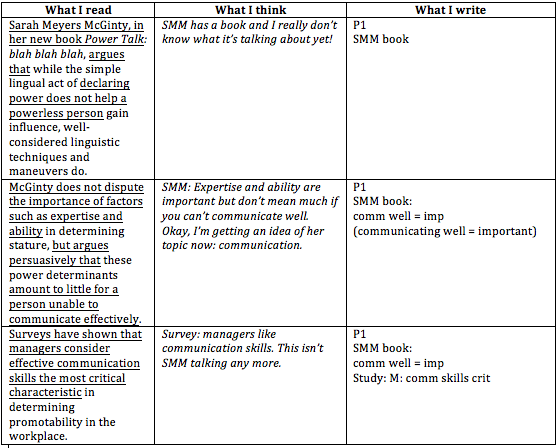
Sarah Meyers McGinty, in her new bookPower Talk: Using Language to Build Authority and Influence, argues that while the simple lingual act of declaring power does not help a powerless person gain influence, well-considered linguistic techniques and maneuvers do. McGinty does not dispute the importance of factors such as expertise and ability in determining stature, but argues persuasively that these power determinants amount to little for a person unable to communicate effectively. Surveys have shown that managers consider effective communication skills the most critical characteristic in determining promotability in the workplace.
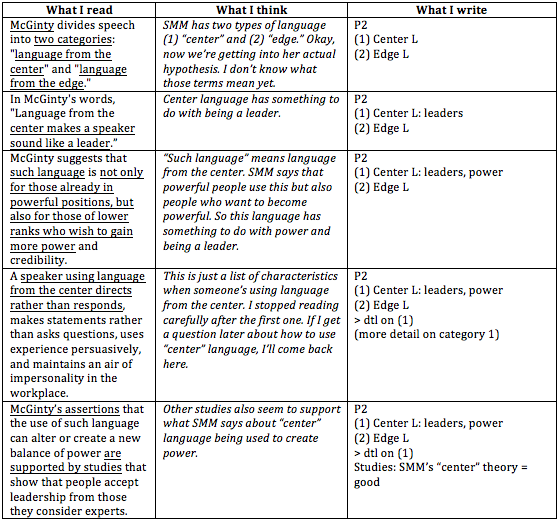
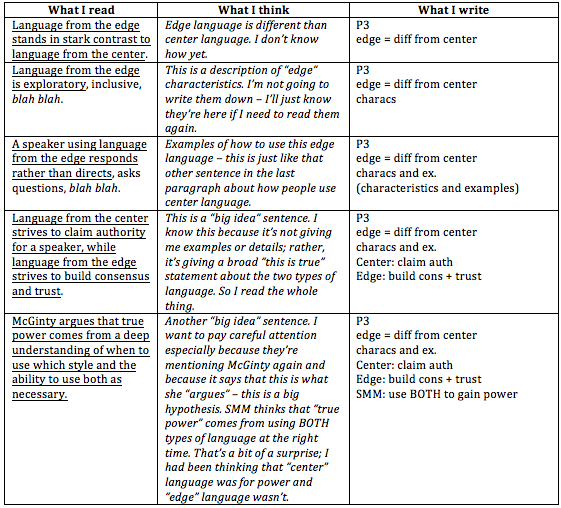
McGinty divides speech into two categories: "language from the center" and "language from the edge." In McGinty's words, "Language from the center makes a speaker sound like a leader. McGinty suggests that such language is not only for those already in powerful positions, but also for those of lower ranks who wish to gain more power and credibility. A speaker using language from the center directs rather than responds, makes statements rather than asks questions, uses experience persuasively, and maintains an air of impersonality in the workplace. McGintys assertions that the use of such language can alter or create a new balance of power are supported by studies that show that people accept leadership from those they consider experts.Language from the edge stands in stark contrast to language from the center. Language from the edge is exploratory, inclusive, deferential, and collaborative. A speaker using language from the edge responds rather than directs, asks questions, strives to make others feel heard, and avoids argument. Language from the center strives to claim authority for a speaker, while language from the edge strives to build consensus and trust. McGinty argues that true power comes from a deep understanding of when to use which style and the ability to use both as necessary.
What distinguishes McGintys discussion of effective communication is her focus on communication skills as a way of gaining power; by contrast, most workplace communication theory focuses on communication skills as a way of preventing misunderstandings, avoiding conflict, and fostering interpersonal relationships. McGinty, however, holds that language not only helps maintain relationships but also lends authority.
Many of you are probably thinking: that was nowhere near enough time. How am I supposed to get through something like that in 3 minutes (or faster!)? If youve read the other article I linked to above, then you know my answer already: because were not going to read and try to understand every last detail in there. Im going to take you through what I would think and what I would write while Im reading this passage for the first time.
Paragraph 1
The first column contains the actual text, but Ive underlined the words that I really read carefully and inserted blah blah blah when I started seriously skimming. The wording without underlines indicates things that I did read but to which I didnt pay that much attention.
Paragraph 2
The first column contains the actual text, but Ive underlined the words that I really read carefully and inserted blah blah blah when I started seriously skimming. The wording without underlines indicates things that I did read but to which I didnt pay that much attention.
Paragraph 3
The first column contains the actual text, but Ive underlined the words that I really read carefully and inserted blah blah blah when I started seriously skimming. The wording without underlines indicates things that I did read but to which I didnt pay that much attention.
Paragraph 4
The first column contains the actual text, but Ive underlined the words that I really read carefully and inserted blah blah blah when I started seriously skimming. The wording without underlines indicates things that I did read but to which I didnt pay that much attention.
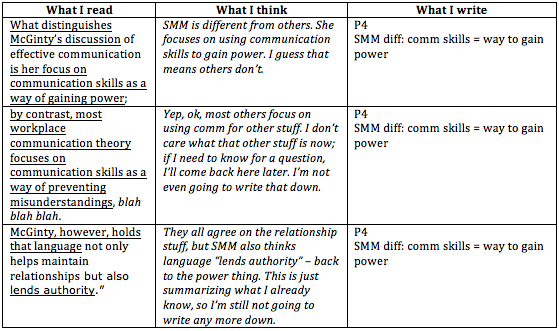
So that last thing that SMM thinks that we can use communication skills to gain power and lend authority seems to be the big idea here. That, and the fact that others dont think the same thing as SMM; this is her theory. The correct answer to a main idea question should address those concepts.
Also, she talks about two different kinds of language: center and edge. People who want power or want to be leaders have to use both and have to know when to use each kind.
Take-aways for Reading an RC Passage:
(1) On the first read-through, were trying to understand the big picture ideas as well as any major contrasts or changes of direction. Thats all. We want to take light notes, delineated by paragraph, while were reading.
(2) We dont have a lot of time to read these passages, so we specifically want to try to avoid getting sucked into the detail on these passages. We should know what kind of detail we have and in which paragraph its located but well come back to that detail later on, and only if we actually get a question about it.
(3) You will likely feel uncomfortable with this approach at first because you will be skimming or outright skipping some of the detail. You should feel as though you dont understand every last thing in the passage if you do understand every last thing, you are reading too carefully and taking too much time. As long as you understand the big ideas and any major contrasts, youll be fine!