BREAKING: Target Test Prep releases Brand New 2026 On Demand GMAT prep course
RedeemThe Next-Gen GMAT: Graphics Interpretation
 Recently, GMAC released a new sample question to illustrate Graphics Interpretation questions that we will see when the Next-Generation GMAT is released in June of 2012. At that time, a new Integrated Reasoning (IR) section will be added to the test; you can read more about it in our previous article published here.
Taking the test before then? You wont see this kind of question on the old school GMAT. Just make sure you leave yourself enough time to take the old-school version a second time in case you dont like your score the first time around. In other words, dont plan to take the test for the first time in May of 2012.
Try the problem
Lets try out the question! Click on this link to go to the GMAT website, and then, about halfway down the page, click on the Graphics Interpretation tab. Next click on the image of the problem and a new window will pop up containing the question. Dont start yet.
Note: when you are done, do NOT click the next button. That will close the window (slightly annoying little feature there). Just leave it up on the screen.
Set your timer for 2 minutes and go! (Note: we dont know yet exactly how long well have to answer all of the questions in the IR section. It took me somewhere between 30 seconds and a minute to finish, so Im guessing the average time expected on this one will be in the 1.5 to 2 minute range.)
Regression line? Whats that?
You probably noticed that this question seems to require us to know a couple of things that we dont need to study for the current version of the test. Or do we?
They never actually ask us what the regression line is or require us to know what that means in order to answer any of the questions. I find that so interesting they toss this really hard term out there to scare us, but then we dont ever actually have to use it. The second question does have the word regression in it, but thats just to specify which line we're talking about, regardless of what kind of line it is.
(If you really want to know: think of it as a line that represents the average of all of the points. The line comes as close as possible to the collective group of points, or it collectively minimizes the distance between the line and each of the points. Arent you glad you know that now? :) )
So, what have we got? They tell us there are 40 points. The X axis represents water temperature and the Y axis represents air temperature. The details about where the temperatures were taken, the fact that they were taken on Wednesdays, etc, that all turns out to be useless, but we dont know that when were first reading the problem, so we have to pay attention.
The first interesting thing I see is that the dashed line represents an arbitrary line a line through points (0, 0) and (6, 6). Why do I think thats interesting? Well, its normal to have a regression line on a scatter plot like this one, but its not necessarily normal to have this other random dashed line. So now Im wondering why they put it in there. I also note that this line has a slope of 1. (Slope = rise / run, so 6/6 = 1.) I dont know how I might use that info, but it is something I can calculate.
All right. First question.
The relationship between the water temperature and the air temperature is _______.
When I first read this, I wasnt 100% sure what they were asking. So I looked at the possible answers in the drop-down menu: positive, negative, or zero. Okay, that was the clue I needed! This is really asking me about proportionality. Is it the case that, when the water temperature goes up, the air temp goes up too? That would be a directly proportional, or positive, relationship. Or maybe the air temp does the opposite maybe when the water temp goes up, the air temp goes down. That would be an indirectly proportional, or negative, relationship. Im guessing that, for a chart such as this one, they would show a zero relationship as one where there isnt a consistent pattern - that is, sometimes the air temp goes up when the water temp goes up, and sometimes the air temp goes down when the water temp goes up. (There are other ways to have a zero relationship, such as a non-linear relationship, but Im not sure yet whether theyll test that.)
So, look at the chart. Is there a pattern? What is it?
Right. In general, when the water temp goes up, so does the air temp. The relationship between the water temperature and the air temperature is positive. The regression line also shows us this because it reflects the relationship between those two variables and it has a positive slope, so if you did know what a regression line was, you could have used that knowledge to answer the first question.
Next, were asked:
The slope of the regression line is _________ the slope of the dashed line.
Oh, hey, I already calculated the slope of the dashed line! Thats 1. Hmm. How am I going to calculate the slope of the regression line?
I could try to figure out points by looking at the chart and then do the rise/run thing again but thats annoying because Im going to have some decimals for the points, not just integers. Is there an easier way?
There is! I dont actually need to know the specific value of the slope; theyve only asked me to compare the two slopes. I can use my knowledge of the characteristics of different kinds of lines and their slopes. For instance, in the below coordinate plane, dashed-line A has a positive slope and dashed-line B has a negative slope.
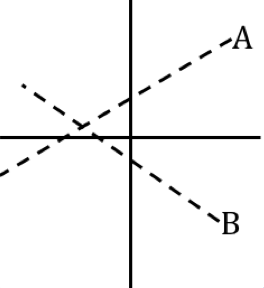
How can I possibly tell that? There arent even any numbers on the coordinate plane. Well, I can tell because lines with negative slopes always go down from left to right, while lines with positive slopes always go up from left to right.
There are four kinds of slopes: positive, negative, zero, and undefined. Heres how I remember all four:
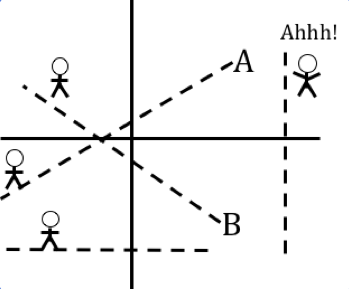
As we discussed before, line A has a positive slope. See our little stickfigure walking uphill? He has to exert positive energy. For line B, by contrast, stickfigure guy gets to walk downhill negative energy, or a negative slope. Our stickfigure guy on the horizontal line is just walking along perfectly evenly thats a slope of zero. Finally, we have the vertical line, where our unhappy stickfigure guy is falling screaming to his death. Thats the undefined slope because stickfigure guy hopes it never happens! :)
Now, back to our problem. We know the dotted line in the problem has a slope of 1. How does the regression line compare? Well, the regression line is closer to being a horizontal line, but it's not actually a horizontal line. A horizontal line has a slope of zero, right? So because the regression line is in between the dotted line and a horizontal line, then slope of the regression line is somewhere in between one and zero.
Therefore, the slope of the regression line is less than the slope of the dotted line.
Our final question asks:
The number of Wednesdays on which the water temperature was greater than 5 C is closest to _________ % of 40.
Interesting. First, theyre asking about water temp, so we want to look at the X axis. Next, theyre asking about water temps greater than 5 degrees, so lets count up all the dots that fall to the right of the 5 degree line on the X axis: there are 5. Great, were done the answer is 5, right?
Not so fast! Look at what they put after the blank: % of 40. Oh. I have to do some math here. Annoying. Lets do some translation. I calculated the number of Wednesdays on which the water temperature was greater than 5 C so I can just substitute that number into the problem. Now it says:
5 is closest to _______% of 40.
Great, this is straight translation.
[pmath]5=(x/100)*40[/pmath]
Solve for x:
[pmath]5=x(2/5)[/pmath]
[pmath]25/2=x[/pmath]
12.5 = x
So 5 is 12.5% of 40. The questions asks me which of the given options is closest to this number, 12.5. The closest one is 10. The number of Wednesdays on which the water temperature was greater than 5 C is closest to 10% of 40.
Our three answers are:
Positive
Less Than
10
If youd like to try another one of these IR problems, click here for a review of the Airports problem. Note that since that article was first published, GMAC changed the link, and altered the screen and the question a bit; read my 26 October 2011 comment in the comments section at the bottom before you begin reading the full article.
Key Takeaways:
(1) The test is changing, but not until June of 2012. If you want to ensure that you can take the old version, then plan to take the GMAT no later than April. That will give you enough time to fix any problems and take the old version again in the event that you dont like your first score.
(2) If youre planning to take the next generation test, you can start studying for quant and verbal at any time, as those sections are not changing. Integrated Reasoning material will begin to be released in March or April of 2012.
* All quotes copyright and courtesy of the Graduate Management Admissions Council. Usage of this material does not imply endorsement by GMAC.