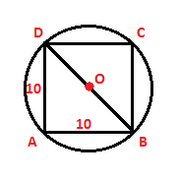
The question should read "What is the APPROXIMATE area?"
ardz24 wrote:A circle is circumscribed around a square such that all the angles of the squares lie on circumference. What is the APPROXIMATE area of the circle, if area of the square is 100 units?
A. 131
B. 137
C. 157
D. 161
E. 174
Here's a diagram of the question:
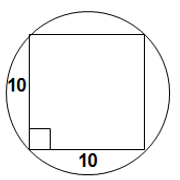
Since each vertex is a RIGHT ANGLE, we know that the diagonal (shown below) must pass through the center of the circle. In other words, the square's diagonal is also the DIAMETER of the circle.
Also, since the area of square is 100, we know that each side has length 10
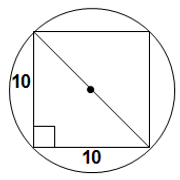
Let's let
d = the length of the diameter
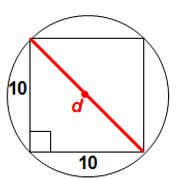
Since d also represents the HYPOTENUSE of a right triangle with the two legs each having length 10, we can apply the Pythagorean Theorem.
When we do this, we get: 10² + 10² =
d²
Simplify: 200 =
d²
So,
d = √200
Or:
d = 10√2
Add that below:
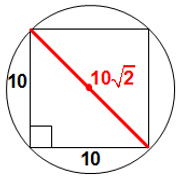
Since the circle's DIAMETER has length 10√2, we can conclude that the circle's RADIUS has length
5√2
What is the APPROXIMATE area of the circle?
Area = (pi)(radius)²
= (pi)(
5√2)²
= (pi)(50)
ASIDE: What value of pi is needed here? We COULD use a very precise value of pi, like 3.1416, but that probably isn't necessary.
If we let pi = 3, then the area ≈ (3)(50) ≈ 150. However, given how close the answer choices are, I might want to be a little more precise than this.
If we let pi = 3.1, then the area ≈ (3.1)(50) ≈ 155.
This is very close to answer choice C, so C must be correct.
Cheers,
Brent