Similar problem:
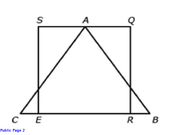
In the figure above, SQRE is a square, AB = AC, and AS = AQ. What is the difference between the perimeter of triangle ABC and the perimeter of square SQRE?
(1) The length of RE is 4 times the length of BR.
(2) The area of triangle ABC is 75% of the area of square SQRE.
Since AB=AC and AS=AQ, both triangle ABC and square SQRE are SYMMETRICAL about height AM in the figures below.
Statement 1: The length of RE is 4 times the length of BR.
RE = 4BR implies FIGURE A below:
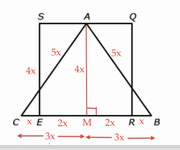
In right triangle ABM, since MB = 3x and AM = 4x, triangle ABM is a 3-4-5 triangle.
Thus, AB = 5x, implying that AC = 5x.
Result:
Perimeter of square SQRE = 4x+4x+4x+4x = 16x.
Perimeter of triangle ABC = 5x+x+2x+2x+x+5x = 16x.
Thus, the difference between the perimeters = 16x-16x = 0.
SUFFICIENT.
Statement 2: The area of triangle ABC is 75% of the area of square SQRE.
In FIGURE A above, the area of triangle ABC is 75% of the area of square SQRE:
(area of triangle ABC)/(area of square SQRE) = (1/2*6x*4x)/(4x*4x) = 12x²/16² = 3/4 = 75%.
Thus, FIGURE A satisfies statement 2.
To determine whether the FIGURE A is the ONLY case that will satisfy statement 2, consider FIGURE B:
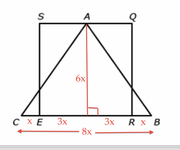
In FIGURE B, RE = 6BR.
Here, (area of triangle ABC)/(area of square SQRE) = (1/2*8x*6x)/(6x*6x) = 24x²/36x² = 2/3 = 66 2/3%.
Doesn't work.
The implication is that, for the area of triangle ABC to be 75% of the area of square SQRE, it must be true that RE=4BR, as in statement 1.
Thus, since statement 1 is sufficient, statement 2 must also be SUFFICIENT.
The correct answer is
D.
Alternate way to evaluate Statement 2:
Plug in a value for the side of the square and SOLVE for the dimensions of the triangle.
Square:
Let s = 8.
Area = s² = 8² = 64.
Perimeter = 4s = 4*8 = 32.
Triangle:
Since the area of the triangle is equal to 75% of the area of the square, we get:
Area = (3/4)64 = 48.
As in FIGURE A above, let AM = the height of triangle ABC.
Since AM = 8, we get:
(1/2) * b * 8 = 48.
b = 12.
Thus, MB = (1/2)b = (1/2)12 = 6.
Since MB=6 and AM=8, triangle ABM is a 6-8-10 triangle, implying that AB=10.
Thus:
Perimeter of the triangle = 10+12+10 = 32.
Result:
Perimeter of the square - perimeter of the triangle = 32-32 = 0.
Last edited by
GMATGuruNY on Sun Nov 15, 2015 5:44 am, edited 1 time in total.
Private tutor exclusively for the GMAT and GRE, with over 20 years of experience.
Followed here and elsewhere by over 1900 test-takers.
I have worked with students based in the US, Australia, Taiwan, China, Tajikistan, Kuwait, Saudi Arabia -- a long list of countries.
My students have been admitted to HBS, CBS, Tuck, Yale, Stern, Fuqua -- a long list of top programs.
As a tutor, I don't simply teach you how I would approach problems.
I unlock the best way for YOU to solve problems.
For more information, please email me (Mitch Hunt) at
[email protected].
Student Review #1
Student Review #2
Student Review #3


























