BREAKING: Target Test Prep releases Brand New 2026 On Demand GMAT prep course

Redeem

Target Test Prep · GMAT

Choose how you want to prepare

Learn live with an expert or move at your own pace. Every option includes the complete TTP study system.

★★★★★5.0559 reviews
GMATLiveTeach 7 seats left
Chris Peckover
NEXT LIVE COHORT

Oct 13 to Jan 7, 2027

with Chris Peckover

Schedule
Tue, Thu · 8:00 to 10:00 PM ET
Included
40 live hours + 6 months of GMAT OnDemand
  • Live instruction and real-time questions
  • Class recordings and assigned practice
View class & enroll
Limited cohort · enrollment openTarget Test Prep
EALiveTeach 5 seats left
Logan Thompson
EXECUTIVE ASSESSMENT

Sep 6 to Dec 6, 2026

with Logan Thompson

Schedule
Sun · 9:30 AM to 12:30 PM ET
Included
Live EA class + 6 months of EA OnDemand
  • Expert-led weekly online sessions
  • EA Masterclass access between classes
View EA class & enroll
Limited cohort · enrollment openTarget Test Prep
GMATOnDemand Start anytime
SELF-PACED MASTERCLASS

Target Test Prep GMAT OnDemand

Complete access from day one. Study on your schedule.

130-point score guarantee
$0to start then $127/mo
  • Personalized study plan and analytics
  • Thousands of lessons and practice questions

Compare the format, schedule, and included access before enrolling. Prices and seat counts shown reflect the supplied offer details.

In the rectangular coordinate system above...

Expert replies
by BTGmoderatorLU » Wed Dec 20, 2017 2:08 pm
Image

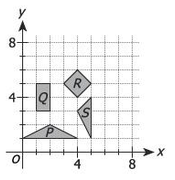
In the rectangular corrdinate system above, for which of the shaded regions is the area 2?

A. None
B. Q Only
C. Q and R
D. P, Q and R only
E. P, Q, R and S

The OA is D.

I should determine single each area, for example, for the triangular regions will be 1/2*B*H (where B is the base and H the height of the triangle), and for the rectangular region will be L*W (where L is the long and W the width of the rectangle), and for the square region will be L^2, right?

My question, is there another way (fast way) to solve this PS question? Experts, can you assist me with it? Thanks in advanced.
Join the discussion
Source: — Problem Solving |

by EconomistGMATTutor » Thu Dec 21, 2017 5:48 am
Hello LUANDATO.

You have to calculate each area. You're right about what you're thinking.

The triangle P. $$Base=4,\ Height=1\ \ \ then\ \ \ Area=\frac{4\cdot1}{2}=2.$$ The rectangle Q. $$Length\ =1,\ Width=2\ \ \ then\ \ \ Area=1\cdot2=2.$$ The scuare R. The side is the hypotenuse of a right triangle with cathetus equals to 1. So $$L=\sqrt{2},\ then\ \ \ \ Area=\left(\sqrt{2}\right)^2=2.$$ Finally, the triangle S. $$Base=3,\ Height\ =1,\ \ \ then\ \ \ Area\ =\frac{3\cdot1}{2}=\frac{3}{2}=1.5.$$ In conlcusion, the correct answer is D.

I hope this explanation may help you.

Feel free to ask me again if you have a doubt.

Regards.
GMAT Prep From The Economist
We offer 70+ point score improvement money back guarantee.
Our average student improves 98 points.

Image
Join the discussion

BTGmoderatorLU wrote:
Wed Dec 20, 2017 2:08 pm
Image

In the rectangular corrdinate system above, for which of the shaded regions is the area 2?

A. None
B. Q Only
C. Q and R
D. P, Q and R only
E. P, Q, R and S

The OA is D.
Observe that the area of each small square formed by the gridlines is 1.

The area of region P is 2 since P is a triangle with base = 4 and height = 1. Thus, the area of P is (1/2)(4)(1) = 2.

The area of region Q is 2 since Q is a rectangle with length = 2 and width = 1. Thus, the area of Q is (2)(1) = 2.

The area of region R is 2 since R can be broken into four right triangles, each of which has an area of exactly 1/2.

The area of region S, however, is not 2. We can see that S is a triangle with base = 3 and height = 1. Thus, the area of S is (1/2)(3)(1) = 3/2.

Answer: D

Scott Woodbury-Stewart
Founder and CEO
[email protected]

Image

See why Target Test Prep is rated 5 out of 5 stars on BEAT the GMAT. Read our reviews

ImageImage
Join the discussion