BREAKING: Target Test Prep releases Brand New 2026 On Demand GMAT prep course

Redeem

UPLOADED IMAGE_PS_Geometry

Expert replies
Source: — Problem Solving |

by [email protected] » Tue Oct 13, 2015 8:28 am
Hi gmat_thingie,

This prompt is incomplete - unless you include an actual LENGTH for ANY of the line segments, there's no way to determine the lengths of the other line segments.

GMAT assassins aren't born, they're made,
Rich
Contact Rich at [email protected]
Image
Join the discussion

by gmat_thingie » Tue Oct 13, 2015 9:39 am
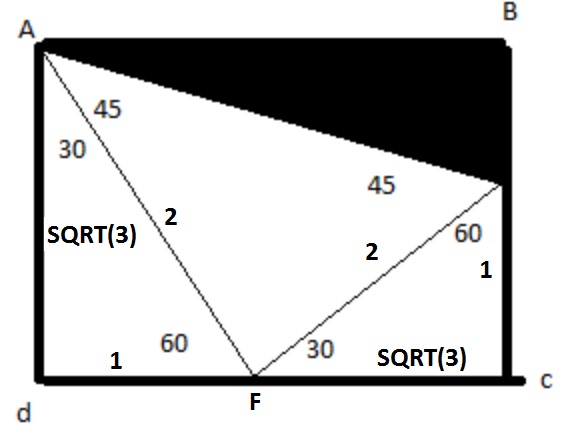
Yes the edited figure is attached
Attachments
Area of shaded triangle_ABF.PNG
Join the discussion

by gmat_thingie » Tue Oct 13, 2015 9:41 am
Same question for "perimeter"
Attachments
Shaded triangle question geometry.png
Join the discussion

by theCEO » Tue Oct 13, 2015 2:53 pm
gmat_thingie wrote:Same question for "perimeter"
Two equations worthwhile to know:
Sin 30 = 1/2
Sin 60 = sqrt(3)/2

lets label the point on CD where the two points meet as F
lets label the point on BC where the two points meet as E

Image

Area of reactangle = AD X CD
Area of reactangle = (sqrt 3) x (1 + sqrt 3) = sqrt 3 + 3

Area of trapezium = 1/2 * (AD + CE) * CD
Area of trapezium = 1/2 * (sqrt 3 + 1) * (1 + sqrt 3))
Area of trapezium = 1/2 * (3 + 2 * sqrt 3 + 1) = 1/2 * (4 + 2 * sqrt 3) = 2 + sqrt 3

Area of shaded region = (sqrt 3 + 3) - (2 + sqrt 3) = 1


Perimeter:
If we continue we have the following for the sides of the shaded region:
AB + BE + AE
1+sqrt(3) + (sqrt(3) - 1) + sqrt(2^2 + 2^2)
1+sqrt(3) + (sqrt(3) - 1) + 2sqrt2
2*sqrt(3) + 2sqrt2
Join the discussion