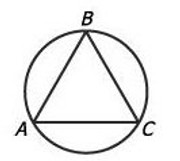
In the figure above, equilateral triangle ABC is inscribed

This topic has expert replies
Source: — Problem Solving |

GMAT/MBA Expert

User avatar
GMAT Instructor
Posts: 2623
Joined: Mon Jun 02, 2008 3:17 am
Location: Montreal
Thanked: 1090 times
Followed by:355 members
GMAT Score:780

by Ian Stewart » Sun May 19, 2019 9:28 am
By symmetry, since the triangle is equilateral, the length of each circular arc between two adjacent corners of the triangle must make up 1/3 of the entire circumference of the circle. Since the arc ABC is two of those arcs put together, 24 is 2/3 of the circumference, and 36 is the entire circumference. Since the circumference equals π*d, where d is the diameter, π*d = 36, and d = 36/π, and since π is slightly bigger than 3, d is slightly less than 12, and 11 is the only reasonable answer among the choices.
For online GMAT math tutoring, or to buy my higher-level Quant books and problem sets, contact me at ianstewartgmat at gmail.com

ianstewartgmat.com

GMAT/MBA Expert

User avatar
GMAT Instructor
Posts: 8086
Joined: Sat Apr 25, 2015 10:56 am
Location: Los Angeles, CA
Thanked: 43 times
Followed by:29 members

by Scott@TargetTestPrep » Tue May 21, 2019 6:28 pm
BTGmoderatorDC wrote:Image

In the figure above, equilateral triangle ABC is inscribed in the circle. If the length of arc ABC is 24, what is the approximate diameter of the circle?

A. 5
B. 8
C. 11
D. 15
E. 19

OA C

Source: GMAT Prep
We are given the length of arc ABC is equal to 24. Since arc AB, BC, and CA each represent 1/3 of the circumference, arc ABC represents 2/3 of the circumference. Thus, we can create the following equation.

2/3(circumference) = 24

2/3(Ï€d) = 24

Ï€d = 24 x 3/2

Ï€d = 36

d = 36/Ï€

d ≈ 11

Answer: C

Scott Woodbury-Stewart
Founder and CEO
[email protected]

Image

See why Target Test Prep is rated 5 out of 5 stars on BEAT the GMAT. Read our reviews

ImageImage