BREAKING: Target Test Prep releases Brand New 2026 On Demand GMAT prep course

Redeem

A number of friends decided to go on a picnic and planned to

Expert replies
by sachin_yadav » Fri Jun 07, 2013 7:21 am
The below two questions are of similar kind in concept but are different in terms of what they want. Please help in understanding them.

A number of friends decided to go on a picnic and planned to spend $96 on eatables. Four of them, however did not turn up. As a consequence, the remaining ones had to contribute $4 each extra. The number of those who attend the picnic was

A). 8
B). 12
C). 16
D). 24
E). 20

Answer is B

[spoiler]Why answer cannot be A ? Please help in understanding the question. I believe it is A.[/spoiler]

Eight people are planning to share equally the cost of a rental car. If one person withdraws from the arrangement and the others share equally the entire cost of the car, then the share of each of the remaining persons increased by
A). 1/7
B). 1/8
C). 1/9
D). 7/8
E). 1/6

Answer is A

Please give your thoughts on this question.

Thanks & Regards
Sachin
Never surrender
Join the discussion
Source: — Problem Solving |

by J N » Fri Jun 07, 2013 9:17 am
you sure it is 12?? i think that 12 were going but only 8 showed up.

96/8= $12 each

96/12 = $8 each

96/16 = $ 6 each

96/24= $4 each

96/20 = not integer so out

******************

conceptually

each of 8 was paying 1/8 but when person did not show up that 1/8 will be divided by the 7 people who did show up so they will be paying 1/8 + 1/7

with an example
total is 56

56/8 = 7
56/7 = 8

so each had to contribute 8-7= $1 more , since 7 of them then 1/7 more each
Join the discussion

by sachin_yadav » Fri Jun 07, 2013 11:07 am
Thanks. Conceptually you made it easy for me to understand the second one.

Now, about first question answer is B, which i doubt too. I believe it has to be A (8 showed up).
lets see what others say. Really want to discuss the first one here before i discuss this question with my tutor.

Help guys.
Never surrender
Join the discussion

For each of these problems, the relationship is: (# of people)(cost per person) = total cost. Let's call this n*c = T.

For the first one, we can solve as a system of equations:

nc = 96 and (n - 4)(c + 4) = 96
simplify the 2nd equation:
nc + 4n - 4c - 16 = 96
96 + 4n - 4c - 16 = 96
4n - 4c - 16 = 0
n - c - 4 = 0
Isolate c and substitute:
c = 96/n
n - 96/n - 4 = 0
multiply by n:
n^2 - 96 - 4n = 0
(n - 12)(n + 8) = 0
n = 12 or -8

Since the number of people can't be negative, n must be 12. That was our original number, though, and the question is asking for how many actually attended. So JN is right, the answer should be 8.

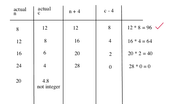
That system of equations was really complicated/laborious though, right? A much better way to solve would be to look at the answer choices and see which one works. Set up a table:

Image

----------------------------------------------------
For the 2nd question, we could also set up a system of equations:

8c = T and 7(c + x) = T
8c = 7c + 7x
c = 7x
x = (1/7)c

In other words, the increase in the cost (x) is equal to 1/7 of the original cost per person, c.

Alternatively, we could pick values, since no actual values are specified. Pick a number that is divisible by 8 and 7 - let's say $56.
If 8c = 56, then the original cost per person was $7.
If only 7 people go, then the cost per person is $8. That extra dollar split 7 ways (among the people going) would be 1/7 of a dollar per person.
Ceilidh Erickson
EdM in Mind, Brain, and Education
Harvard Graduate School of Education
Join the discussion

by sachin_yadav » Sat Jun 08, 2013 9:20 am
Ceilidh, thank you very much. Appreciate your reply. :D

Regards
Sachin
Never surrender

Join the discussion

ceilidh.erickson wrote:For each of these problems, the relationship is: (# of people)(cost per person) = total cost. Let's call this n*c = T.

For the first one, we can solve as a system of equations:

nc = 96 and (n - 4)(c + 4) = 96
simplify the 2nd equation:
nc + 4n - 4c - 16 = 96
96 + 4n - 4c - 16 = 96
4n - 4c - 16 = 0
n - c - 4 = 0
Isolate c and substitute:
c = 96/n
n - 96/n - 4 = 0
multiply by n:
n^2 - 96 - 4n = 0
(n - 12)(n + 8) = 0
n = 12 or -8

Since the number of people can't be negative, n must be 12. That was our original number, though, and the question is asking for how many actually attended. So JN is right, the answer should be 8.

That system of equations was really complicated/laborious though, right? A much better way to solve would be to look at the answer choices and see which one works. Set up a table:

Image

----------------------------------------------------
For the 2nd question, we could also set up a system of equations:

8c = T and 7(c + x) = T
8c = 7c + 7x
c = 7x
x = (1/7)c

In other words, the increase in the cost (x) is equal to 1/7 of the original cost per person, c.

Alternatively, we could pick values, since no actual values are specified. Pick a number that is divisible by 8 and 7 - let's say $56.
If 8c = 56, then the original cost per person was $7.
If only 7 people go, then the cost per person is $8. That extra dollar split 7 ways (among the people going) would be 1/7 of a dollar per person.
On the second question:
If 8 ppl were contributing 1/8
and after 1 left
7 were contributing 1/7
so per person increase is 1/7-1/8 = 1/56.

Whats wrong here?
Join the discussion

by sachin_yadav » Sun Jun 09, 2013 9:04 am
ygdrasil24 wrote:
On the second question:
If 8 ppl were contributing 1/8
and after 1 left
7 were contributing 1/7
so per person increase is 1/7-1/8 = 1/56.

Whats wrong here?
Question is increase out of what ?

1/56 divided by 1/8 = 1/7

Sachin
Never surrender

Join the discussion