BREAKING: Target Test Prep releases Brand New 2026 On Demand GMAT prep course

Redeem

Target Test Prep · GMAT

Choose how you want to prepare

Learn live with an expert or move at your own pace. Every option includes the complete TTP study system.

★★★★★5.0559 reviews
GMATLiveTeach Starts Oct 17
Chris Peckover, Target Test Prep GMAT expert
LIVE ONLINE CLASSES

Get Ready for GMAT Test Day Faster with Live Online Classes

with Chris Peckover, 100th-Percentile GMAT Scorer

Oct 17 · Chris Peckover
Sat · 11:00 AM to 2:00 PM ET
Oct 20 · Chris Peckover
Tue, Thu · 8:00 to 10:00 PM ET
Oct 25 · Josh Braslow
Sun · 1:00 to 4:00 PM ET
Included
40 hours of live online classes + 6 months of TTP OnDemand
  • Attend the first class for free
  • Every class is recorded, so you never fall behind
View classes & enroll
Limited seats availableTarget Test Prep
EALiveTeachOnDemand 5 seats left Start anytime
EXECUTIVE ASSESSMENT

Target Test Prep EA OnDemand

Self-paced EA prep. Study on your schedule.

Logan Thompson
EXECUTIVE ASSESSMENT

Sep 6 to Dec 6, 2026

with Logan Thompson

165+ EA score guarantee
$05-day trial no automatic billing
Schedule
Sun · 9:30 AM to 12:30 PM ET
Included
40 hours of live online classes plus six months of access to the complete TTP EA OnDemand course.
  • 165+ EA Score Guarantee
  • 4,100+ Quant, Verbal, and Integrated Reasoning practice questions
  • 400+ hours of in-depth video lessons
  • 3,000+ step-by-step video solutions
View EA class & enroll Start free 5-day trial
Limited cohort · enrollment openTrial includes full course accessTarget Test Prep
GMATOnDemand Start anytime
SELF-PACED MASTERCLASS

Target Test Prep GMAT OnDemand

Complete access from day one. Study on your schedule.

715+ score guarantee
$0to start then $127/mo
  • Personalized study plan and analytics
  • Thousands of lessons and practice questions

Compare the format, schedule, and included access before enrolling. Prices and seat counts shown reflect the supplied offer details.

A number of friends decided to go on a picnic and planned to

Expert replies
by sachin_yadav » Fri Jun 07, 2013 7:21 am
The below two questions are of similar kind in concept but are different in terms of what they want. Please help in understanding them.

A number of friends decided to go on a picnic and planned to spend $96 on eatables. Four of them, however did not turn up. As a consequence, the remaining ones had to contribute $4 each extra. The number of those who attend the picnic was

A). 8
B). 12
C). 16
D). 24
E). 20

Answer is B

[spoiler]Why answer cannot be A ? Please help in understanding the question. I believe it is A.[/spoiler]

Eight people are planning to share equally the cost of a rental car. If one person withdraws from the arrangement and the others share equally the entire cost of the car, then the share of each of the remaining persons increased by
A). 1/7
B). 1/8
C). 1/9
D). 7/8
E). 1/6

Answer is A

Please give your thoughts on this question.

Thanks & Regards
Sachin
Never surrender
Join the discussion
Source: — Problem Solving |

by J N » Fri Jun 07, 2013 9:17 am
you sure it is 12?? i think that 12 were going but only 8 showed up.

96/8= $12 each

96/12 = $8 each

96/16 = $ 6 each

96/24= $4 each

96/20 = not integer so out

******************

conceptually

each of 8 was paying 1/8 but when person did not show up that 1/8 will be divided by the 7 people who did show up so they will be paying 1/8 + 1/7

with an example
total is 56

56/8 = 7
56/7 = 8

so each had to contribute 8-7= $1 more , since 7 of them then 1/7 more each
Join the discussion

by sachin_yadav » Fri Jun 07, 2013 11:07 am
Thanks. Conceptually you made it easy for me to understand the second one.

Now, about first question answer is B, which i doubt too. I believe it has to be A (8 showed up).
lets see what others say. Really want to discuss the first one here before i discuss this question with my tutor.

Help guys.
Never surrender
Join the discussion

For each of these problems, the relationship is: (# of people)(cost per person) = total cost. Let's call this n*c = T.

For the first one, we can solve as a system of equations:

nc = 96 and (n - 4)(c + 4) = 96
simplify the 2nd equation:
nc + 4n - 4c - 16 = 96
96 + 4n - 4c - 16 = 96
4n - 4c - 16 = 0
n - c - 4 = 0
Isolate c and substitute:
c = 96/n
n - 96/n - 4 = 0
multiply by n:
n^2 - 96 - 4n = 0
(n - 12)(n + 8) = 0
n = 12 or -8

Since the number of people can't be negative, n must be 12. That was our original number, though, and the question is asking for how many actually attended. So JN is right, the answer should be 8.

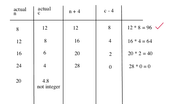
That system of equations was really complicated/laborious though, right? A much better way to solve would be to look at the answer choices and see which one works. Set up a table:

Image

----------------------------------------------------
For the 2nd question, we could also set up a system of equations:

8c = T and 7(c + x) = T
8c = 7c + 7x
c = 7x
x = (1/7)c

In other words, the increase in the cost (x) is equal to 1/7 of the original cost per person, c.

Alternatively, we could pick values, since no actual values are specified. Pick a number that is divisible by 8 and 7 - let's say $56.
If 8c = 56, then the original cost per person was $7.
If only 7 people go, then the cost per person is $8. That extra dollar split 7 ways (among the people going) would be 1/7 of a dollar per person.
Ceilidh Erickson
EdM in Mind, Brain, and Education
Harvard Graduate School of Education
Join the discussion

by sachin_yadav » Sat Jun 08, 2013 9:20 am
Ceilidh, thank you very much. Appreciate your reply. :D

Regards
Sachin
Never surrender

Join the discussion

ceilidh.erickson wrote:For each of these problems, the relationship is: (# of people)(cost per person) = total cost. Let's call this n*c = T.

For the first one, we can solve as a system of equations:

nc = 96 and (n - 4)(c + 4) = 96
simplify the 2nd equation:
nc + 4n - 4c - 16 = 96
96 + 4n - 4c - 16 = 96
4n - 4c - 16 = 0
n - c - 4 = 0
Isolate c and substitute:
c = 96/n
n - 96/n - 4 = 0
multiply by n:
n^2 - 96 - 4n = 0
(n - 12)(n + 8) = 0
n = 12 or -8

Since the number of people can't be negative, n must be 12. That was our original number, though, and the question is asking for how many actually attended. So JN is right, the answer should be 8.

That system of equations was really complicated/laborious though, right? A much better way to solve would be to look at the answer choices and see which one works. Set up a table:

Image

----------------------------------------------------
For the 2nd question, we could also set up a system of equations:

8c = T and 7(c + x) = T
8c = 7c + 7x
c = 7x
x = (1/7)c

In other words, the increase in the cost (x) is equal to 1/7 of the original cost per person, c.

Alternatively, we could pick values, since no actual values are specified. Pick a number that is divisible by 8 and 7 - let's say $56.
If 8c = 56, then the original cost per person was $7.
If only 7 people go, then the cost per person is $8. That extra dollar split 7 ways (among the people going) would be 1/7 of a dollar per person.
On the second question:
If 8 ppl were contributing 1/8
and after 1 left
7 were contributing 1/7
so per person increase is 1/7-1/8 = 1/56.

Whats wrong here?
Join the discussion

by sachin_yadav » Sun Jun 09, 2013 9:04 am
ygdrasil24 wrote:
On the second question:
If 8 ppl were contributing 1/8
and after 1 left
7 were contributing 1/7
so per person increase is 1/7-1/8 = 1/56.

Whats wrong here?
Question is increase out of what ?

1/56 divided by 1/8 = 1/7

Sachin
Never surrender

Join the discussion