BTGmoderatorDC wrote: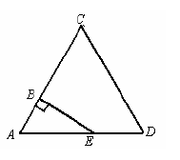
If each side of ΔACD above has length 3 and if AB has length 1, what is the area of region BCDE?
(A) \(\frac{9}{4}\)
(B) \(\frac{7}{4} \sqrt{3}\)
(C) \(\frac{9}{4} \sqrt{3}\)
(D) \(\frac{7}{2} \sqrt{3}\)
(E) \(6 + \sqrt{3}\)
OA
B
Source: Official Guide
Given each side of ΔACD above has length 3, ∆ACD is an equilateral triangle, thus, /_A = 60º. It is given that /_ABE = 90º, thus, /_ABE = 30º. Thus, ∆ABE is a 90-60-30 triangle. In a 90-60-30 triangle, the ratio of sides opposite to respective angles is 2 : √3 : 1. Given that AE, the side opposite to /_30º is 1, thus, the side opposite to /_60º would be √3. Thus, the area of ∆ABE = 1/2*AB*AE = 1/2*1*√3 = √3/2.
Note that the area of an equilateral triangle = √3/4*side^2 = √3/4*3^2 = 9√3/4
Thus, the area of region BCDE = 9√3/4 - √3/2 = 9√3/4 - 2√3/4 = 7√3/4
The correct answer:
B
Hope this helps!
-Jay
_________________
Manhattan Review GRE Prep
Locations:
GMAT Classes San Diego |
GRE Prep Course Boston |
GRE Prep Chicago |
TOEFL Prep Classes NYC | and many more...
Schedule your free consultation with an experienced GMAT Prep Advisor!
Click here.























