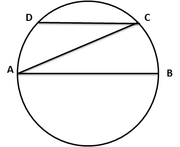
I did a similar question in PS in GMAT Prep Test 1 (Old Version) in which the angle was 35 and radius was given 9. I also couldn't do this question at first attempt, but when I tried again, I was able to do it. This in fact uses good geometry concepts.
1. With only the radius given, there is no way to calculate length of arc CD. So, insufficient.
2. Let O be centre of circle. Join DO and CO.
Angle ACO = 30 (Since, Triangle ACO is isosceles and Angle ACO = Angle CAO and Angle CAO is given as 30)
So, Angle DCO = 60
Similarly, Angle CDO = 60
Consider Triangle OCD, using sum of angles of triangle is 180, Angle COD = 60.
Arc CD now subtends 60 degree angle, so length of arc CD is (2(pi)*r*60)/360.
But, we don't know radius 'r'. So, insufficient.
Combining 1 & 2.
Length of arc CD is (2(pi)*r*60)/360 = (2(pi)*12*60)/360 = 4(pi).
So, answer is C.
Hope this helps!
BREAKING: Target Test Prep releases Brand New 2026 On Demand GMAT prep course
Redeem
Target Test Prep GMAT OnDemand
Scott Woodbury-Stewart’s private virtual classroom — 400 hours of master-class video lessons for the GMAT Focus Edition.
- 715+ score guarantee — highest in the industry (99th percentile)
- 52 chapters · 1,500+ lessons · 4,000+ practice questions
- 400 hours of video · 1,500+ instructor-led HD smartboard lessons
- 300,000+ students accepted to Harvard, Stanford, Wharton, Booth & Sloan & more
- 24/7 live support + weekly Zoom office hours with GMAT instructors
- TTP AI Assist — 24/7 AI-powered virtual tutor for instant help
- 1,200+ flashcards + AI-powered study assistant & daily calendar
- OnDemand, LiveTeach & GMAT Bootcamp formats available
- Also: GRE, SAT Math & Executive Assessment courses
- MBA Admissions Consulting now available
- 🏆 2025 EdTech Breakthrough Award: Test Prep Solution Provider of the Year
- 200,000+ students served
- 5-day free trial — $0 to start, no auto-billing, cancel anytime
★★★★★
5.0
(559 reviews)
130-pt guarantee
$0 to start
then $127/mo
Good DS question :
Source: Beat The GMAT — Data Sufficiency |
Sahil Chaudhary
If you find this post helpful, please take a moment to click on the "Thank" icon.
https://www.sahilchaudhary007.blocked
If you find this post helpful, please take a moment to click on the "Thank" icon.
https://www.sahilchaudhary007.blocked
We can answer this question without performing any calculations. Instead, we can use some visualization.
IMPORTANT: For geometry DS questions, we are typically checking to see whether the statements "lock" a particular angle or length into having just one value. This concept is discussed in much greater detail in our free video: https://www.gmatprepnow.com/module/gmat- ... cy?id=1103
This technique can save a lot of time.
Target question: What is the length of minor arc CD?
Statement 1: The radius of the circle is 12.
This information LOCKS in the size of the circle . . .
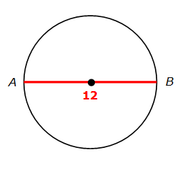
. . . but it does not lock in the placement of line DC.
So, we could have something like this. . .
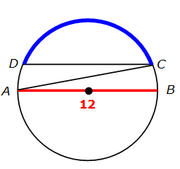
. . . or something like this.
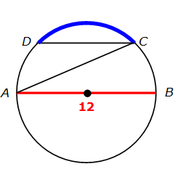
Notice that the length of minor arc CD is different for each example.
In other words, statement 1 does not lock in the length of minor arc CD
So, statement 1 is NOT SUFFICIENT
Statement 2: The measure of ∠CAB is 30º
IMPORTANT: If we are not given ANY lengths, then we cannot find a certain length (e.g., the length of minor arc CD).
Since we are not given any lengths, statement 2 is NOT SUFFICIENT
Statements 1 and 2 combined
Statement 1 LOCKS in the size of the circle.
Statement 2 LOCKS in the placement of line AC (since there's only one way to draw AC such that the angle is 30º)
So, we have this.
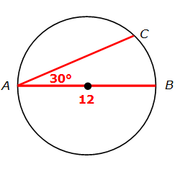
Since DC is parallel to AB, there's only one way to add DC to this diagram.
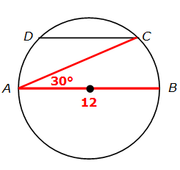
So, as you can see, there's ONLY ONE WAY to draw this diagram. So, there's only one possible length of minor arc CD.
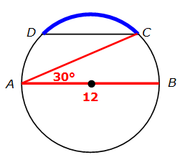
Do we need to find that length? No.
We need only recognize that statements 1 and 2 combined create a situation in which there's only one possible length of minor arc CD.
As such, the combined statements are SUFFICIENT
Answer = C
Cheers,
Brent
Last edited by Brent@GMATPrepNow on Thu Apr 19, 2018 2:18 pm, edited 2 times in total.
Thanks, ankitbagla
Here's a question you can practice with: https://www.beatthegmat.com/is-there-any ... 63160.html
Cheers,
Brent
Here's a question you can practice with: https://www.beatthegmat.com/is-there-any ... 63160.html
Cheers,
Brent
Thanks, ankitbagla
Here are some questions you can practice with:
- https://www.beatthegmat.com/is-there-any ... 63160.html
- https://www.beatthegmat.com/is-there-a-s ... 63887.html
- https://www.beatthegmat.com/btg-pq-if-cd ... 85847.html
Cheers,
Brent
Here are some questions you can practice with:
- https://www.beatthegmat.com/is-there-any ... 63160.html
- https://www.beatthegmat.com/is-there-a-s ... 63887.html
- https://www.beatthegmat.com/btg-pq-if-cd ... 85847.html
Cheers,
Brent
Excellent technique Brent, will try to use this when struck.Brent@GMATPrepNow wrote:We can answer this question without performing any calculations. Instead, we can use some visualization.
IMPORTANT: For geometry DS questions, we are typically checking to see whether the statements "lock" a particular angle or length into having just one value. This concept is discussed in much greater detail in our free video: https://www.gmatprepnow.com/module/gmat- ... cy?id=1103
This technique can save a lot of time.
Target question: What is the length of minor arc CD?
Statement 1: The radius of the circle is 12.
This information LOCKS in the size of the circle . . .
. . . but it does not lock in the placement of line DC.
So, we could have something like this. . .
. . . or something like this.
Notice that the length of minor arc CD is different for each example.
In other words, statement 1 does not lock in the length of minor arc CD
So, statement 1 is NOT SUFFICIENT
Statement 2: The measure of ∠CAB is 30º
IMPORTANT: If we are not given ANY lengths, then we cannot find a certain length (e.g., the length of minor arc CD).
Since we are not given any lengths, statement 2 is NOT SUFFICIENT
Statements 1 and 2 combined
Statement 1 LOCKS in the size of the circle.
Statement 2 LOCKS in the placement of line AC (since there's only one way to draw AC such that the angle is 30º)
So, we have this.
Since DC is parallel to AB, there's only one way to add DC to this diagram.
So, as you can see, there's ONLY ONE WAY to draw this diagram. So, there's only one possible length of minor arc CD.
Do we need to find that length? No.
We need only recognize that statements 1 and 2 combined create a situation in which there's only one possible length of minor arc CD.
As such, the combined statements are SUFFICIENT
Answer = C
Cheers,
Brent

Sahil Chaudhary
If you find this post helpful, please take a moment to click on the "Thank" icon.
https://www.sahilchaudhary007.blocked
If you find this post helpful, please take a moment to click on the "Thank" icon.
https://www.sahilchaudhary007.blocked
Hi Brent,Brent@GMATPrepNow wrote:We can answer this question without performing any calculations. Instead, we can use some visualization.
IMPORTANT: For geometry DS questions, we are typically checking to see whether the statements "lock" a particular angle or length into having just one value. This concept is discussed in much greater detail in our free video: https://www.gmatprepnow.com/module/gmat- ... cy?id=1103
This technique can save a lot of time.
Target question: What is the length of minor arc CD?
Statement 1: The radius of the circle is 12.
This information LOCKS in the size of the circle . . .
. . . but it does not lock in the placement of line DC.
So, we could have something like this. . .
. . . or something like this.
Notice that the length of minor arc CD is different for each example.
In other words, statement 1 does not lock in the length of minor arc CD
So, statement 1 is NOT SUFFICIENT
Statement 2: The measure of ∠CAB is 30º
IMPORTANT: If we are not given ANY lengths, then we cannot find a certain length (e.g., the length of minor arc CD).
Since we are not given any lengths, statement 2 is NOT SUFFICIENT
Statements 1 and 2 combined
Statement 1 LOCKS in the size of the circle.
Statement 2 LOCKS in the placement of line AC (since there's only one way to draw AC such that the angle is 30º)
So, we have this.
Since DC is parallel to AB, there's only one way to add DC to this diagram.
So, as you can see, there's ONLY ONE WAY to draw this diagram. So, there's only one possible length of minor arc CD.
Do we need to find that length? No.
We need only recognize that statements 1 and 2 combined create a situation in which there's only one possible length of minor arc CD.
As such, the combined statements are SUFFICIENT
Answer = C
Cheers,
Brent
I really love watching Gmatprepnow videos. They are not only helpful but also sometimes funny
Thanks,
Rakesh
Hi Rakesh,rakeshd347 wrote:
Hi Brent,
I really love watching Gmatprepnow videos. They are not only helpful but also sometimes funny. I wonder who have recorded them. Specially SC part is funny at times. I have seen the same problem in gmatclub but they have tried to solve it with angle properties and all.

Thanks,
Rakesh
Thanks for the feedback. Glad to hear you like the videos. I enjoyed making them.
Cheers,
Brent
Have a different approach not sure if it is right-experts can confirm.
we do not have to do any calculations
circumference of a circle is 2pir
Half of the circumference is (180/360)pir=arc ADCB
If we can find out the length of the arc AD and CD we can subtract it from arc ADCB to get CD
To find lenth of arc we need radius and inscribed angle
1. Statement 1 only radius is given. Not sufficient
2. Statement 2 angle CAB is give=30 degree. (please note this is equal to angle DCA since DC is parallel to AB)-Not sufficient.
Combing both the statements we can calculate length of respective arcs's and subtract to get CD hence answer is C.
we do not have to do any calculations
circumference of a circle is 2pir
Half of the circumference is (180/360)pir=arc ADCB
If we can find out the length of the arc AD and CD we can subtract it from arc ADCB to get CD
To find lenth of arc we need radius and inscribed angle
1. Statement 1 only radius is given. Not sufficient
2. Statement 2 angle CAB is give=30 degree. (please note this is equal to angle DCA since DC is parallel to AB)-Not sufficient.
Combing both the statements we can calculate length of respective arcs's and subtract to get CD hence answer is C.