
I can't solve it, DS problem source from innstitute

This topic has expert replies
User avatar
Junior | Next Rank: 30 Posts
Posts: 22
Joined: Thu Aug 30, 2012 10:23 pm
Hi Dears

It looks simple, but I have no way out.
please help using your brilliant brain. :)

If xy<3, is x<1 ?
(1) y>3
(2) x<3

a.Statement(1) ALONE is sufficient, but statement (2) alone is not sufficient.
b.Statement(2) ALONE is sufficient, but statement (1) alone is not sufficient.
c.BOTH statements TOGETHER are sufficient, but NEITHER statement ALONE is sufficient.
d.EACH statement ALONE is sufficient.
e.Statements (1) and (2) TOGETHER are NOT sufficient.

OA is A

what's the way to solve this problem?
Source: — Data Sufficiency |

GMAT/MBA Expert

User avatar
GMAT Instructor
Posts: 273
Joined: Tue Sep 21, 2010 5:37 am
Location: Durham, NC
Thanked: 154 times
Followed by:74 members
GMAT Score:770

by Whitney Garner » Mon Oct 08, 2012 8:42 pm
Castor.kim wrote:Hi Dears

It looks simple, but I have no way out.
please help using your brilliant brain. :)

If xy<3, is x<1 ?
(1) y>3
(2) x<3

a.Statement(1) ALONE is sufficient, but statement (2) alone is not sufficient.
b.Statement(2) ALONE is sufficient, but statement (1) alone is not sufficient.
c.BOTH statements TOGETHER are sufficient, but NEITHER statement ALONE is sufficient.
d.EACH statement ALONE is sufficient.
e.Statements (1) and (2) TOGETHER are NOT sufficient.

OA is A

what's the way to solve this problem?
Hi Castor.kim!

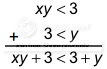
You can definitely go the picking number route, BUT I always like to start Systems of Inequalities problems by trying the "Elimination" method (this is the same as Stack-and-Add for systems of equations). The only rule is that the little inequality symbol has to line up and face the same direction.

Statement(1): "y>3"
Ok, this is how you can stack this with the info from the stem...
Image

Now we can subtract a 3 from both sides
xy < y

And since we know that y>3 and therefore positive, we can divide by y without worry:
x < 1

So Statement (1) says that x<1, this is [spoiler]SUFFICIENT![/spoiler]

Statement(2): "x<3"
Do the same thing...
Image

Now, FIGHT the temptation to subtract this second equation. What are we actually doing when we subtract an equation? We're multiplying it by -1 and adding. And what happens when we multiply by -1 in an inequality - you guessed it, our symbol changes direction and then they aren't lined up anymore!

So we get this ugly mess that at best we can factor an x out of x(y+1) < 6 or x<6/(y+1) but who knows what that means. Can I pick a couple of numbers and test quickly for Not Sufficient.

Sure,
x=2, y=1 (x is NOT less than 1)
x=0, y=anything (x is less than 1)
[spoiler]
NOT Sufficient![/spoiler]

Hope this helps!
:)
Whit
Whitney Garner
GMAT/GRE/EA Instructor & Anxiety/Accommodations Coach
www.whitneygarner.com

Contributor to Beat The GMAT!

Math is a lot like love - a simple idea that can easily get complicated :heart-eyes:

GMAT/MBA Expert

User avatar
GMAT Instructor
Posts: 16207
Joined: Mon Dec 08, 2008 6:26 pm
Location: Vancouver, BC
Thanked: 5254 times
Followed by:1268 members
GMAT Score:770

by Brent@GMATPrepNow » Mon Oct 08, 2012 9:11 pm
Castor.kim wrote: If xy<3, is x<1 ?
(1) y>3
(2) x<3
Target question: Is x<1 ?

Statement 1: y > 3
Since we're already told that xy < 3, and since both inequalities have a 3 in them, we can now write the following 3-part inequality: xy < 3 < y
Since we now know that y is positive, we can divide all 3 parts by y to get: x < 3/y < 1
From here, we can see that it must be the case that x < 1
As such, statement 1 is SUFFICIENT


Statement 2: x < 3
This tells us that x < 3, but it doesn't help us determine whether or not x < 1
If x < 3 and xy < 3, there are several possible cases that satisfy these conditions. Here are two such cases:
case a: x=2, y=1, in which case x is not less than 1.
case b: x=0, y=1, in which case x is not less than 1.

Since we cannot answer the target question with certainty, statement 2 is NOT SUFFICIENT

Answer = A

Cheers,
Brent
Brent Hanneson - Creator of GMATPrepNow.com
Image

















