BREAKING: Target Test Prep releases Brand New 2026 On Demand GMAT prep course

Redeem

How many triangles and quadrilaterals

Expert replies
by gmatdriller » Sat Jan 10, 2015 4:56 am
How many triangles and quadrilaterals altogether can be formed using the vertices
of a 7-sided regular polygon?

A 35; B:40; C:50; D:65; E:70

OA is 70...Source:gmatclub
I don't understand the OE
[spoiler]Any 3 vertices from 7 can form a triangle and any 4 vertices from 7 can form a quadrilateral, so total of C73+C74=35+35=70C^3_7+C^4_7=35+35=70 different triangles and quadrilaterals can be formed. The correct answer is E[/spoiler]
Join the discussion
Source: — Problem Solving |

by Brent@GMATPrepNow » Sat Jan 10, 2015 10:06 am
gmatdriller wrote:How many triangles and quadrilaterals altogether can be formed using the vertices
of a 7-sided regular polygon?

A 35; B:40; C:50; D:65; E:70
TRIANGLES
If you choose any 3 of the 7 vertices, you can connect them with lines to create a unique triangle.
So, the question becomes "In how many different ways can we select 3 vertices from 7 vertices?"
Since the order in which we select the 3 vertices does not matter, we can use COMBINATIONS.
We can select 3 vertices from 7 vertices in 7C3 ways.
7C3 = 35

If anyone is interested, we have a free video on calculating combinations (like 7C3 and 7C4) in your head: https://www.gmatprepnow.com/module/gmat-counting?id=789


QUADRILATERALS
If you choose any 4 of the 7 vertices, you can connect them with lines to create a unique quadrilateral.
So, in how many different ways can we select 4 vertices from 7 vertices?
Since the order in which we select the 4 vertices does not matter, we can use COMBINATIONS.
We can select 4 vertices from 7 vertices in 7C4 ways.
7C4 = 35

So, the TOTAL number of triangles and quadrilaterals possible = 35 + 35 = 70

Answer: E

Cheers,
Brent
Brent Hanneson - Creator of GMATPrepNow.com
Image
Join the discussion

by [email protected] » Sat Jan 10, 2015 10:40 am
Hi gmatdriller,

Brent's explanation is spot-on, so I won't rehash any of those ideas here.

While it's not the most practical way to find EVERY shape, you could draw a picture to help you visualize the solution to this question:

1) Draw 7 dots in a circle. This will approximate the 7 vertices of the 7-sided shape in the question.
2) Label the dots A, B, C, D, E, F, and G
3) Draw 1 triangle using any 3 of those points:

For example:
ABC

Notice how when you pick those 3 points, it doesn't matter which is first, second or third? ABC, BAC, CAB, etc. create the SAME triangle, so those are NOT different triangles (and you're not allowed to count that triangle more than once). This is a huge clue that this is a Combination Formula question.

From here, you can either proceed with the math (as Brent explained) or list out all of the possible triangles and quadrilaterals (which would take a little while, but does follow a "letter sliding" pattern.).

GMAT assassins aren't born, they're made,
Rich
Contact Rich at [email protected]
Image
Join the discussion

by Brent@GMATPrepNow » Sat Jan 10, 2015 10:40 am
ASIDE: Some people may have noticed that 7C3 and 7C4 BOTH equal 35
This illustrates a sometimes useful property that says, nCr = nC(n-r). In other words, "n choose r" is equal to "n choose n - r"
So, for example: 10C7 = 10C3
12C9 = 12C3
8C7 = 8C1
100C75 = 100C25
7C3 = 7C4
etc.

Cheers,
Brent
Brent Hanneson - Creator of GMATPrepNow.com
Image
Join the discussion

by gmatdriller » Sun Jan 11, 2015 7:38 am
Sure, thanks
Join the discussion

by Brent@GMATPrepNow » Wed Jan 14, 2015 12:08 pm
How many triangles and quadrilaterals altogether can be formed using the vertices of a 7-sided regular polygon?

A 35; B:40; C:50; D:65; E:70
In case anyone is wondering, the question states a REGULAR polygon for a good reason.

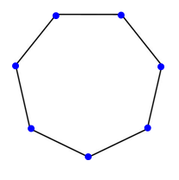
Here's a 7-sided REGULAR polygon.
Image
If we select ANY 3 points and connect them with lines, we are GUARANTEED to create a triangle.

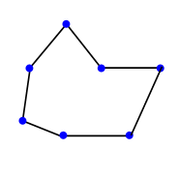
Here's an NON-REGULAR 7-sided polygon.
Image
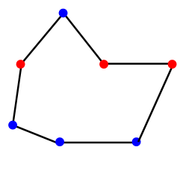
If we select ANY 3 points and connect them with lines, we are NOT guaranteed to create a triangle.

For example, if we select these 3 points....
Image


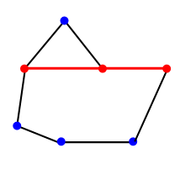
...and connect them with lines...
Image
..we don't get a triangle.

So, specifying that the polygon is regular results in only one answer.

Cheers,
Brent
Brent Hanneson - Creator of GMATPrepNow.com
Image
Join the discussion