Timer
00:00
Answers
A
B
C
D
E
Stats
Difficulty—
I can't understand this problem:
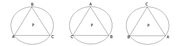
In the figure above, triangle ABC is equilateral, and point P is equidistant from vertices A, B, and C. If triangle ABC is rotated clockwise about point P, what is the minimum number of degrees the triangle must be rotated so that point B will be in the position where point A is now?
(A) 60
(B) 120
(C) 180
(D) 240
(E) 270
I already read the explanation but still no clues to handle this question type. Please help me understand this solution.
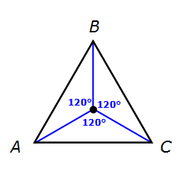
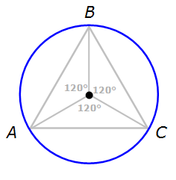
[spoiler]Since ABC is equilateral, the measure of <ACB is 60°. Therefore, the measure of <BCD is 180°- 60° = 120°. Rotating the figure clockwise about point P through an angle of 120° will produce the figure shown below.
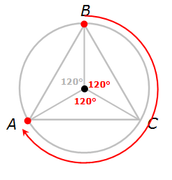
Then rotating this figure clockwise about point P through an angle of 120° will produce the figure shown below.
In this figure, point B is in the position where points was in the original figure. The triangle was rotated clockwise about point P through 120° + 120° = 240°.
The correct answer is D.[/spoiler]
In the figure above, triangle ABC is equilateral, and point P is equidistant from vertices A, B, and C. If triangle ABC is rotated clockwise about point P, what is the minimum number of degrees the triangle must be rotated so that point B will be in the position where point A is now?
(A) 60
(B) 120
(C) 180
(D) 240
(E) 270
I already read the explanation but still no clues to handle this question type. Please help me understand this solution.
[spoiler]Since ABC is equilateral, the measure of <ACB is 60°. Therefore, the measure of <BCD is 180°- 60° = 120°. Rotating the figure clockwise about point P through an angle of 120° will produce the figure shown below.
Then rotating this figure clockwise about point P through an angle of 120° will produce the figure shown below.
In this figure, point B is in the position where points was in the original figure. The triangle was rotated clockwise about point P through 120° + 120° = 240°.
The correct answer is D.[/spoiler]
Last edited by amirhakimi on Thu Oct 31, 2013 7:43 am, edited 1 time in total.