BREAKING: Target Test Prep releases Brand New 2026 On Demand GMAT prep course

Redeem

Target Test Prep · GMAT

Choose how you want to prepare

Learn live with an expert or move at your own pace. Every option includes the complete TTP study system.

★★★★★5.0559 reviews
Vote for Target Test Prep, Newsweek Readers’ Choice Awards 2026
NEWSWEEK READERS’ CHOICE 2026

BIG NEWS! Target Test Prep has been nominated, and they’d love your vote!

TTP has worked incredibly hard to build the best test prep experience possible, and winning Newsweek’s 2026 Readers’ Choice Award for Best Test Prep would mean a lot to them. If TTP has helped you, they’d be incredibly grateful for your vote. You can vote once each day through September 9.

Vote for TTP
GMATLiveTeach 7 seats left
Chris Peckover
NEXT LIVE COHORT

Oct 13 to Jan 7, 2027

with Chris Peckover

Schedule
Tue, Thu · 8:00 to 10:00 PM ET
Included
40 live hours + 6 months of GMAT OnDemand
  • Live instruction and real-time questions
  • Class recordings and assigned practice
View class & enroll
Limited cohort · enrollment openTarget Test Prep
EALiveTeach 5 seats left
Logan Thompson
EXECUTIVE ASSESSMENT

Sep 6 to Dec 6, 2026

with Logan Thompson

Schedule
Sun · 9:30 AM to 12:30 PM ET
Included
40 hours of live online classes plus six months of access to the complete TTP EA OnDemand course.
  • 165+ EA Score Guarantee
  • 4,100+ Quant, Verbal, and Integrated Reasoning practice questions
  • 400+ hours of in-depth video lessons
  • 3,000+ step-by-step video solutions
View EA class & enroll
Limited cohort · enrollment openTarget Test Prep
GMATOnDemand Start anytime
SELF-PACED MASTERCLASS

Target Test Prep GMAT OnDemand

Complete access from day one. Study on your schedule.

715+ score guarantee
$0to start then $127/mo
  • Personalized study plan and analytics
  • Thousands of lessons and practice questions

Compare the format, schedule, and included access before enrolling. Prices and seat counts shown reflect the supplied offer details.

Please help explain this probability question

Expert replies
by utkalnayak » Fri Jan 16, 2015 4:22 pm
I spent about 4 minutes on this and gave up, the official explanation was tough to understand as well. Anybody has a way to explain it in another way?

Yes ~ No ~ Unsure
==================================
Subject M ~ 500 ~ 200 ~ 100
Subject R ~ 400 ~ 100 ~ 300

A total of 800 students were asked whether they found two subjects M and R, interesting. Each answer was either "yes"or "no" or "unsure", and the numbers of students who gave the answers are listed above in the table above. If 200 students answered "yes" only for subject M , how many of the students did NOT answer "yes for each answer?

A. 100
B. 200
C. 300
D. 400
E. 500

Thank you.
Join the discussion
Source: — Problem Solving |

by Brent@GMATPrepNow » Fri Jan 16, 2015 5:10 pm
----------------YES---------NO----UNSURE
Subject M----500--------200-----100
Subject R----400--------100-----300


A total of 800 students were asked whether they found two subjects, M and R, interesting. Each answer was either "yes" or "no" or "unsure", and the numbers of students who gave these answers are listed in the table above. If 200 students answered "yes" only for subject M, how many of the students did not answer "yes" for either subject?

A. 100
B. 200
C. 300
D. 400
E. 500
One approach is to use the Double Matrix Method. This technique can be used for most questions featuring a population in which each member has two characteristics associated with it (aka overlapping sets questions).
Here, we have a population of students, and the two characteristics are:
- Said "yes" to liking subject M or didn't say "yes" to liking subject M
- Said "yes" to liking subject R or didn't say "yes" to liking subject R

IMPORTANT: Notice that I just lumped the "unsure" respondents in with those who answered "no." It's okay to do this since the question is only interested in those who did not answer "yes"
So, we can CONDENSE our table to get:
Subject M: 500 answered "yes," and 300 did NOT answer "yes"
Subject R: 400 answered "yes," and 400 did NOT answer "yes"


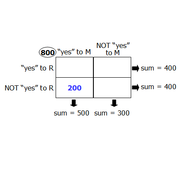
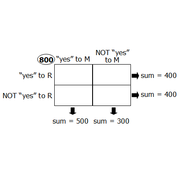
We can now set up our diagram as follows:
Image

The question tells us 200 students answered "yes" only for subject M
So, we know that 200 students can be placed in the bottom-left box:
Image

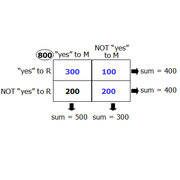
From here, we can find the other values in the empty boxes:
Image

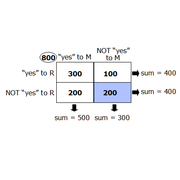
The question asks: How many of the students did not answer "yes" for either subject?
The bottom-right box represents those students:
Image

So, the correct answer is B

------------------------

NOTE: This question type is VERY COMMON on the GMAT, so be sure to master the technique.

To learn more about the Double Matrix Method, watch our free video: https://www.gmatprepnow.com/module/gmat- ... ems?id=919

Once you're familiar with this technique, you can attempt these additional practice questions:

Easy Problem Solving questions
- https://www.beatthegmat.com/the-aam-aadm ... 72242.html
- https://www.beatthegmat.com/finance-majo ... 67425.html

Medium Problem Solving questions
- https://www.beatthegmat.com/probability- ... 73360.html
- https://www.beatthegmat.com/posted-speed ... 72374.html
- https://www.beatthegmat.com/motel-t271938.html
- https://www.beatthegmat.com/of-the-appli ... 70255.html
- https://www.beatthegmat.com/opening-nigh ... 64869.html
- https://www.beatthegmat.com/ds-french-ja ... 22297.html

Difficult Problem Solving questions
- https://www.beatthegmat.com/ratio-problem-t268339.html
- https://www.beatthegmat.com/overlapping- ... 65223.html
- https://www.beatthegmat.com/fractions-t264254.html
- https://www.beatthegmat.com/overlapping- ... 64092.html
- https://www.beatthegmat.com/mba/2011/05/ ... question-2

Easy Data Sufficiency questions
- https://www.beatthegmat.com/for-what-per ... 70596.html
- https://www.beatthegmat.com/ds-quest-t187706.html

Medium Data Sufficiency questions
- https://www.beatthegmat.com/sets-matrix-ds-t271914.html
- https://www.beatthegmat.com/each-of-peop ... 71375.html
- https://www.beatthegmat.com/a-manufacturer-t270331.html
- https://www.beatthegmat.com/in-costume-f ... 69355.html
- https://www.beatthegmat.com/mba/2011/05/ ... question-1

Difficult Data Sufficiency questions
- https://www.beatthegmat.com/double-set-m ... 71423.html
- https://www.beatthegmat.com/sets-t269449.html
- https://www.beatthegmat.com/mba/2011/05/ ... question-3

Cheers,
Brent
Brent Hanneson - Creator of GMATPrepNow.com
Image
Join the discussion

by MartyMurray » Fri Jan 16, 2015 5:12 pm
utkalnayak wrote:I spent about 4 minutes on this and gave up, the official explanation was tough to understand as well. Anybody has a way to explain it in another way?

Yes ~ No ~ Unsure
==================================
Subject M ~ 500 ~ 200 ~ 100
Subject R ~ 400 ~ 100 ~ 300

A total of 800 students were asked whether they found two subjects M and R, interesting. Each answer was either "yes"or "no" or "unsure", and the numbers of students who gave the answers are listed above in the table above. If 200 students answered "yes" only for subject M , how many of the students did NOT answer "yes for each answer?

A. 100
B. 200
C. 300
D. 400
E. 500

Thank you.
Well first of all, we already know how many did not answer "yes" for each subject. What I believe the question to be asking is how many did not answer "yes" for either subject.

We know that of the 500 who answered "yes" for M, 200 answered "yes" only for M. If I am reading it correctly, that leaves 300 who answered "yes" for both M and R. 500 - 200 = 300

So if 300 answered "yes" for both, then of the 400 who answered "yes" for R, 300 answered "yes" for both and 100 answered "yes" just for R. 400 - 300 = 100

So we have the following.

200 answered "yes" for only M.

300 answered "yes" for both.

100 answered "yes" for only R.

Total who answered "yes" is 600.

Total students - Total who answered "yes" = Total who did not answer "yes" for either one

800 - 600 = 200

Choose B.
Marty Murray
Perfect Scoring Tutor With Over a Decade of Experience
MartyMurrayCoaching.com
Contact me at [email protected] for a free consultation.
Join the discussion

by GMATGuruNY » Fri Jan 16, 2015 7:50 pm
----------------YES---------NO----UNSURE
Subject M--------500--------200-----100
Subject R--------400--------100-----300


A total of 800 students were asked whether they found two subjects, M and R, interesting. Each answer was either "yes" or "no" or "unsure", and the numbers of students who gave these answers are listed in the table above. If 200 students answered "yes" only for subject M, how many of the students did not answer "yes" for either subject?

A. 100
B. 200
C. 300
D. 400
E. 500
An alternate approach is to use a Venn diagram to represent all of the YES voters:

Image

The TOTAL who voted YES for M = 500.
The number who voted YES for ONLY M = 200.
Thus, the number who voted YES for BOTH M AND R = 300.

Since the TOTAL number who voted YES for R=400, and 300 of these people voted YES for BOTH M AND R, the number who voted YES for ONLY R = 400-300 = 100.

Adding the values in the Venn diagram, we get:
Total number of YES voters = 200+300+100 = 600.

Since the total number of voters = 800, and the total number of YES voters = 600, the number who did NOT vote YES = 800-600 = 200.

The correct answer is B.
Private tutor exclusively for the GMAT and GRE, with over 20 years of experience.
Followed here and elsewhere by over 1900 test-takers.
I have worked with students based in the US, Australia, Taiwan, China, Tajikistan, Kuwait, Saudi Arabia -- a long list of countries.
My students have been admitted to HBS, CBS, Tuck, Yale, Stern, Fuqua -- a long list of top programs.

As a tutor, I don't simply teach you how I would approach problems.
I unlock the best way for YOU to solve problems.

For more information, please email me (Mitch Hunt) at [email protected].
Student Review #1
Student Review #2
Student Review #3
Join the discussion

by gmatdriller » Sat Jan 17, 2015 12:34 am
The "YES", "NO", "UNSURE" parts are treated as 3 different matrices or sets.

GMAT deliberately included all the stuffs to cause confusion.
Join the discussion

by regor60 » Tue Jan 20, 2015 10:10 am
Problems states that 200 answered "yes" only to M.

That means they answered "unsure" or "no" to R.

Subject R counts 400 Unsure/No, 200 of which must therefore be "yesses" for M

Therefore, the remainder of 200 are those who answered no to R and M
Join the discussion