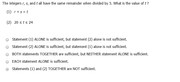
I took below approach to solve this.Please let me know if this is correct and also if any simpler approach is available.
When divided by 5, any number can have remainder from {0,1,2,3,4}
Remainder 0 => 0,5,10,15,20,25 etc
Remainder 1 => 1,6,11,16,21 etc
Remainder 2 => 2,7,12,17,22 etc
Remainder 3 => 3,8,13,18,23 etc
Remainder 4 => 4,9,14,19,24 etc
Considering statement (1), r + s = t
so we have to find a combination of two nos (from same remainder list) which add to give another number in the same series(remainder list)
As we can see that we cannot find any such numbers from list with remainder 1,2,3,4.
I found so by below approach , example for 1 case => any two numbers when added will give a number with unit digit either 7 or 2( 1+6 or 1+1 or 6+6). So that number will leave remainder 2 when divided by 5. Hence not the correct list.Similarly, I eliminated list 2,3,4. However list 0 has values which comply (1) but not unique answer({10,5,15},{5,15,20} etc) so (1) NOT SUFFICIENT.
For (2) NOT SUFFICIENT as value can be 20,21,22,23,24
Combining (1) & (2) t can be 20 which is unique value. SO SUFFICIENT.
Please suggest.

When divided by 5, any number can have remainder from {0,1,2,3,4}
Remainder 0 => 0,5,10,15,20,25 etc
Remainder 1 => 1,6,11,16,21 etc
Remainder 2 => 2,7,12,17,22 etc
Remainder 3 => 3,8,13,18,23 etc
Remainder 4 => 4,9,14,19,24 etc
Considering statement (1), r + s = t
so we have to find a combination of two nos (from same remainder list) which add to give another number in the same series(remainder list)
As we can see that we cannot find any such numbers from list with remainder 1,2,3,4.
I found so by below approach , example for 1 case => any two numbers when added will give a number with unit digit either 7 or 2( 1+6 or 1+1 or 6+6). So that number will leave remainder 2 when divided by 5. Hence not the correct list.Similarly, I eliminated list 2,3,4. However list 0 has values which comply (1) but not unique answer({10,5,15},{5,15,20} etc) so (1) NOT SUFFICIENT.
For (2) NOT SUFFICIENT as value can be 20,21,22,23,24
Combining (1) & (2) t can be 20 which is unique value. SO SUFFICIENT.
Please suggest.