BREAKING: Target Test Prep releases Brand New 2026 On Demand GMAT prep course

Redeem

Target Test Prep · GMAT

Choose how you want to prepare

Learn live with an expert or move at your own pace. Every option includes the complete TTP study system.

★★★★★5.0559 reviews
GMATLiveTeach 7 seats left
Chris Peckover
NEXT LIVE COHORT

Oct 13 to Jan 7, 2027

with Chris Peckover

Schedule
Tue, Thu · 8:00 to 10:00 PM ET
Included
40 live hours + 6 months of GMAT OnDemand
  • Live instruction and real-time questions
  • Class recordings and assigned practice
View class & enroll
Limited cohort · enrollment openTarget Test Prep
EALiveTeach 5 seats left
Logan Thompson
EXECUTIVE ASSESSMENT

Sep 6 to Dec 6, 2026

with Logan Thompson

Schedule
Sun · 9:30 AM to 12:30 PM ET
Included
40 hours of live online classes plus six months of access to the complete TTP EA OnDemand course.
  • 165+ EA Score Guarantee
  • 4,100+ Quant, Verbal, and Integrated Reasoning practice questions
  • 400+ hours of in-depth video lessons
  • 3,000+ step-by-step video solutions
View EA class & enroll
Limited cohort · enrollment openTarget Test Prep
GMATOnDemand Start anytime
SELF-PACED MASTERCLASS

Target Test Prep GMAT OnDemand

Complete access from day one. Study on your schedule.

715+ score guarantee
$0to start then $127/mo
  • Personalized study plan and analytics
  • Thousands of lessons and practice questions

Compare the format, schedule, and included access before enrolling. Prices and seat counts shown reflect the supplied offer details.

fourteen rectangular tiles

Expert replies
by jain2016 » Mon Apr 04, 2016 8:44 pm
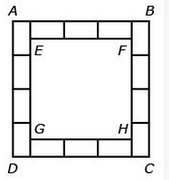
In the diagram above, the fourteen rectangular tiles are all identical. What percent of the area of rectangle ABCD is covered by the tiles?

(1) ABCD is a square.

(2) EFGH is a square.

OAD

Hi Experts ,

Please explain.

Thanks,

SJ
Attachments
square.gif
Join the discussion
Source: — Data Sufficiency |

by MartyMurray » Mon Apr 04, 2016 10:07 pm
Statement 1: ABCD is a square.

Let the length of each tile be l and the width be w.

If ABCD is a square, then AB = AD.

So 3l + 2w = 4l and 2w = l.

EG = 4l - 2w = 3l.

So EG = EF, meaning EFGH is also a square, and has sides 3w.

Area ABCD = (4l)² and area EFGH = (3L)².

We don't have to do the math at this point, but we could find the ratio of 16l²:9l² = 16:9.

Sufficient.

Statement 2: EFGH is a square.

If EFGH is a square, then 3l = 4l - 2w. So l = 2w.

Given that l = 2w, can show that ABCD is a square with sides 4l, and we already know that once we do that we can determine the ratios of the areas.

Sufficient.

The correct answer is D.
Marty Murray
Perfect Scoring Tutor With Over a Decade of Experience
MartyMurrayCoaching.com
Contact me at [email protected] for a free consultation.
Join the discussion

by Brent@GMATPrepNow » Tue Apr 05, 2016 6:27 am
Image

In the diagram, the fourteen rectangular tiles are all identical. What percent of the area of rectangle ABCD is covered by the tiles?

(1) ABCD is a square.

(2) EFGH is a square.
Target question: What percent of the area of rectangle ABCD is covered by the tiles?

Statement 1: ABCD is a square
IMPORTANT: Once we know that ABCD is a square, we also know that EFGH is a square. Notice that if you take square ABCD and "shave" off the same amount (i.e., the width of each rectangle) from the four sides, we get another square (EFGH).

Let L = length of one rectangle.

Side AD has length 4L, which means all four sides of square ABCD have length 4L.
So, the area of ABCD = (4L)(4L) = 16L²
Side EF has length 3L, which means all four sides of square EFGH have length 3L.
So, the area of EFGH = (3L)(3L) = 9L²
From this, we can conclude that the total area of the rectangles = 16L² - 9L² = 7L²
So, the fraction of square ABCD taken up by tiles = (7L²)/(16L²) = 7/16
Since we could convert 7/16 to a percent, we could determine the percent of the area of rectangle ABCD is covered by the tiles.
Since we can answer the target question with certainty, statement 1 is SUFFICIENT

Statement 2: EFGH is a square
Using the same logic that we used above, we know that ABCD must also be a square.
From here, if we follow the same steps as above, we can answer the target question with certainty.
So statement 2 is SUFFICIENT

Answer = D

Cheers,
Brent
Brent Hanneson - Creator of GMATPrepNow.com
Image
Join the discussion


















